

Exchange-traded funds tied to Solana are showing surprising resilience even as the cryptocurrency’s price has fallen sharply. Since the launch of Solana ETFs in the United States in July, the token has dropped 57%, yet investors have continued pouring money into the funds.
According to Eric Balchunas, a senior ETF analyst at Bloomberg, the performance of these ETFs has been “pretty impressive” considering the difficult market environment. Despite the steep decline in the token’s value, the funds have collectively attracted about $1.5 billion in inflows.
The stability of these flows suggests that many investors—especially large institutions—still believe in Solana’s long-term potential. Balchunas noted that roughly 50% of ETF inflows come from institutional investors, which typically include hedge funds, asset managers, and pension funds.
Institutional participation is important because these investors usually make long-term decisions and conduct deep research before investing. Their involvement can add stability to financial products tied to volatile assets like cryptocurrencies.
Key data behind Solana ETF inflows:
- Total ETF inflows: about $1.5 billion
- Institutional share: roughly 50% of total investments
- Token performance since ETF launch: −57%
- Current SOL price: around $87–$88
These numbers highlight how ETF investors are staying committed even while the underlying asset struggles.
Comparing Solana and Bitcoin ETFs
Balchunas also compared the early growth of Solana ETFs to the launch phase of Bitcoin ETFs. While Bitcoin ETFs initially gained attention because of the cryptocurrency’s massive market size, Solana funds appear to be growing faster relative to their underlying market value.
Solana currently has a market capitalization of about $50 billion, which is far smaller than Bitcoin’s roughly $1.4 trillion market value. When analysts adjust ETF inflows to account for this difference, Solana’s early demand looks even more impressive.
Based on that comparison, the $1.5 billion that has entered Solana ETFs would be equivalent to about $54 billion in inflows if Solana had Bitcoin’s market size. At the same stage after launch, Bitcoin ETFs had roughly half that level of relative demand.
This comparison suggests that investor appetite for Solana investment products may be stronger than many analysts expected.
Balchunas emphasized that launching ETFs during a major market downturn usually makes it extremely difficult to attract new money. In many cases, funds struggle to survive if the underlying asset falls sharply during their first months of trading.
Yet Solana ETFs have continued attracting investors despite the token’s deep price decline.
SOL Price Drops From Record High
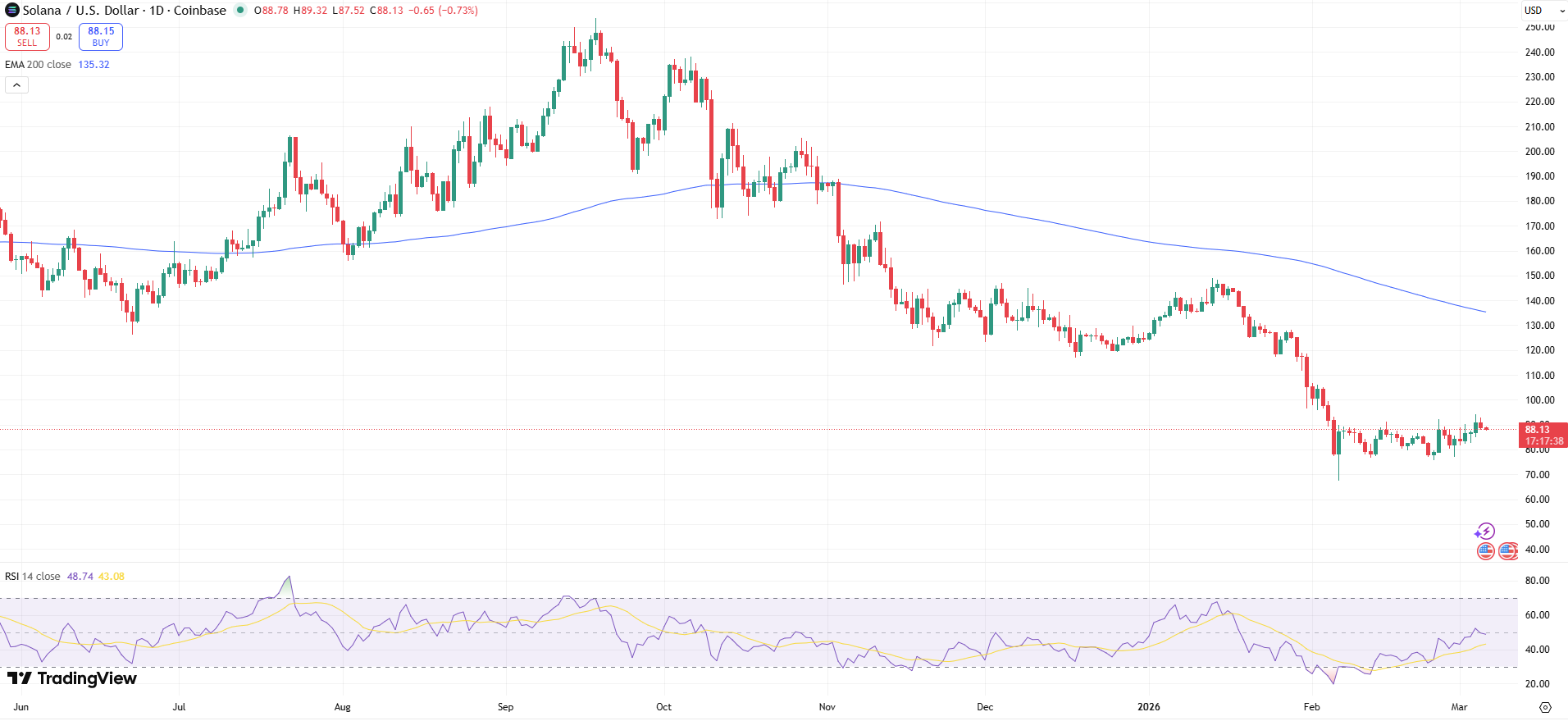
While ETF inflows remain strong, the price performance of Solana has been far less encouraging. The cryptocurrency reached an all-time high of $293 in January 2025, driven by a surge in activity related to meme coin creation and blockchain trading.
Since then, the market has cooled significantly.
Today, Solana trades near $88, representing a drop of roughly 70% from its record high. The token also declined 2.7% in the latest trading session and has fallen about 11% over the past month, according to CoinGecko data.
ETF flows have also shown some short-term volatility:
- Wednesday: about $19 million in net inflows
- Thursday: roughly $6 million in net outflows
- First outflow day: after more than one month of inflows
Even with occasional withdrawals, analysts say the overall trend remains strong. For many investors, ETFs provide a regulated and convenient way to gain exposure to cryptocurrency markets without directly holding digital assets.
As a result, the performance of Solana ETFs could become an important signal of how institutional investors view the future of blockchain networks beyond Bitcoin.
