Tom Lee says Ethereum’s 22% decline reflects quarter-end selling, not weak fundamentals, as Bitmine nears a 5% ETH stake despite market volatility.
Tom Lee Says Ethereum Selloff Reflects Market Positioning, Not Weak Fundamentals
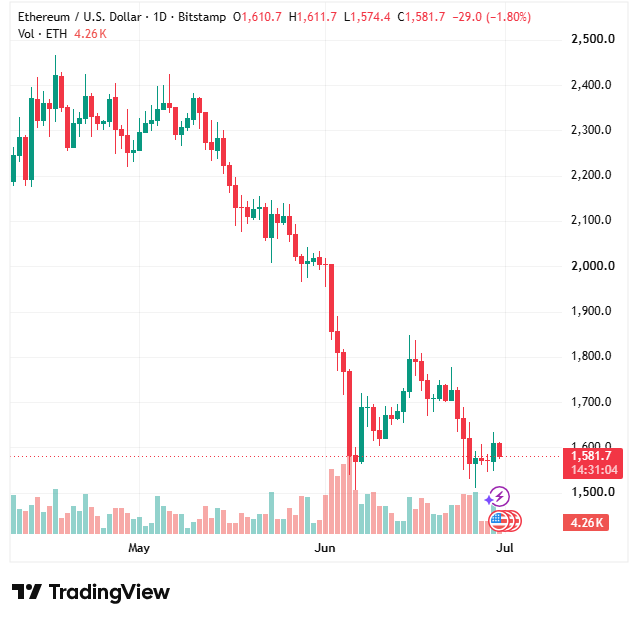
Ethereum has endured another difficult week, with its price slipping 7% and extending its monthly decline to nearly 22%. Trading around $1,587, the second-largest cryptocurrency has struggled to maintain investor confidence as broader digital asset markets remain under pressure.
While the decline has sparked fresh concerns among traders, Bitmine Chairman Tom Lee argues that the selloff should not be interpreted as a sign of weakening fundamentals.
Instead, Lee believes institutional portfolio adjustments at the end of the financial quarter are largely responsible for the latest price weakness. According to his assessment, Ethereum’s underlying ecosystem continues to strengthen despite short-term market volatility.
For long-term investors, the distinction between temporary selling pressure and deteriorating fundamentals could prove significant as blockchain adoption continues to expand across financial markets.
Quarter-End Selling Drives Price
Lee attributes much of Ethereum’s recent decline to a practice commonly known as window dressing. During this process, institutional fund managers reduce exposure to underperforming assets before quarterly reporting periods to improve the appearance of their portfolios.
According to Lee, this type of selling is a recurring event rather than an indication that confidence in Ethereum has weakened. Although Ethereum has fallen approximately 22% over the past month—slightly exceeding Bitcoin’s 19% decline—he argues that the broader investment thesis remains intact.
Several long-term developments continue supporting Ethereum’s outlook:
- Growing institutional interest in blockchain infrastructure.
- Expansion of real-world asset tokenization.
- Rising demand for AI-powered payment networks.
- Increasing use of Ethereum-based decentralized financial applications.
Lee believes these structural trends are advancing even as market prices temporarily move in the opposite direction.
Bitmine Expands Ethereum Holdings
Bitmine has reinforced its confidence through aggressive accumulation rather than caution.
The company recently acquired an additional 27,084 ETH, increasing its total holdings to approximately 5.7 million ETH. At current market prices, that position is valued at nearly $9 billion, representing roughly 4.7% of Ethereum’s circulating supply.
The latest purchase places Bitmine within just 0.3 percentage points of its publicly stated objective of controlling 5% of all Ethereum in circulation.
Lee summarized the current market environment by noting that Ethereum’s price is trailing its improving fundamentals. He pointed to expanding blockchain adoption and growing institutional interest as indicators that the network’s long-term value proposition continues to strengthen.
Beyond cryptocurrency markets, Ethereum is increasingly viewed as infrastructure capable of supporting tokenized financial assets, automated settlements, and future AI-driven payment systems.
Whale Activity Tests Support
Despite the optimistic long-term narrative, short-term market risks remain elevated.
Crypto analyst Ali Martinez reported that large Ethereum holders sold nearly 550,000 ETH during the past week, representing transactions worth roughly $880 million. The selling pressure contributed to Ethereum falling below the important $1,633 support level.
Martinez now identifies $1,583 as the immediate support zone. If buyers fail to defend that level, attention could shift toward significantly lower demand areas.
Key technical levels include:
- Immediate support: $1,583
- Secondary demand zone: $1,237
- Major downside support: $1,089
Although whale selling continues to weigh on short-term sentiment, institutional accumulation by companies such as Bitmine presents a contrasting picture. Investors now face a market where price weakness reflects competing forces—profit-taking and portfolio rebalancing on one side, and growing long-term conviction on the other.
If Ethereum’s expanding role in financial infrastructure and AI-enabled payments continues to develop, current volatility may ultimately prove to be a temporary phase rather than the beginning of a prolonged bearish cycle.
Sources & Methodology
Primary-source standard: Market-moving facts should link to original data releases, regulator notices, company filings or official project announcements whenever available. Secondary reporting is used for additional context, not as a substitute for original evidence.
Page last reviewed: