


Bitcoin falls below $60,000 as the Japanese yen sinks to a 40-year low, fueling market volatility and raising concerns over crypto, stocks, and global carry trades.
Bitcoin Faces Fresh Selling Pressure
Bitcoin slipped below the critical $60,000 mark on Tuesday as the Japanese yen weakened to its lowest level against the U.S. dollar in four decades, adding fresh uncertainty across global financial markets.
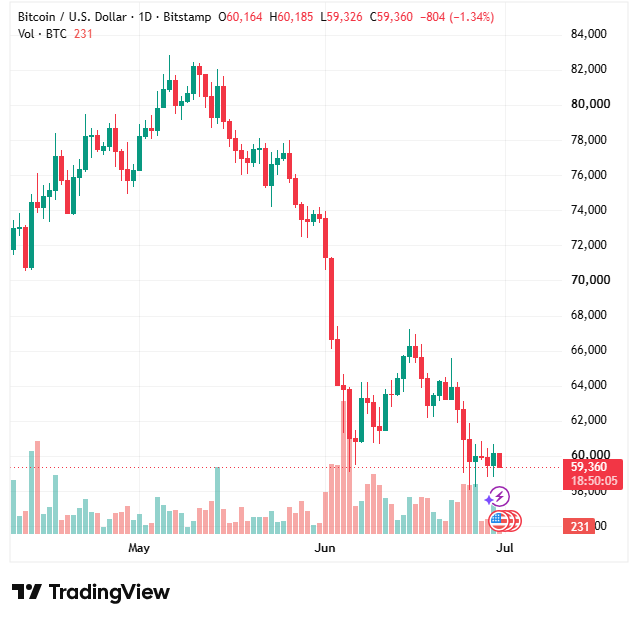
The world’s largest cryptocurrency declined by more than 1%, remaining below its closely watched 200-week simple moving average, a technical level many traders consider an important indicator of long-term market direction.
The latest decline highlights how macroeconomic forces continue to shape digital asset prices. Currency fluctuations, interest rate expectations, and institutional investment decisions are increasingly influencing Bitcoin alongside traditional financial markets.
Another development weighing on investor sentiment came from Strategy, the world’s largest publicly traded corporate holder of Bitcoin. The company announced authorization for up to $1 billion in share buybacks while simultaneously introducing a $1.25 billion monetization program designed to generate capital through Bitcoin sales.
The move represents a notable shift from Executive Chairman Michael Saylor’s long-standing message encouraging investors to hold Bitcoin rather than sell it. While the company maintains one of the largest corporate Bitcoin reserves, the possibility of large-scale sales has increased short-term market uncertainty.
Strategy’s Shift Raises Questions
Market analysts remain divided over Strategy’s latest financial decisions. Some believe the capital restructuring may improve liquidity, while others argue it reflects growing pressure on the firm’s funding model.
Recent weakness in STRC, Strategy’s preferred stock that previously helped finance Bitcoin purchases, has reduced one of the company’s primary fundraising channels. Analysts note that declining investor demand for these securities could make future Bitcoin acquisitions more difficult.
Key developments include:
- Bitcoin traded below $60,000, extending recent weakness.
- Strategy approved up to $1 billion in stock buybacks.
- The company launched a $1.25 billion capital-raising program.
- Investors are monitoring whether additional Bitcoin sales will follow.
Several market observers argue that these financial adjustments may temporarily ease pressure but do not fully resolve the company’s long-term capital structure challenges.
Yen Weakness Drives Global Risk
The Japanese yen fell to approximately 162.40 per U.S. dollar, marking its weakest level since 1986. The currency has lost roughly 57% of its value against the dollar since 2021, largely because of the widening interest rate gap between the United States and Japan.
While the U.S. Federal Reserve previously raised interest rates above 5% before easing toward current levels, the Bank of Japan has maintained comparatively low borrowing costs despite modest policy tightening. This difference has encouraged investors to borrow inexpensive yen and invest in higher-yielding assets through so-called carry trades.
Japan also faces structural fiscal pressures, with government debt exceeding 220% of GDP, limiting the central bank’s flexibility to raise rates aggressively. Faster tightening could stabilize the yen but may also increase borrowing costs and place additional strain on public finances.
Analysts warn that if Japanese policymakers eventually intervene more aggressively or significantly increase interest rates, investors could rapidly unwind yen-funded carry trades. Such a move could create selling pressure across equities, bonds, and cryptocurrencies, reinforcing Bitcoin’s sensitivity to broader macroeconomic developments.
For now, global investors remain focused on currency markets as an important driver of digital asset performance.
