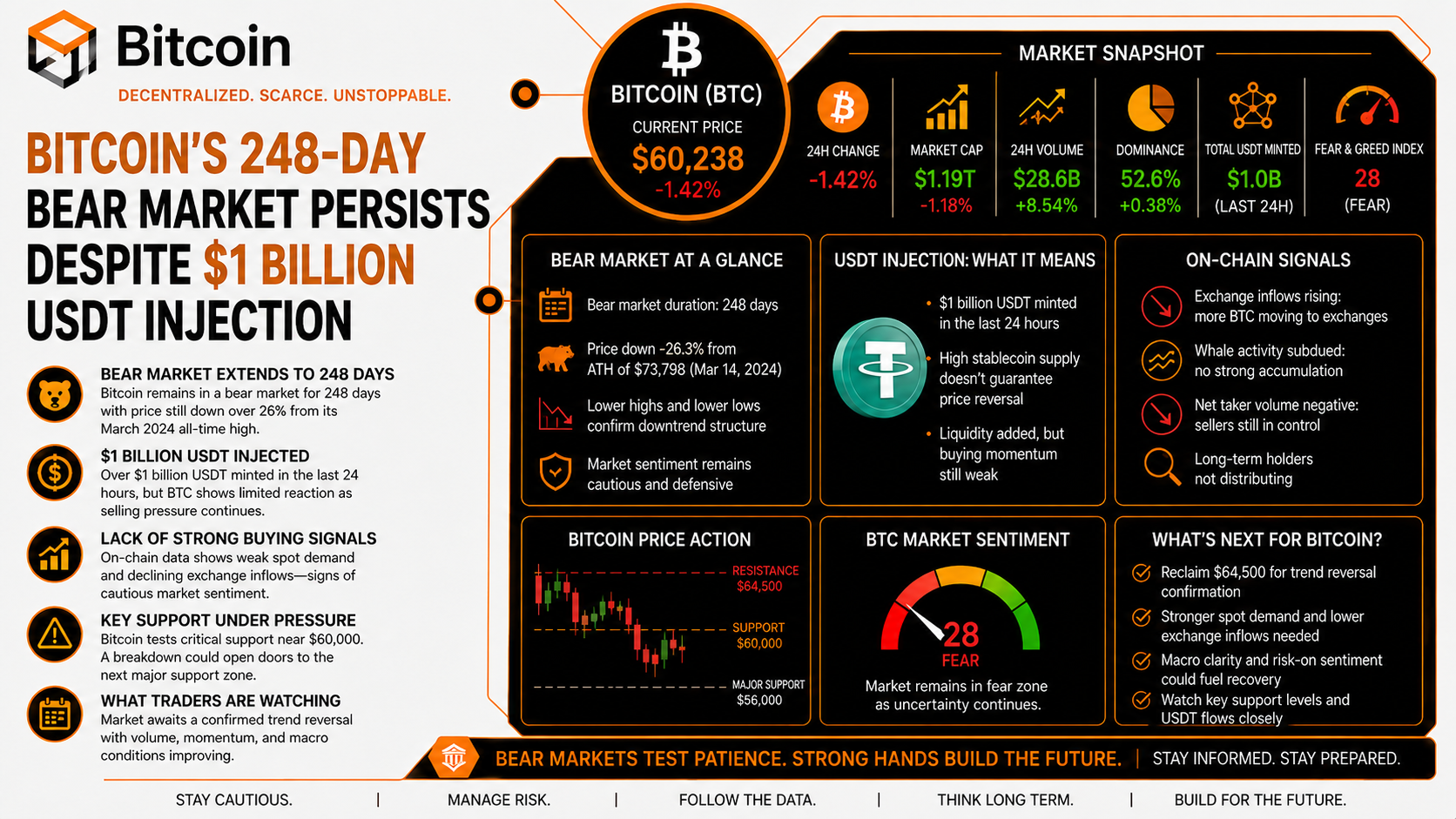
Bitcoin demand remains weak despite a $1 billion USDT injection. ETF outflows, soft spot buying, and rising leverage raise concerns over BTC’s recovery.
Bitcoin Demand Remains Fragile
Bitcoin continues to face a challenging market environment despite a fresh $1 billion USDT issuance from Tether. Under normal conditions, a large stablecoin injection is often viewed as a sign of incoming buying pressure for cryptocurrencies. This time, however, the market response has been noticeably different.
Recent geopolitical uncertainty surrounding tensions in the Middle East has pushed investors toward a more cautious stance. While Bitcoin has avoided a collapse in sentiment, the underlying demand picture remains far from convincing. Market indicators suggest that investors are not aggressively deploying capital into Bitcoin, even as additional liquidity enters the crypto ecosystem.
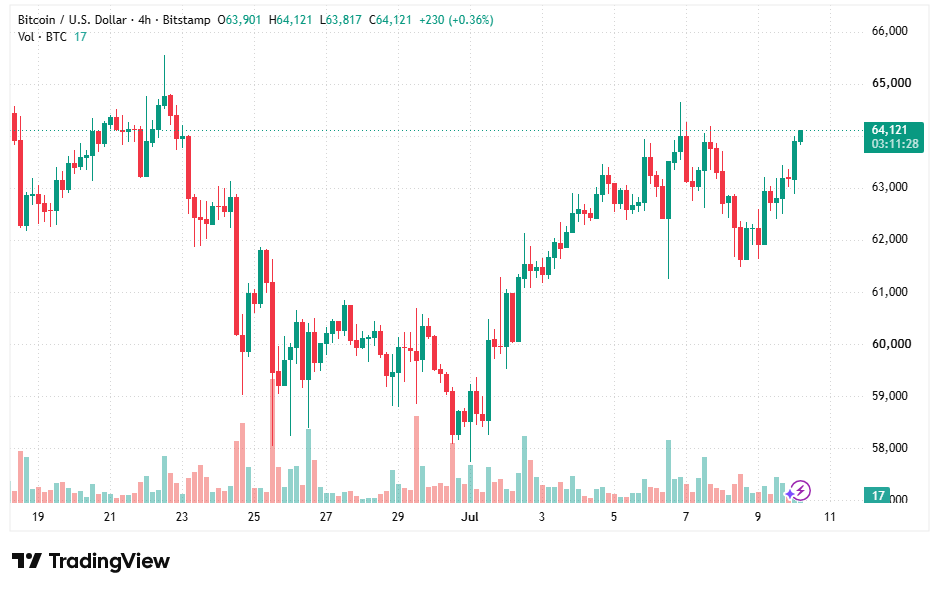
The Crypto Fear & Greed Index has managed to stay above extreme fear levels, signaling that panic has not fully taken hold. Nevertheless, resilience in sentiment alone has not translated into stronger spot market demand. Instead, investors appear to be holding capital on the sidelines while waiting for clearer macroeconomic and geopolitical signals.
ETF Outflows Signal Caution
Institutional activity offers further evidence of a cautious market backdrop. After recording three consecutive days of inflows, U.S. spot Bitcoin exchange-traded funds experienced more than $85 million in net outflows as risk appetite weakened.
The reversal highlights how quickly professional investors can reduce exposure when uncertainty rises. Demand indicators tracking U.S. spot market activity have also turned negative, suggesting institutional participation remains subdued.
Key market observations include:
- Spot Bitcoin ETFs recorded over $85 million in net outflows.
- Bitcoin’s current bear market has lasted 248 days.
- The 2022 bear cycle lasted 381 days.
- The 2018 bear cycle extended to 385 days.
- Spot demand remains near -78,000 BTC, reflecting weak buying interest.
These figures suggest that Bitcoin has not yet entered a sustained risk-on phase that typically supports long-term rallies.
Derivatives Drive Recovery Risks
One of the most notable developments in recent weeks has been the growing gap between spot and derivatives demand. Bitcoin’s 30-day cumulative demand metric has improved significantly, recovering from nearly negative 500,000 BTC to approximately negative 75,000 BTC. At first glance, this appears encouraging.
A closer examination reveals a different story. Most of the improvement has come from derivatives markets rather than direct Bitcoin purchases. Futures demand has surged from roughly negative 295,000 BTC to slightly positive territory, while spot demand remains deeply negative.
This divergence matters because derivative-driven recoveries often rely on leverage rather than genuine capital inflows. As leverage increases, market stability can weaken. If investor sentiment suddenly shifts due to economic data, geopolitical developments, or broader market stress, leveraged positions can unwind rapidly and trigger sharp price declines.
The recent $1 billion USDT issuance further reinforces this concern. Instead of flowing directly into Bitcoin purchases, much of the liquidity appears to be waiting on the sidelines. This suggests investors are preserving flexibility rather than expressing confidence in an immediate market recovery.
Historical comparisons also indicate caution. At 248 days, Bitcoin’s current bear market remains considerably shorter than the 381-day and 385-day downturns recorded in previous cycles. While history never repeats exactly, the data suggest the current correction may still have room to develop before a durable bullish trend emerges.
Sources & Methodology
Primary-source standard: Market-moving facts should link to original data releases, regulator notices, company filings or official project announcements whenever available. Secondary reporting is used for additional context, not as a substitute for original evidence.
Page last reviewed: