
Polymarket seeks U.S. approval for margin trading as prediction markets hit $47 billion in monthly volume, intensifying competition with Kalshi.
Polymarket, one of the world’s largest prediction market platforms, is moving closer to offering regulated margin trading in the United States. The company has submitted applications through its affiliated entities, signaling a major step toward expanding how users participate in event-based markets.
If approved, margin trading would allow traders to gain exposure to larger positions while committing only a fraction of the total capital typically required.
Polymarket Eyes U.S. Expansion
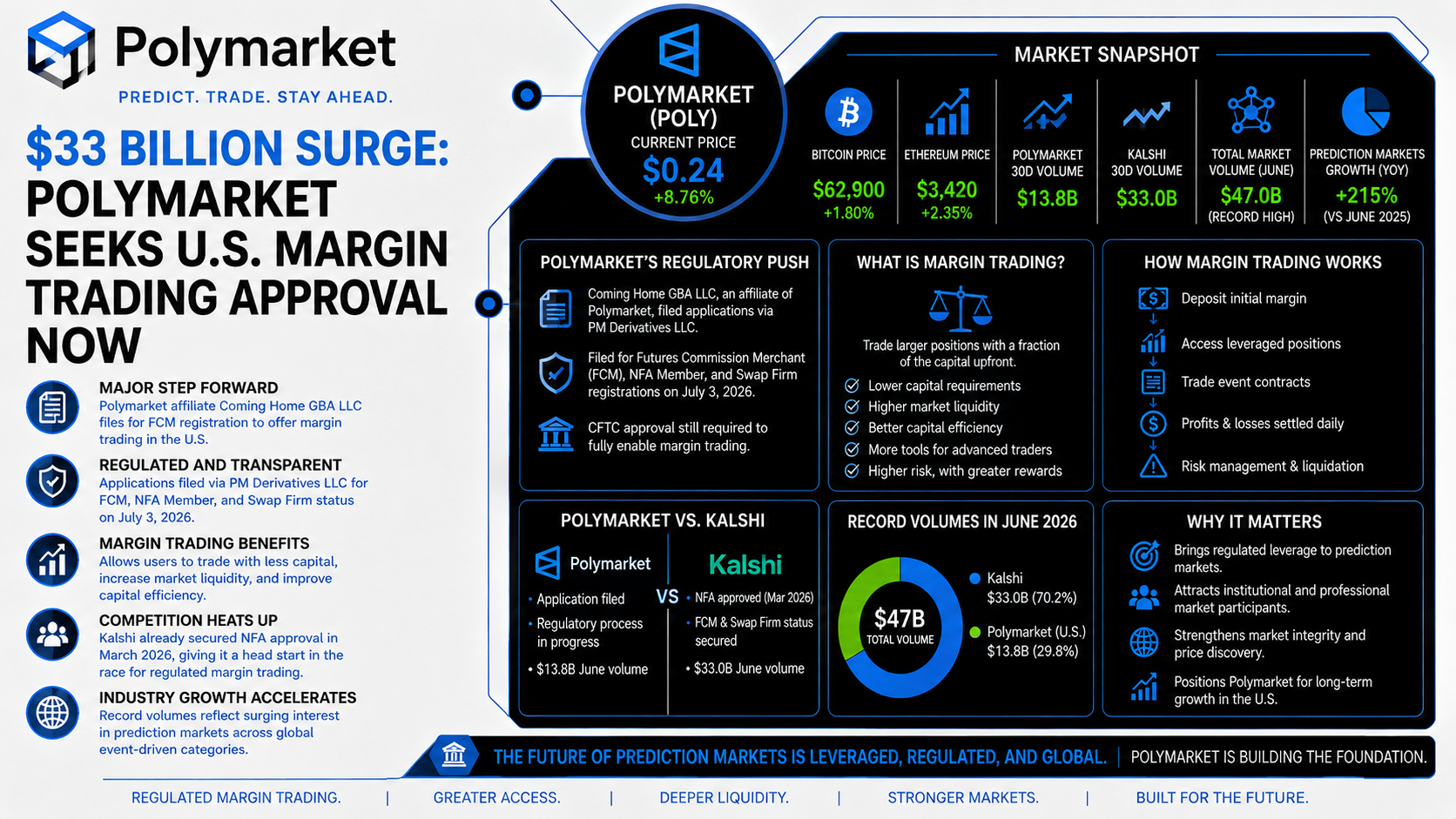
Recent filings in the National Futures Association (NFA) BASIC database show that Coming Home GBA LLC, an affiliate linked to Polymarket, has applied for regulatory approvals through PM Derivatives LLC. The applications include registration as a Futures Commission Merchant (FCM), NFA membership, and Swap Firm status.
PM Derivatives filed the core applications on July 3, marking one of the most significant regulatory efforts undertaken by the prediction market operator. However, registration alone would not immediately unlock leveraged trading. The company would also require authorization from the Commodity Futures Trading Commission (CFTC), the primary regulator overseeing U.S. derivatives markets.
For Polymarket, gaining these approvals could create a pathway to offering more sophisticated financial products while strengthening its position in the rapidly growing prediction market industry.
Margin Trading Gains Momentum
Margin trading enables participants to control larger positions with less upfront capital. Instead of fully funding a trade, users deposit a portion of the required amount, increasing both potential returns and potential losses.
For prediction markets, this could significantly change user behavior by improving capital efficiency and increasing market liquidity.
Key benefits of regulated margin trading include:
- Lower capital requirements for traders.
- Greater market participation and liquidity.
- More efficient price discovery.
- Increased flexibility for professional and institutional users.
At the same time, regulators typically impose strict oversight because leverage can amplify risks during periods of market volatility.
Kalshi Sets the Competitive Pace
While Polymarket works through the approval process, rival prediction market platform Kalshi has already secured an important regulatory advantage. In March 2026, Kalshi affiliate Kinetic Markets LLC received NFA approval as both a registered FCM and Swap Firm.
That approval positions Kalshi to advance its margin trading ambitions ahead of competitors. The development highlights the intensifying race among prediction market operators to expand their offerings and attract a broader user base.
The timing is notable because industry activity has reached unprecedented levels. According to market data, June produced record trading volumes across the sector. Kalshi generated approximately $33 billion in monthly volume, while Polymarket and its U.S.-focused operations recorded nearly $14 billion combined.
Together, the two platforms accounted for roughly $47 billion in trading activity during a single month, underscoring growing public interest in markets that allow participants to speculate on elections, economic developments, sports outcomes, and other real-world events.
As regulators evaluate these applications, the outcome could shape the next phase of growth for the U.S. prediction market industry, potentially bringing leveraged event trading into a more regulated and institutional framework.
