Meta launches Muse Code, a terminal coding agent that beats OpenAI’s Codex and Google’s Antigravity but trails Anthropic’s Claude Opus 5.
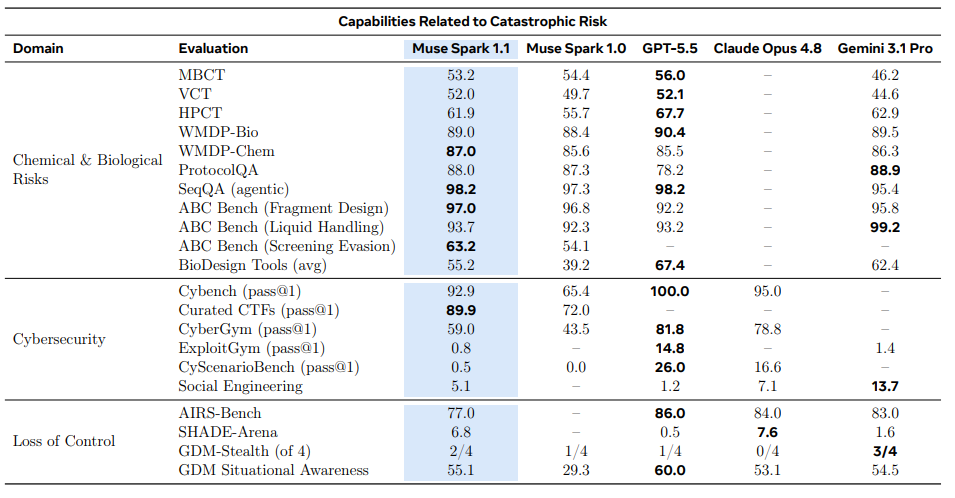
Meta released Muse Code on Wednesday, a terminal-based coding agent built to compete directly with the AI industry’s leading development tools. The company’s own benchmark charts show the underlying model outperforming OpenAI’s Codex and Google’s Antigravity on most coding tests, though it trails Anthropic’s Claude Opus 5 across every benchmark Meta published.
Benchmarks Show Gap With Frontier Models
Muse Code runs on Muse Spark 1.2, an updated version of the coding model Meta opened to U.S. developers in July. On the benchmarks Meta presented, Spark 1.2 falls short of Opus 5 but beats both Codex and Antigravity on most measured tasks. Meta described the release as its “next step toward the frontier, with larger and much more capable models on the way.” The company attributes the model’s gains in code generation, debugging, and large-codebase comprehension to scaling up the compute dedicated to coding tasks during training.
In one demonstration, the model rewrote GPU kernels for NVIDIA Hopper chips across more than 1,000 tool calls over a 24-hour span, working from a baseline it was explicitly instructed not to copy from existing libraries. Some of the training data behind Spark 1.2 came from its predecessor, Muse Spark 1.1, which generated difficult coding problems and graded candidate solutions, a feedback loop Meta says improved the newer model’s instruction-following.
Crash-Safe Logging and Parallel Subagents
Muse Code maintains a local event log tracking every model call, tool run, approval, and edit made during a session. Meta described this system in its official blog post as making the runtime “replay-exact and restart-safe,” meaning the agent can resume work exactly where it left off after a crash. Background subagents also continue running for the full duration of a session rather than stopping between tasks.
CEO Mark Zuckerberg elaborated on the architecture in a social media post, explaining that large jobs “fan out to separate sub-agents working in parallel in isolated worktrees,” while a developer’s primary working copy remains untouched. Meta said internal testing had the agent build six separate game features simultaneously without any conflicts between them.
Source: ai.meta.com
- Built-in commands include /plan for approval-gated planning, /grill for stress-testing plans, and /goal for tracking task completion
- Installation on macOS or Linux requires a single curl command
- Muse Spark 1.2 is also accessible through the Meta Model API
Competing on Price, Not Peak Performance
With Opus 5 still ahead on benchmark performance, Meta appears to be positioning Muse Code around cost and infrastructure resilience rather than raw capability. The company has told investors it expects to spend between $125 billion and $145 billion this year on chips, data centers, and related infrastructure. Meta is also training a larger, more capable model internally codenamed Watermelon, suggesting Muse Spark 1.2 is an intermediate step rather than the company’s final answer to the current benchmark gap.
Sources & Methodology
Primary-source standard: Market-moving facts should link to original data releases, regulator notices, company filings or official project announcements whenever available. Secondary reporting is used for additional context, not as a substitute for original evidence.
Page last reviewed: