XRP traded near $0.97 on Friday, recovering less than 1% on the day but remaining under pressure after a six-week decline. The token recently touched $0.89, its weakest level since November 2024, and sits roughly 73% below its reported peak of $3.66 in July 2025. The downturn raises a key question: why has XRP struggled despite improved US regulatory clarity, expanding payment partnerships and the arrival of spot exchange-traded funds (ETFs)?
Macro pressure outweighs XRP fundamentals
XRP’s decline reflects a broader retreat from risk assets as investors reassess interest-rate expectations and reduce exposure to volatile investments. October US inflation data added to concerns about persistent price pressures. The Consumer Price Index (CPI) increased 0.4% month over month, while core CPI rose 0.3%, according to the figures in the supplied report.
Markets consequently increased their expectations of further Federal Reserve tightening. Higher interest rates can make government bonds and cash investments more attractive relative to cryptocurrencies, which generate no conventional interest income.
Institutional flows also weakened. US spot Bitcoin ETFs recorded approximately $1.07 billion in weekly outflows in the period cited, while Ethereum funds lost about $399 million. XRP products experienced withdrawals too, including roughly $19 million in outflows during the week ending November 13.
The broader mood was reflected in the Crypto Fear and Greed Index, which the supplied report placed at 10, indicating extreme fear. In this environment, positive developments specific to Ripple have struggled to counter market-wide selling.
Ripple grows as XRP demand lags
Regulatory uncertainty was a major obstacle for XRP for years. On March 17, 2026, the SEC and CFTC issued a joint interpretation that included XRP among examples of digital commodities. The guidance improved regulatory clarity, although it does not mean every transaction involving XRP is automatically exempt from securities laws.
Meanwhile, Ripple has expanded its business through Ripple Payments, partnerships and acquisitions. Its RLUSD stablecoin also provides another route for institutions to use Ripple’s infrastructure. However, growth in Ripple’s business does not automatically translate into demand for XRP.
That distinction matters because companies can use stablecoins for payments and settlement without necessarily holding XRP. The token’s role as a bridge asset may require only brief exposure during some transactions, rather than long-term accumulation.
Supply is another consideration. CoinGecko lists circulating supply at approximately 63.5 billion XRP, while around 31.1 billion tokens remain in Ripple escrow, according to the supplied data. Future releases can influence investor expectations about available supply.
Can XRP recover from the downturn?
The investment case remains divided. Potential supports include:
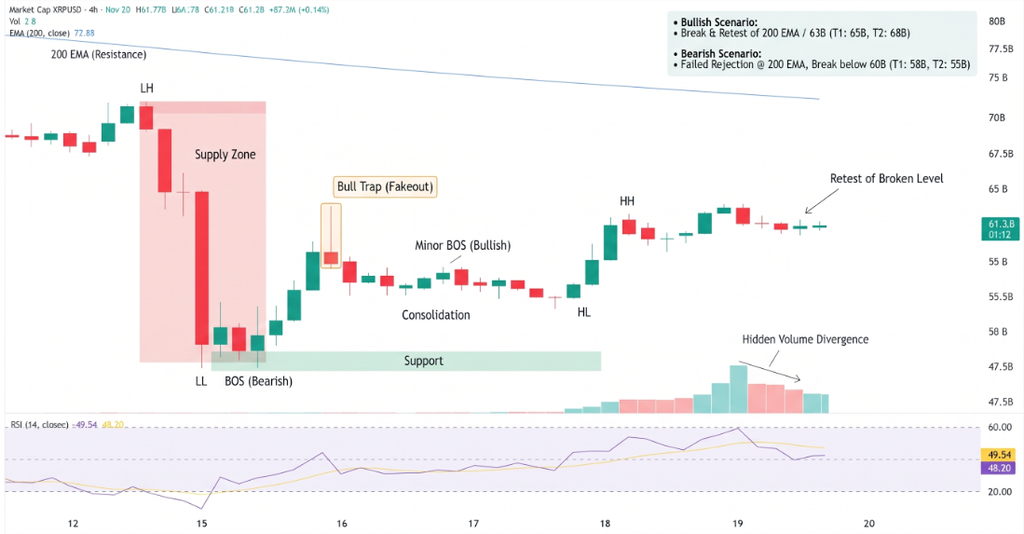
- Greater US regulatory clarity following the SEC-CFTC interpretation.
- Expanding Ripple payment infrastructure and RLUSD adoption.
- Spot XRP ETFs, which provide investors with regulated market exposure.
However, persistent ETF withdrawals, macroeconomic pressure and the gap between Ripple’s commercial growth and XRP token demand remain significant risks.
Conclusion
XRP’s weakness illustrates why a growing blockchain business does not guarantee a rising token price. Regulatory progress and institutional products can improve access, but sustained appreciation requires stronger demand for XRP itself. A recovery will depend on improving market liquidity, renewed ETF inflows and evidence that Ripple’s expanding payment network is translating into meaningful token usage. Until those conditions emerge, XRP remains vulnerable despite the progress made across its broader ecosystem.
Sources & Methodology
Primary-source standard: Market-moving facts should link to original data releases, regulator notices, company filings or official project announcements whenever available. Secondary reporting is used for additional context, not as a substitute for original evidence.
Page last reviewed: