
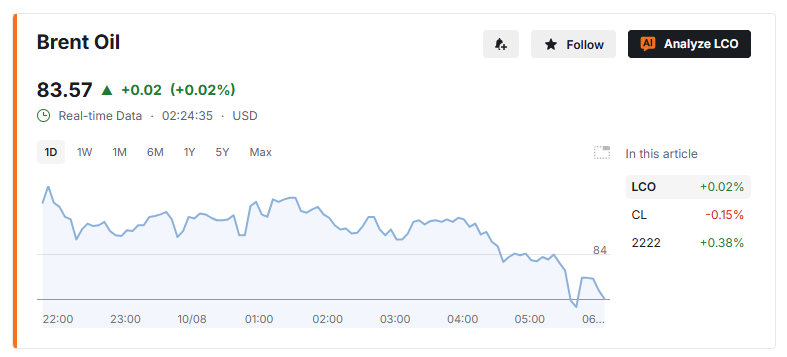
Oil prices pared early gains on Monday as uncertainty over reopening the Strait of Hormuz kept supply risks elevated, compounded by an Iran-backed Houthi attack on a Saudi refinery that processes 400,000 barrels of crude daily. Brent crude rose 0.5% to $83.98 a barrel as of 01:28 ET, while WTI gained 0.3% to $78.44, both retreating from session highs even as Brent’s three-day gain held above 5%. The pullback reflects a market weighing incremental diplomatic progress against a widening pattern of regional attacks.
Hormuz Reopening Talks Remain Unresolved
Iranian Foreign Minister Abbas Araghchi said over the weekend that an agreement with Oman on a shipping route through the strait was “very close,” though he cautioned any deal would not immediately reopen the waterway to normal traffic. Iran has ruled out direct talks with the U.S., citing alleged violations of the interim peace agreement reached in June, and has demanded an end to the U.S. naval blockade, removal of sanctions, and compensation for war damage before granting full access. Washington maintains it is involved in discussions over managing the waterway, a claim Tehran disputes.
The standoff has kept shipping through the chokepoint constrained. An ADNOC tanker was targeted in the strait over the weekend, following a week in which three ADNOC tankers were attacked while transiting Hormuz. Prices jumped Friday after Iran’s semi-official Fars news agency reported strikes near Qeshm Island against targets it described as hostile.
Houthi Strikes Widen the Conflict’s Reach
Yemen’s Houthi movement said Sunday it struck Saudi Aramco’s Jazan refinery with a drone, an attack military spokesperson Yahya Saree described as a direct hit carried out in retaliation for alleged Saudi drone incursions into Yemen’s Saada and Hajjah provinces. Saudi Arabia’s energy ministry confirmed a resulting fire, later extinguished without injuries. The refinery has been targeted before; the Houthis have also previously struck the Yanbu export terminal on Saudi Arabia’s Red Sea coast. In a separate assault Sunday, Houthi forces carried out missile and drone strikes on the Yemeni Red Sea port of Mocha, killing seven people, according to Yemen’s internationally recognized government. The attacks came two days after Saudi Arabia signed a mutual-defense pact with Turkey and Pakistan in response to the region’s deepening instability.
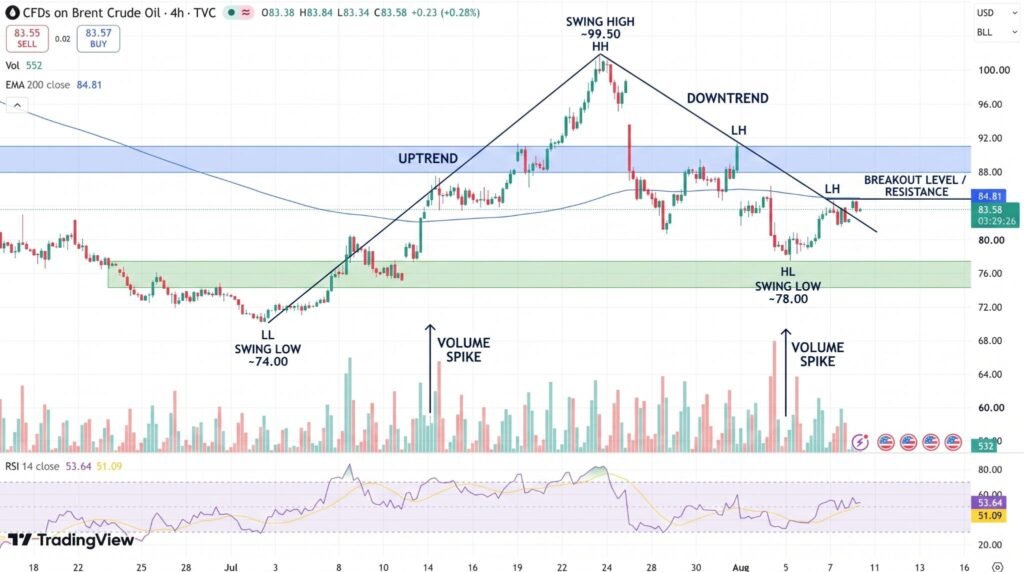
ANZ analysts noted oil had already endured a volatile week: prices fell sharply after the U.S. said it would pause strikes on Iran to allow Hormuz talks to proceed, then recovered once it became clear any reopening would still carry significant restrictions on vessel traffic. Some supply risk eased elsewhere after Ukraine agreed not to target certain non-Russian tankers and Black Sea infrastructure tied to Kazakhstan’s crude exports, though the Caspian Pipeline Consortium terminal, which handles roughly 1.8 million barrels a day of Kazakh output, has faced repeated attacks in recent weeks.
Conclusion
Oil’s retreat from session highs shows traders discounting diplomatic headlines against a conflict that keeps expanding geographically rather than resolving. Iran’s insistence on lifting the naval blockade and securing compensation before any full Hormuz reopening leaves little near-term prospect for smoother flows through the strait, while the Houthis’ willingness to strike both Saudi refining capacity and Red Sea shipping signals the fighting is no longer confined to a single chokepoint. Until either front stabilizes, oil prices are likely to keep trading on the balance between negotiation progress and fresh attacks rather than settling into a clear direction.
Sources & Methodology
Primary-source standard: Market-moving facts should link to original data releases, regulator notices, company filings or official project announcements whenever available. Secondary reporting is used for additional context, not as a substitute for original evidence.
Page last reviewed: