West Texas Intermediate (WTI), the US crude benchmark, trades near $91.40 during early Asian hours on Thursday, extending its pullback as expectations for renewed US-Iran diplomacy reduce part of the geopolitical premium embedded in crude prices. Iran has indicated that it remains open to negotiations, although major differences with Washington remain unresolved. At the same time, a larger-than-expected increase in US crude inventories has added another bearish factor for the oil market.
US-Iran Talks Weigh on WTI
Oil prices have come under pressure as traders assess whether diplomatic engagement between Washington and Tehran could reduce disruptions across key Middle Eastern supply routes. Iran has said it is prepared to reopen the Strait of Hormuz within a week if the United States eases military pressure and lifts its blockade of Iranian ports. Tehran submitted its proposal through intermediaries on September 16, according to Reuters.
The Strait is a critical shipping route for global energy markets, making any improvement in traffic conditions relevant to crude pricing. Recent reports indicate that Saudi oil shipments through Hormuz have also increased, with exports averaging around 2.9 million barrels per day over a six-day period. These developments have encouraged traders to reduce some of the supply-risk premium built into oil prices.
However, the physical oil market has not fully normalized. Continuing military tensions, uncertain sanctions policy and the possibility of renewed disruptions mean crude remains highly sensitive to geopolitical headlines.
- WTI spot price: around $91.40
- Iran’s proposed Hormuz reopening: within one week
- Saudi exports through Hormuz: around 2.9 million bpd
US Inventories Add Bearish Pressure
Fresh EIA data provided another source of pressure for WTI. Commercial US crude inventories excluding the Strategic Petroleum Reserve increased by about 3.0 million barrels during the week ended September 18, reaching 426.4 million barrels. The previous week’s level was 423.4 million barrels.
The increase was particularly notable because the market had been expecting a decline. Crude stocks at the Cushing, Oklahoma, delivery hub also rose by about 2.27 million barrels to 23.75 million barrels. Meanwhile, refinery crude inputs fell to 16.81 million barrels per day, while refinery utilization dropped to 94.0% from 96.8% a week earlier.
The inventory increase suggests that near-term physical demand did not absorb available crude as quickly as traders had anticipated. Gasoline inventories, however, declined by roughly 1.7 million barrels, showing that conditions remain different across individual petroleum products.
WTI Technical Levels to Watch
The daily technical structure remains constructive despite the latest decline. WTI is still trading above its 100-day moving average at $84.95 and the lower Bollinger Band near $83.35. The Relative Strength Index (RSI) around 51 points to neutral momentum after the market previously entered overbought territory.
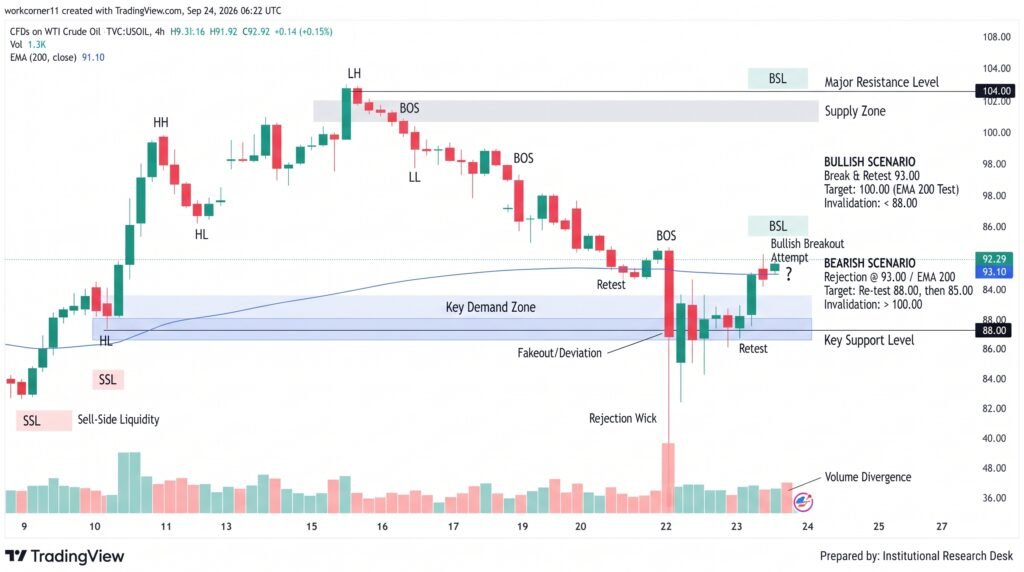
The first upside barrier is the Bollinger middle band, which aligns with the 20-day SMA near $92.65. A sustained move above $92.65 would keep the recent recovery structure intact and could bring the upper Bollinger Band near $101.95 back into focus.
On the downside, the 100-day moving average at $84.95 is the first major technical support. A decisive break below it would shift attention toward the lower Bollinger Band around $83.35 and would indicate a deeper correction.
Key levels:
- Resistance: $92.65 and $101.95
- Support: $84.95 and $83.35
- RSI: around 51
Conclusion
WTI has slipped below $91.50 as diplomatic signals between the US and Iran reduce part of the market’s geopolitical risk premium, while the latest US inventory build adds pressure. Still, supply conditions remain sensitive to developments around the Strait of Hormuz. Technically, WTI retains a constructive structure above $84.95, but a break below that level would expose $83.35. On the upside, $92.65 remains the first important hurdle before the $101.95 area.
Sources & Methodology
Primary-source standard: Market-moving facts should link to original data releases, regulator notices, company filings or official project announcements whenever available. Secondary reporting is used for additional context, not as a substitute for original evidence.
Page last reviewed: