Asian stocks traded mostly higher on Wednesday as a renewed rally in semiconductor shares pushed South Korea’s KOSPI up 3.7% to 6,579.04, its third straight session of gains, while investors stayed cautious ahead of U.S. inflation data and oil prices climbed on renewed uncertainty over the Strait of Hormuz. Nasdaq 100 futures rose 0.4% and S&P 500 futures gained about 0.2% in Asian trade, after Wall Street closed lower Tuesday, with the S&P 500 falling 0.32% to 7,728.2 and the Nasdaq Composite down 0.6%.
Temasek Report Ignites a Chip Rally
The KOSPI’s advance was driven almost entirely by two stocks: Samsung Electronics and SK Hynix each rallied more than 8% intraday after South Korea’s Asia Business Daily reported that Singapore’s sovereign wealth fund Temasek plans to invest directly in both companies, marking the state fund’s first-ever direct equity investment in South Korean stocks. Temasek, which manages a net portfolio of roughly $401 billion, reportedly views memory chips within the AI supply chain as undervalued and has been discussing investment timing with South Korean officials. Foreign investors net-bought 2.83 trillion won ($2 billion) of Kospi-listed shares during the session, while retail investors sold a net 3.19 trillion won, and the exchange briefly triggered a five-minute buy-side sidecar halt around midday as buying pressure intensified.
The gains extended a broader recovery in Korean chip stocks following a volatile stretch in recent weeks; both companies remain up more than 100% year-to-date despite that turbulence. Analysts also pointed to growing investor pressure on both firms to lift shareholder returns: Samsung and SK Hynix currently target payouts equivalent to about 50% of free cash flow, and SK Hynix has said it is reviewing additional capital-return measures with details expected in the third quarter.
Wall Street Earnings Reinforce the AI Trade
The rally built on strong overnight results from U.S. tech names. CoreWeave surged 16% in extended trading on stronger-than-expected sales growth, while Super Micro Computer jumped 7.6% after its revenue forecast topped estimates, reinforcing confidence that AI infrastructure spending remains intact. Nvidia separately said it partnered with six major financial institutions on compute-financing platforms designed to mobilize more than $500 billion in third-party capital for AI infrastructure. Japan’s Nikkei 225 rose 1%, with Kioxia Holdings up 3.7% and TDK and Murata Manufacturing each gaining more than 1%, while China’s CSI 300 added 0.6% on strength in SMIC and Cambricon Technologies. Hong Kong diverged sharply: the Hang Seng fell about 1% as Alibaba, Tencent, and NetEase each dropped more than 2.9%.
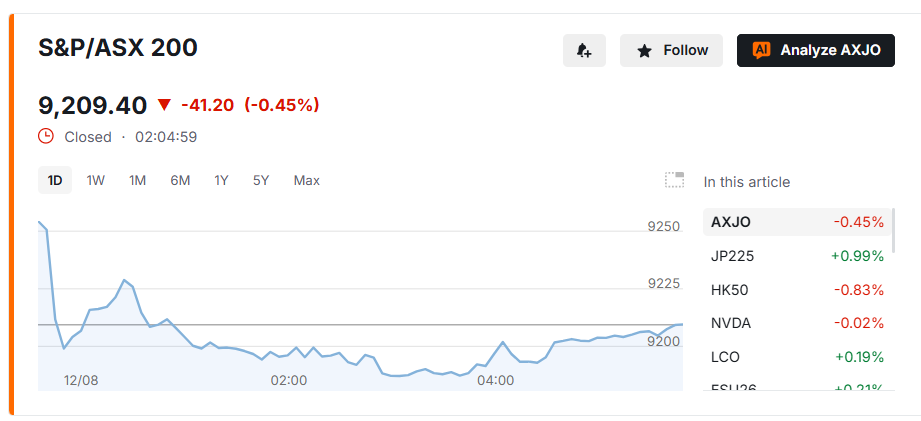
- Australia’s ASX 200 fell 0.5% after the RBA held its cash rate at 4.35%, though Governor Michele Bullock said another hike remained “quite possible” if inflation risks strengthen
- Brent crude extended its rally for a sixth straight session to around $89.44 a barrel as hopes for a quick Hormuz reopening faded
Conclusion
Wednesday’s session captured two forces pulling Asian markets in opposite directions: renewed conviction in AI-driven chip demand lifting Korea and mainland China, against energy-driven inflation risk weighing on markets more exposed to import costs, including Australia, India, and Singapore. The U.S. CPI report due later Wednesday, forecast at a 0.1% monthly and 3.4% annual increase, will determine whether easing inflation can keep rate expectations contained even as the Hormuz standoff threatens to push energy costs higher through the rest of the quarter.
Sources & Methodology
Primary-source standard: Market-moving facts should link to original data releases, regulator notices, company filings or official project announcements whenever available. Secondary reporting is used for additional context, not as a substitute for original evidence.
Page last reviewed: