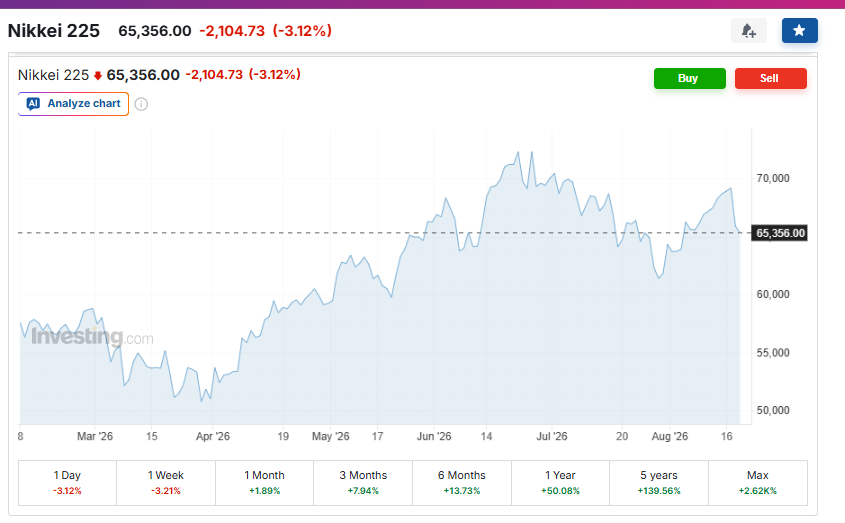
The Nikkei 225 closed down 3.16% at 65,326.42 on 19 August 2026 as technology and semiconductor stocks led losses amid rising global bond yields, higher oil prices and risk-off sentiment.
Japan stocks closed sharply lower on Wednesday, with the Nikkei 225 falling 3.16% or 2,134 points to 65,326.42, as losses in technology, semiconductor and related sectors led the decline. The broader TOPIX dropped 3.09% to 4,012.31 amid a global risk-off move driven by higher bond yields, elevated oil prices and lingering Middle East tensions, as reported across major market data providers.
Nikkei 225 Closes at 65,326.42 (-3.16%) as Furukawa Electric Drops 13.7% and Mercari Rises 6.2%
At the close in Tokyo, the Nikkei 225 lost 3.16% to finish at 65,326.42. The TOPIX ended 3.09% lower at 4,012.31.
The best performers on the Nikkei 225 were Mercari Inc (TYO:4385), which rose 6.19% or 277 points to 4,750.00; Shift Inc (TYO:3697), up 3.43% or 30.20 points to 909.70; and M3 Inc (TYO:2413), which gained 2.18% or 37 points to 1,732.50.
The worst performers were Furukawa Electric Co., Ltd. (TYO:5801), which fell 13.69% or 598 points to 3,770.00; Kioxia Holdings Corp (TYO:285A), down 12.60% or 7,200 points to 49,950.00; and Pan Pacific International Holdings Corp (TYO:7532), which declined 11.08% or 101.40 points to 814.10.
Falling stocks heavily outnumbered advancing ones on the Tokyo Stock Exchange by 2,759 to 795, with 196 ending unchanged. The Nikkei Volatility index, measuring implied volatility of Nikkei 225 options, rose 3.53% to 30.51.
In commodities, crude oil for October delivery was up 0.63% or $0.53 to $84.59 a barrel. Brent oil for October delivery rose 0.55% or $0.50 to $91.52 a barrel, while the December Gold Futures contract fell 0.40% or $17.51 to $4,403.09 a troy ounce. USD/JPY was down 0.23% to 159.24, and EUR/JPY fell 0.07% to 184.64.
Japanese Equities Fall as Wall Street Tech Sell-Off, Rising Yields and Oil Prices Weigh on Sentiment
Japanese equities tracked overnight losses on Wall Street, where technology and semiconductor stocks came under heavy pressure. Rising global bond yields — including Japan’s 10-year yield reaching multi-decade highs — increased the perceived cost of capital for growth stocks and prompted profit-taking after recent strong runs. Higher oil prices, linked to ongoing uncertainty over shipping through the Strait of Hormuz and the broader Middle East situation, added to inflation and risk-off concerns. Semiconductor-related names, including Kioxia and equipment makers, were among the hardest hit as the global AI trade cooled.
Nikkei Hits Two-Week Low as Asian Markets Slide on Chip Sell-Off and Rising Yields
The Nikkei’s decline marked a second consecutive session of losses and brought the index to its lowest close in about two weeks. The sell-off extended a broader Asian market retreat, with South Korea’s Kospi falling more than 5% amid similar pressure on chipmakers Samsung and SK Hynix. Global investors remained focused on elevated long-term yields in the US, Europe and Japan, as well as the lack of progress toward stabilising energy supply routes. Paper & Pulp, Transport and Communication sectors were among the weaker industry groups on the day, according to market reports.
The Nikkei remains well above levels seen earlier in 2026 but has pulled back from its recent peak near 72,832.
Investors Watch Fed Minutes, Bond Yields and Middle East Risks for Next Market Direction
Attention will centre on upcoming Federal Reserve minutes for clues on US interest-rate policy, further moves in global bond yields, and any developments that could ease or intensify Middle East supply risks. Investors will also watch whether the technology and semiconductor sell-off stabilises or deepens, and how Japanese exporters react to the yen’s levels near 159 per dollar. Full-session data and sector rotation trends in the coming sessions will indicate whether the risk-off mood persists.
Sources & Methodology
Primary-source standard: Market-moving facts should link to original data releases, regulator notices, company filings or official project announcements whenever available. Secondary reporting is used for additional context, not as a substitute for original evidence.
Page last reviewed: