EUR/USD trades near 1.1685 on Monday, holding most of last week’s gains after the US Treasury moved to cap surging bond yields. The pair sits just below its August 20 high of 1.1706, with the dollar under pressure from fiscal intervention. Traders now watch two events: Treasury Secretary Scott Bessent’s press conference on Iran sanctions and Fed Chairman Kevin Warsh’s Friday speech at Jackson Hole. A stretched daily RSI reading suggests the rally may need to pause before extending further.
Treasury Buybacks Pressure the Dollar
The 30-year Treasury yield touched 5.33% on August 19, a 19-year high, before Bessent’s department said it would at least double its long-end buyback operations, raising the ceiling from $2 billion to a $4 billion floor per operation starting September 9. Bessent told CNBC the total could run even higher, describing the effort as a bid to “make a market” in thin, illiquid long-dated debt. Yields eased on the news before partially rebounding, with the 30-year settling near 5.25% to 5.28% through the following sessions.
The intervention reflects growing unease over Washington’s deficit trajectory and an unclear path for Fed policy under Warsh, who took over as the 17th Fed chair in May. That uncertainty has weighed on the Greenback broadly, lifting EUR/USD alongside other major pairs.
A second, larger risk factor looms separately: Bessent is set to brief reporters Monday at 2:00 p.m. ET on new Iran sanctions he has called the toughest in the country’s history, paired with a naval blockade nearly six months into the US-backed war against Tehran. Washington is pressing China, which buys the bulk of Iran’s oil exports and draws roughly half its own energy from the Gulf, to cooperate. Iran’s Foreign Ministry has dismissed the plan, while a wider standoff with Beijing could trigger a flight to the dollar as a safe-haven asset, working against the Euro.
Warsh Speech Is the Bigger Catalyst
Fed Chairman Kevin Warsh addresses the Jackson Hole symposium on Friday, his highest-profile appearance since taking office. The Fed has held its benchmark rate at 3.50%-3.75% through four straight meetings, and Warsh has so far avoided forward guidance while pushing what he calls a “regime change” in how the central bank communicates.
Commerzbank analysts have flagged the speech as the bigger swing factor for EUR/USD this week, noting that a firmer-than-expected tone from Warsh could unsettle current dollar weakness and add volatility to the pair. A softer message would likely extend the dollar’s recent slide.
This week’s key drivers:
- Bessent’s Monday briefing on Iran sanctions and China’s response
- Warsh’s Friday address at Jackson Hole
- Treasury buybacks running from September 9 through November 4
Technical Picture: Bullish but Overbought
On the daily chart, EUR/USD trades above both the 20-day Bollinger midline and the 100-day simple moving average, a structure that has favored buyers through August. Price is pressing near the top of its recent range, just under the Bollinger upper band.
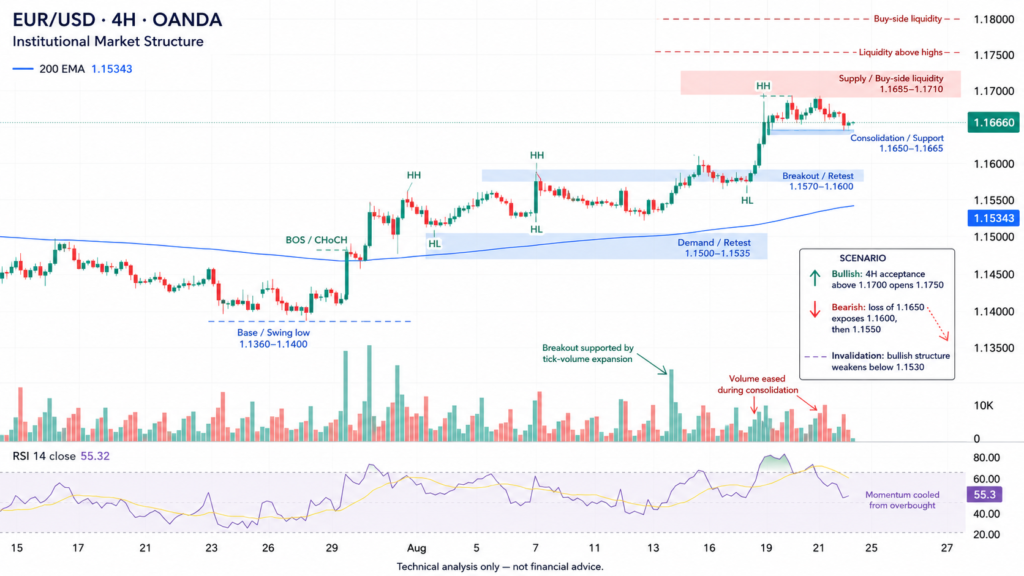
The 14-day Relative Strength Index sits near 73, in overbought territory, which raises the odds of a short-term pullback even as the broader trend stays constructive. Resistance sits first at 1.1705, the Bollinger upper band; a close above it would open the way toward fresh multi-month highs. Support builds at 1.1575, the 100-day SMA, then 1.1558, the 20-day Bollinger midline, with a deeper floor near 1.1415, the lower Bollinger band.
Conclusion
EUR/USD enters the week caught between two forces pulling in opposite directions: a US Treasury actively working to weaken the dollar’s yield advantage, and a geopolitical standoff that could just as quickly send investors back into it. Bessent’s Monday briefing sets the immediate tone, but Warsh’s Friday remarks carry more weight for where rates, and the dollar, head next. Until then, the overbought RSI reading argues for some caution near 1.1700, even as the broader structure keeps the path of least resistance tilted higher.
Sources & Methodology
Primary-source standard: Market-moving facts should link to original data releases, regulator notices, company filings or official project announcements whenever available. Secondary reporting is used for additional context, not as a substitute for original evidence.
Page last reviewed: