
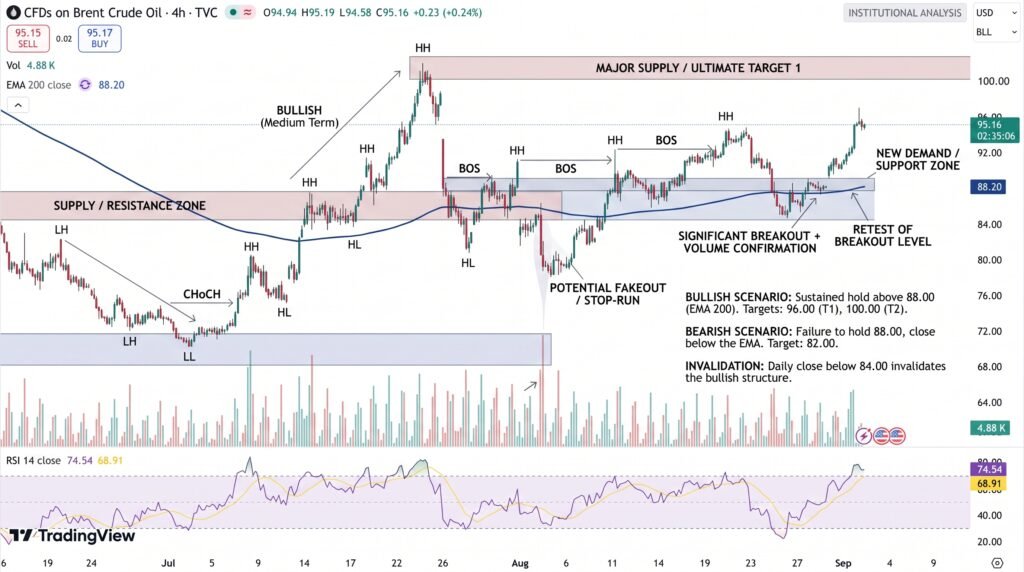
Oil prices extended their advance Wednesday after fresh U.S.-Iran strikes increased concerns about crude shipments through the Strait of Hormuz. Brent crude futures rose $1.03, or 1.1%, to $95.68 a barrel by 0605 GMT, while U.S. West Texas Intermediate futures gained 61 cents, or 0.7%, to $90.83. Both benchmarks had jumped more than $4 on Tuesday, with Brent posting its strongest daily gain since July 24 and WTI its biggest since July 23.
US-Iran Strikes Push Oil Higher
The latest gains followed a new exchange of military strikes between Washington and Tehran. The United States said it carried out overnight attacks on Iranian targets, while Iran responded with missile and drone attacks against U.S.-linked positions in the region. Jordan said its air defenses intercepted 10 of 13 ballistic missiles that entered its airspace, while Bahrain reported intercepting drones. Reuters reported that U.S. officials said there were no American casualties from the attacks at that point.
The escalation has shifted traders’ attention toward the physical oil market. Two tankers departing the Strait of Hormuz were attacked on Monday, adding to concerns about shipping security and the availability of alternative crude supplies.
Brent’s Tuesday settlement at $94.65 represented a $4.16, or 4.6%, gain. WTI settled at $90.22 after rising $4.46, or 5.2%. Both contracts closed at their highest levels since late July.
For the market, the key prices are:
- Brent: $95.68 a barrel
- WTI: $90.83 a barrel
- Brent Tuesday gain: 4.6%
- WTI Tuesday gain: 5.2%
Hormuz Becomes Central Oil Risk
The Strait of Hormuz remains the central supply concern. The International Energy Agency says an average of about 20 million barrels per day of crude oil and oil products moved through the strait in 2025, equal to roughly 25% of global seaborne oil trade. The waterway has limited alternatives, making sustained disruption a major risk for international energy markets.
However, current flows are already far below pre-conflict levels. The U.S. Energy Information Administration estimates that crude oil and petroleum liquids transported through Hormuz averaged only 4.9 million barrels per day in the second quarter of 2026, compared with 21.6 million barrels per day in the fourth quarter of 2025 before the conflict began.
That decline means further disruption could tighten an already constrained supply route. Higher shipping costs, longer voyages and the need to source crude from alternative producers could increase the cost of supplying refineries in Asia and other major consuming regions.
The market is therefore pricing a broader risk than the possibility of additional military action. Traders are assessing how long the disruption could last and whether normal tanker traffic can resume.
US Oil Inventories Add Price Support
U.S. inventory data are providing another source of support for crude prices. Market sources citing the American Petroleum Institute reported that U.S. crude inventories fell by 2.6 million barrels in the week ended August 28. Distillate stocks, which include diesel and heating oil, declined by 265,000 barrels.
The inventory decline matters because tighter domestic stockpiles can reinforce concerns about available supply when geopolitical risks are already elevated. However, API figures are preliminary industry data; traders will also watch the U.S. Energy Information Administration’s official inventory report for confirmation.
The immediate direction of oil prices will depend on developments around Hormuz, further military action and evidence of whether tanker traffic can normalize. Brent above $95 and WTI above $90 show that supply concerns have already produced a significant risk premium.
If the conflict expands or shipping restrictions intensify, crude prices could move higher and add to inflation pressures worldwide. Conversely, a credible reduction in hostilities and a sustained return of tanker traffic could remove part of the premium now embedded in oil prices.
Sources & Methodology
Primary-source standard: Market-moving facts should link to original data releases, regulator notices, company filings or official project announcements whenever available. Secondary reporting is used for additional context, not as a substitute for original evidence.
Page last reviewed: