
British stocks slipped Monday as an intensifying U.S.-Iran confrontation in the Persian Gulf and Strait of Hormuz stoked fears of prolonged oil-supply disruption. The FTSE 100 fell 0.13% as of 07:25 GMT, Germany’s DAX was down 0.13%, and France’s CAC 40 eased 0.07%. Sterling firmed against the dollar, with GBP/USD up 0.077% at 1.3525. Brent crude rose 0.95% to $97.19 a barrel, while WTI gained 0.66% to $92.09.
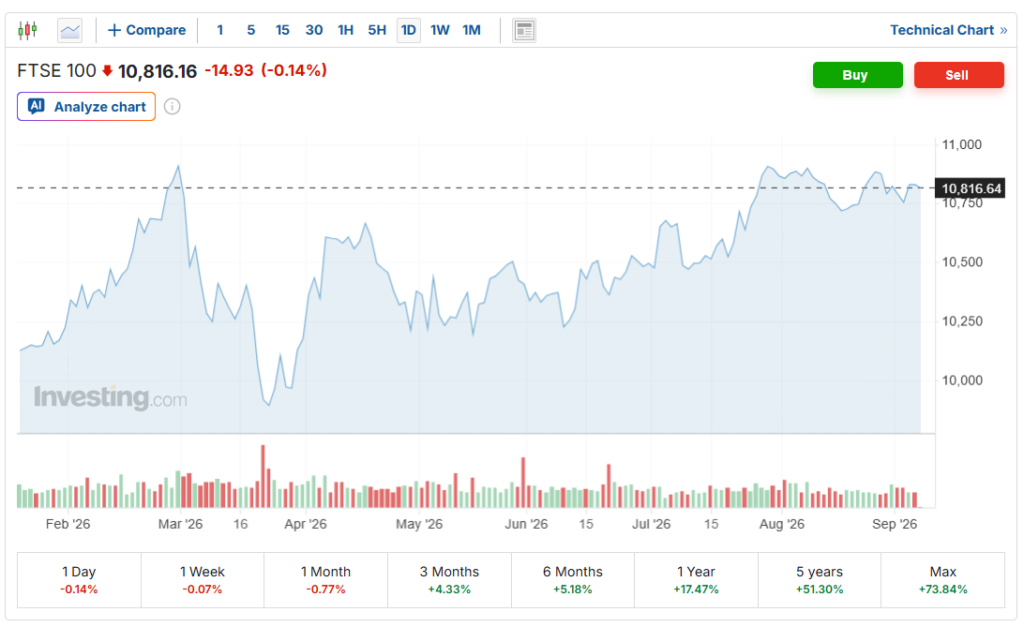
Source: investing.com
Iran Sinks Tanker, Oil Jumps
U.S. Central Command released footage showing the Iranian tanker M/T Kylo, also known as the “Noxen,” sinking in the Gulf of Oman after U.S. strikes, part of a wider operation that also disabled the M/T Downy near Kharg Island and M/T Stark 1 near Jask. CENTCOM said the strikes followed Islamic Revolutionary Guard Corps missile launches at two U.S. Navy vessels, both evaded without American casualties. Iran plans to announce a new restricted zone in the Gulf and approve maps for a shipping corridor through the Strait of Hormuz, warning it will only keep the waterway open if the U.S. ends attacks and threats against Iran. War Secretary Pete Hegseth said, “If Iran shoots at U.S. ships, we will destroy and sink their oil tankers,” while CENTCOM commander Adm. Brad Cooper warned Iran would face “an even higher economic cost” for further attacks. Iran’s Foreign Ministry called the strikes a “war crime” and a breach of the UN Charter.
Fed Odds and ECB Loom Large
ING commodities strategists said Monday that “the oil market remains well-supported with little sign of a peace between the US and Iran,” warning Iran’s planned restricted zone “could put additional vessels in the Gulf of Oman at risk.” Despite the escalation, oil continues to flow, with the U.S. energy secretary citing throughput of “a little more than 9m b/d” through Hormuz under Navy escort, while speculators lifted their net long position in ICE Brent by 37,837 lots to 261,435 as of last Tuesday. Jefferies’ Mohit Kumar said rates rose and risk assets weakened Friday after U.S. payrolls beat expectations, pushing September Fed hike odds to near 60%, and flagged this week’s U.S. CPI print and Wednesday’s ECB decision as the next catalysts alongside continued Gulf risk. Britain’s Energy Secretary Ed Miliband discussed de-escalation by phone with Saudi Foreign Minister Prince Faisal bin Farhan, according to the Saudi foreign ministry:
- Jefferies has “stayed away from long end rates since July,” citing no easy resolution to the U.S.-Iran conflict
- Speculative net-long positioning in Brent crude rose to one of its highest levels in recent weeks
UK Housing and Corporate News
Lloyds house price data showed British house prices fell 0.4% year-on-year in August, the first annual decline since November 2023 and well below economists’ forecast for a 0.2% rise; prices also fell 0.2% month-on-month against expectations for a 0.1% gain. In corporate news, TotalEnergies moved its Papua LNG project closer to a final investment decision after cutting capital spending to around $14 billion through contract rebidding, finalizing an amended gas agreement with Papua New Guinea and forming an LNG marketing joint venture with Kumul Petroleum. IQE swung to a first-half adjusted core profit of £6 million on strong demand from AI infrastructure, data center and defense customers, reiterating its full-year forecast. Waterland is preparing an offer for Gamma Communications exceeding Epiris’ £1.08 billion bid, according to the Sunday Times, after Gamma agreed last week to a 1,120-pence-per-share Epiris offer. Standard Life reported better-than-expected first-half profit on new business growth and steady demand for pension risk transfer deals.
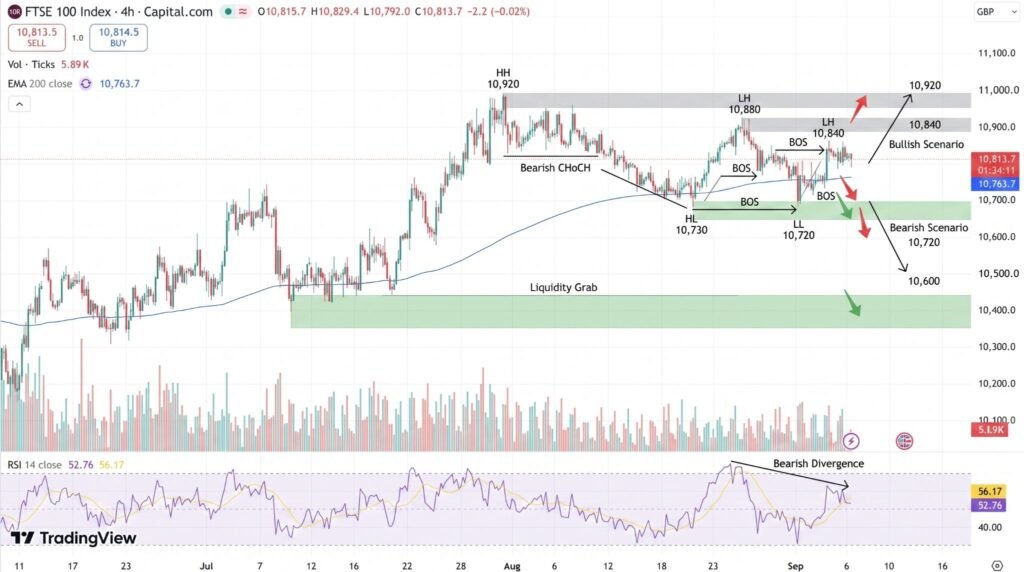
FTSE 100 Price Chart – Source: Tradingview
Conclusion
Monday’s modest 0.13% FTSE decline understates how much is genuinely unresolved: a shooting war in the Gulf that has now claimed a tanker outright, oil prices climbing toward $98 with speculators adding to bullish bets, and a Fed decision complicated by Friday’s strong jobs data arriving in the same week as an ECB meeting. None of the individual UK corporate stories — a housing market posting its first annual price decline in nearly three years, a takeover battle over Gamma Communications, or steady profit at Standard Life — carries the same weight as the Gulf conflict, which remains the single variable capable of overriding all of them if oil supply disruption becomes more than a risk premium.
Sources & Methodology
Primary-source standard: Market-moving facts should link to original data releases, regulator notices, company filings or official project announcements whenever available. Secondary reporting is used for additional context, not as a substitute for original evidence.
Page last reviewed: