Key Points
- XRP is trading around $1.38–$1.40 as investors prepare for the Senate’s September 15 CLARITY Act vote.
- President Donald Trump has accepted most of a bipartisan ethics proposal, removing a major negotiating obstacle without guaranteeing enough votes for the bill.
- XRP ETF demand remains supportive, while $1.35 and $1.43 are emerging as important short-term price levels.
XRP is trading around $1.38–$1.40 ahead of a major test for U.S. cryptocurrency policy. The Senate is scheduled to hold a procedural vote on the CLARITY Act on September 15, putting digital-asset regulation back at the center of market attention. President Donald Trump’s acceptance of most of a bipartisan ethics compromise has improved negotiations, but lawmakers still need enough cross-party support to reach the 60-vote threshold. XRP has responded positively alongside the broader crypto market, although regulatory developments will compete with Federal Reserve policy and inflation concerns for traders’ attention this week.
Trump Compromise Changes CLARITY Debate
The most important development is not that the CLARITY Act is assured of passage—it is not—but that one of the largest political barriers has been reduced. According to Associated Press reporting, Trump agreed to key components of an ethics package negotiated by Republican Senator Thom Tillis and Democratic Senator Ruben Gallego.
The compromise includes stronger restrictions on crypto-related conflicts of interest. Among the proposals are mechanisms that could require officials with substantial digital-asset interests to divest those holdings or place them into a blind trust. It would also give state attorneys general additional authority to enforce parts of the legislation.
Trump reportedly accepted roughly 80% of the bipartisan proposal. That represents meaningful progress because ethics rules surrounding politicians’ cryptocurrency interests had become a major source of opposition. However, the agreement does not guarantee passage. AP reported that questions remain over whether the concessions will attract enough senators to advance the legislation.
Senate Still Faces a 60-Vote Test
The next major event comes September 15, when the Senate is expected to hold its key procedural vote. Reuters reported that cryptocurrency companies and banking groups have intensified lobbying ahead of the vote as disagreements continue over stablecoins, banking competition, anti-money-laundering protections and other provisions.
The legislation needs 60 votes to clear the procedural hurdle, meaning Republican support alone is insufficient. The revised legislation has attempted to address those concerns. Recent reporting indicates that Republicans incorporated more than 100 provisions sought by Democrats, including changes involving decentralized finance and other regulatory issues.
The bill’s broader objective is to establish clearer federal rules governing digital assets and determine how oversight responsibilities are divided between agencies including the SEC and CFTC.
That regulatory distinction is particularly relevant for assets such as XRP because uncertainty over whether digital tokens fall under securities or commodities rules has shaped the U.S. crypto industry for years.
XRP ETF Demand Provides Separate Support
XRP also has a fundamental catalyst outside Washington: continued demand through regulated investment products. Recent market data show that U.S. XRP ETFs have continued recording positive flows. SoSoValue reported another approximately $7.69 million of net XRP ETF inflows in its latest available daily reading.
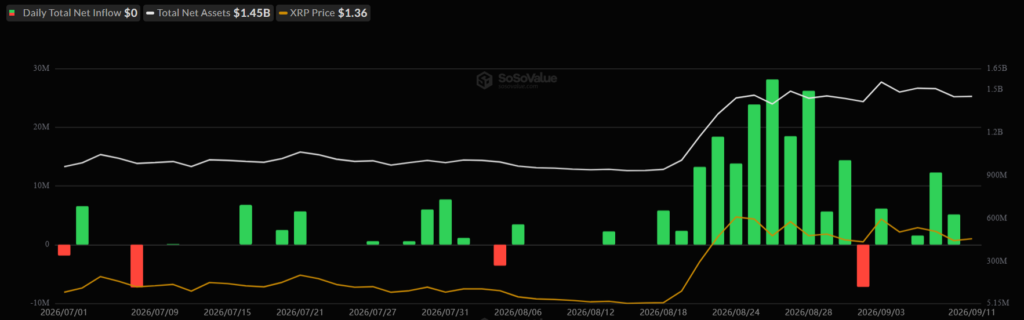
Earlier flows were also positive, reinforcing evidence that institutional exposure has continued despite volatility in XRP’s spot price. This is important because ETF flows and the CLARITY Act represent two different drivers. The legislation concerns the regulatory structure surrounding U.S. digital assets, while ETF flows provide a more direct measure of capital entering XRP investment products. Investors should therefore avoid treating every XRP move as a reaction to Washington.
XRP Tests $1.38–$1.43 Resistance
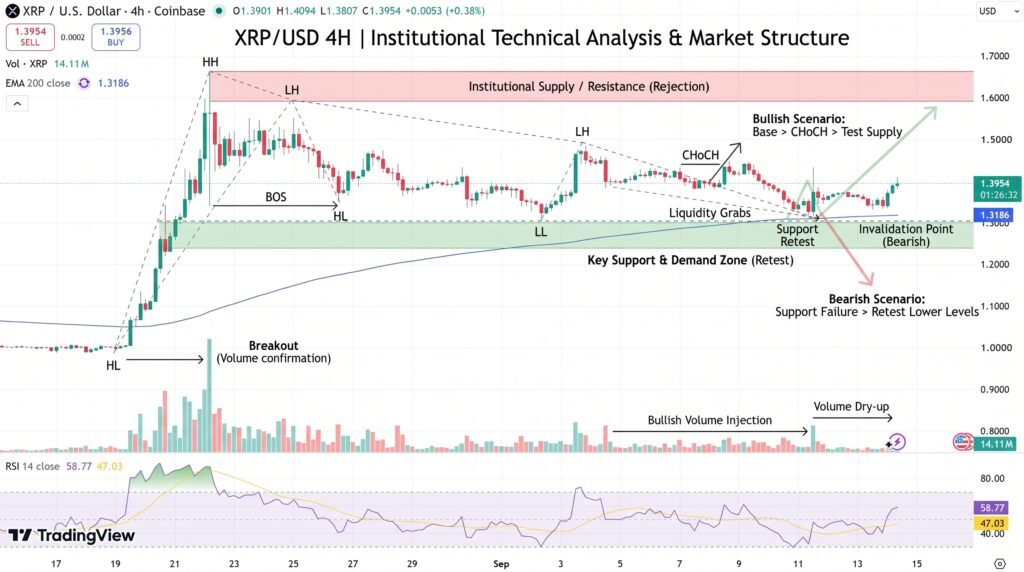
XRP has recently traded around $1.38–$1.40, recovering alongside Bitcoin and other major cryptocurrencies. The immediate technical structure has improved, but XRP still needs confirmation. The $1.35–$1.37 region is the first area buyers need to defend. Holding above it would preserve the recent recovery structure and keep attention on approximately $1.42–$1.43.
A convincing breakout above $1.43 would provide stronger evidence that buyers are taking control and could shift attention toward $1.50, followed by the more significant $1.60 psychological level. The bearish scenario begins to strengthen if XRP falls back below $1.35. A deeper break beneath roughly $1.31 would undermine the current recovery and indicate that the recent advance was unable to establish durable support.
Traders should also account for the broader macro backdrop. Reuters notes that crypto markets face both the congressional vote and a major Federal Reserve decision, with elevated inflation creating uncertainty over interest rates and liquidity conditions.
Conclusion
XRP enters the September 15 Senate vote with a stronger regulatory backdrop, but the outcome remains uncertain. Trump’s acceptance of most of the bipartisan ethics proposal removes an important negotiating obstacle, yet 60 Senate votes are still required to advance the CLARITY Act. Investors should therefore distinguish between improving political conditions and confirmed legislative approval. At the same time, continuing XRP ETF inflows provide support that is independent of the Senate negotiations.
For price action, $1.35–$1.37 is the immediate support zone and $1.42–$1.43 is the next major test. Breaking the upper range could put $1.50 and eventually $1.60 into focus. Losing $1.35 would weaken that scenario and shift attention back toward $1.31. The September 15 vote could produce significant volatility, but XRP’s next sustained move will ultimately depend on both regulatory progress and whether buyers can convert the recent recovery into a confirmed technical breakout.
Sources & Methodology
Primary-source standard: Market-moving facts should link to original data releases, regulator notices, company filings or official project announcements whenever available. Secondary reporting is used for additional context, not as a substitute for original evidence.
Page last reviewed: