
Silver is testing a critical $63.08 support level as persistent selling pressure pushes XAG/USD toward the lower end of its recent range. The five-hour chart shows price around $63.55 in the supplied setup, leaving the market only modestly above the 50% Fibonacci retracement. A decisive break could accelerate the correction, while a strong rebound would signal that buyers are defending the broader uptrend.
Latest spot data put silver near $63.35 on September 15, after the metal fell 1.21% on September 14. The market remains volatile as investors reassess the outlook for U.S. interest rates ahead of the Federal Reserve decision.
$63.08 Becomes the Key Test
The $63.08 Fibonacci level is now the central technical battleground. It has acted as support several times in the supplied five-hour structure, but repeated tests can weaken a level if buyers fail to generate a sustained rebound.
Silver remains below its key short-term moving averages, while the supplied chart shows the SuperTrend sell signal around $66.41. That configuration keeps the immediate trend tilted toward sellers.
Momentum also remains weak. The Relative Strength Index (RSI) near 38.28 is approaching oversold territory but has not yet reached the conventional 30 threshold. That means selling pressure remains significant, although the risk of a short-term relief bounce is increasing.
The Money Flow Index presents a more mixed signal, with signs of improving buying pressure despite the decline. That divergence is worth watching because it could indicate that sellers are losing some force even while price remains under pressure.
The important levels are:
- Primary support: $63.08
- Next downside target: $61.18
- Major resistance: $64.99
- Recovery zone: $65.00–$65.87
Fed, Oil Keep Silver Under Pressure
Silver’s technical weakness is developing against a difficult macro backdrop. The Federal Reserve is widely expected to raise its policy rate by 25 basis points at the September 15–16 meeting after August inflation data strengthened the case for tighter policy. A Reuters poll found 85% of economists expected the move, while futures markets have priced an even higher probability.
Higher interest rates and rising bond yields can pressure silver because the metal does not generate interest income. The opportunity cost of holding bullion increases when government bonds offer higher yields.
That pressure has intensified as energy prices have climbed. Brent crude recently traded around $107.55, while WTI reached roughly $103.27, after attacks on Saudi energy infrastructure threatened about 4 million barrels per day of pipeline capacity.
The U.S. 10-year Treasury yield also reached roughly 5.03%, its highest level since 2007, reinforcing the broader pressure on precious metals.
Breakdown or Rebound Will Decide Trend
A five-hour close below $63.08 would be the clearest bearish signal. Such a move would expose the next Fibonacci and structural support near $61.18, with the possibility of a deeper decline toward the $59 area if selling volume expands.
For bulls, the first objective is to reclaim $64.99, the 38.2% Fibonacci retracement in the supplied setup. A stronger recovery above $65.00 would bring the Ichimoku cloud and moving-average resistance back into focus.
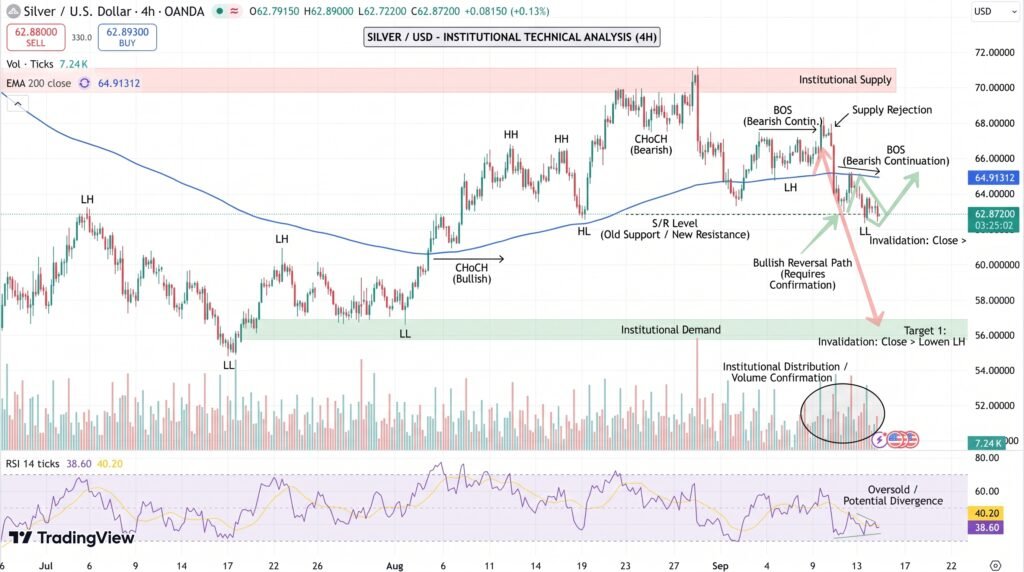
The bearish structure would only begin to weaken meaningfully if silver can recover those resistance zones while momentum improves. Until then, rallies are more likely to be treated as corrective moves rather than evidence of a confirmed reversal.
Conclusion
Silver is approaching a decisive test at $63.08, where Fibonacci support could determine the next major move. Persistent selling, weak momentum and elevated Treasury yields favor bears, while the RSI approaching oversold territory and improving money-flow signals leave room for a sharp technical rebound. A confirmed break below $63.08 would expose $61.18 and potentially $59.00. Conversely, reclaiming $64.99–$65.00 would give buyers their first meaningful opportunity to challenge the bearish structure.
Sources & Methodology
Primary-source standard: Market-moving facts should link to original data releases, regulator notices, company filings or official project announcements whenever available. Secondary reporting is used for additional context, not as a substitute for original evidence.
Page last reviewed: