
Pump.fun has become one of the most important venues for launching and trading memecoins on Solana, turning token creation into a low-cost process that can take seconds. The platform has also built a substantial fee-generating business, with its own dashboard showing annualized revenue of roughly $468 million. But the economics of the platform do not automatically translate into value for its PUMP token, which faces competing forces from buybacks, burns, new token unlocks and ongoing litigation.
How Pump.fun Generates Revenue
Pump.fun allows users to create tokens through a bonding-curve system rather than relying on a traditional order book. The curve automatically adjusts a token’s price as buying and selling activity changes, allowing new projects to begin trading without conventional market-making infrastructure.
Tokens that reach the platform’s graduation threshold can transition into a broader trading environment through PumpSwap, Pump.fun’s decentralized exchange. This model creates revenue from transaction activity rather than requiring individual tokens to succeed over the long term.
The platform’s revenue has historically been highly dependent on speculative memecoin trading. That makes the business financially significant but also cyclical because transaction fees rise and fall with market participation.
- Annualized revenue: About $468 million, according to the platform’s disclosure
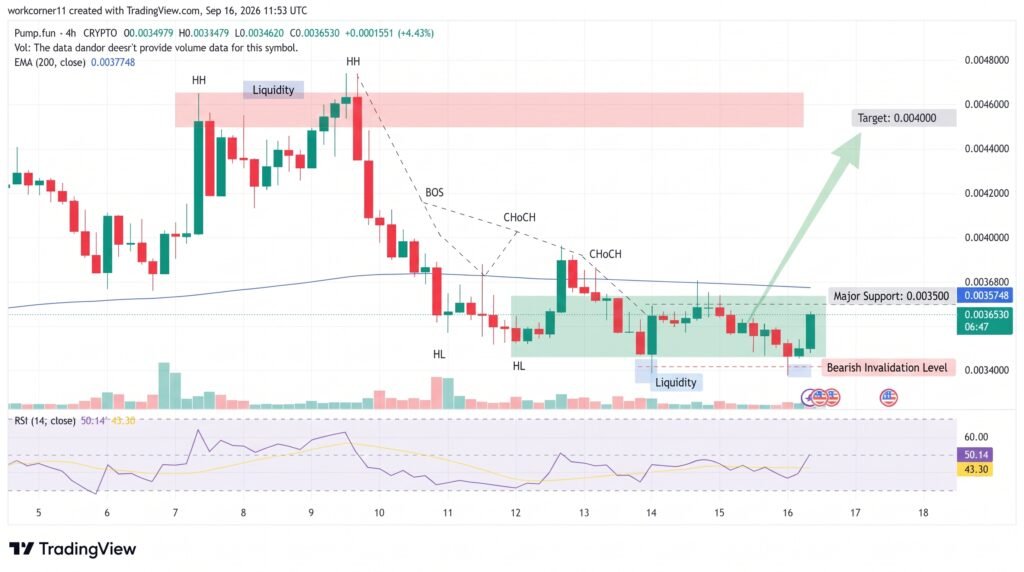
- PUMP launch price: $0.004
- 2026 token burn: About $370 million
- Supply removed: Roughly 36% of circulating PUMP
Pump.fun surpassed $1 billion in cumulative revenue across its ecosystem by April 2026, according to data cited by The Block.
Buybacks Meet a Growing Token Supply
The connection between Pump.fun’s business revenue and PUMP is indirect. PUMP holders do not have a contractual claim on platform revenue. Instead, the economic link comes through the company’s discretionary buyback-and-burn program.
In April, Pump.fun permanently burned approximately $370 million worth of previously repurchased PUMP, equivalent to about 36% of circulating supply. The company then changed its policy, committing 50% of net revenue from its bonding curve, PumpSwap and Terminal to an automated buyback-and-burn program for one year.
That supply reduction has to be viewed alongside token unlocks. In July, Pump.fun distributed about 57.3 billion PUMP tokens to 121 team and investor wallets, valued at roughly $86.5 million at the time. Another 82.5 billion tokens had been released earlier that month, bringing the combined July unlock to about 140 billion tokens within days.
The result is a direct tension between two token-supply forces: buybacks and burns remove tokens, while vesting releases increase the amount potentially available to the market.
Lawsuit Adds a Separate Risk
Pump.fun is also facing a major legal challenge in the U.S. District Court for the Southern District of New York. In Aguilar v. Baton Corporation, plaintiffs allege that Pump.fun facilitated an operation involving unregistered securities and other misconduct and estimate that retail traders collectively lost between $4 billion and $5.5 billion trading Pump.fun tokens. Those are allegations, not established findings.
The legal picture changed materially on August 31, 2026. Judge Colleen McMahon dismissed the securities claims but allowed substantive RICO and RICO-conspiracy claims by two plaintiffs against Baton Corporation and Pump.fun’s three founders to proceed. The claims against the Solana defendants were dismissed, while the court also dismissed the plaintiffs’ unjust-enrichment claims.
That means the case is no longer simply a question of whether certain Pump.fun tokens qualified as securities. At least some racketeering allegations remain active against the platform’s operator and founders.
Conclusion:
Pump.fun combines substantial platform activity with significant legal and tokenomic uncertainty. Its revenue demonstrates that the launchpad can generate meaningful fees when Solana memecoin activity is strong, while the $370 million burn shows how aggressively the company has used token supply management. At the same time, large unlocks can increase available supply, and the Aguilar litigation remains an important risk after federal claims were allowed to proceed.
Sources & Methodology
Primary-source standard: Market-moving facts should link to original data releases, regulator notices, company filings or official project announcements whenever available. Secondary reporting is used for additional context, not as a substitute for original evidence.
Page last reviewed: