
Cardano (ADA) is extending its recovery after rising about 12% last week, with the token trading near $0.23 on September 21. Market attention is focused on two developments: the Cardano Foundation joining Mastercard’s Crypto Partner Program and new Leios testing that demonstrated roughly 1,000 simple transactions per second in a controlled environment. ADA is now approaching a major long-term moving-average barrier, leaving the next move dependent on whether buyers can convert the recent rebound into a sustained break above resistance.
Mastercard partnership supports sentiment
The Cardano Foundation joined the Mastercard Crypto Partner Program on September 15. Under the program’s Blockchains track, Cardano will engage with Mastercard and other participants on cross-border transfers, business-to-business transactions and settlement, including stablecoin-related applications.
The announcement gives Cardano a channel for discussions around established payment infrastructure, but the available information does not indicate that ADA itself has been added as a Mastercard payment asset. Mastercard says its program is designed to help blockchain networks develop scalable, compliant use cases across areas such as cross-border payments, B2B transactions and settlement.
The second catalyst is Cardano Leios, a protocol development project designed to increase transaction throughput while retaining Cardano’s proof-of-stake architecture. Recent testing demonstrated roughly 1,000 simple transactions per second in a local simulated environment. The result is a development milestone, not current mainnet capacity.
- Leios uses parallel processing through Endorser Blocks.
- Testing has targeted substantially higher throughput than the current network.
- Real-world performance will depend on network conditions and implementation.
ADA tests key technical resistance
ADA reached a recent high around $0.235 on September 19 before consolidating near $0.23. Historical market data shows the token closed at about $0.228 on September 20, after climbing from roughly $0.202 on September 17.
The technical structure remains constructive while ADA holds above its 50-day and 100-day EMAs near $0.2038 and $0.2029, respectively. The next major hurdle is the 200-day EMA, which the supplied technical setup places around $0.2401. A sustained move above that level would put the March 29 low near $0.2328 and the higher resistance zone back into focus.
Momentum indicators also support the recovery. The daily RSI is around 64, indicating stronger buying momentum without yet reaching the conventional 70 overbought threshold. Meanwhile, the MACD has moved above its signal line, with the histogram turning positive.
$0.2632 remains key upside barrier
For the recovery to develop into a broader technical advance, ADA needs to clear the $0.2401 area and then confront resistance near $0.2632. That zone combines a rising trendline with the 78.6% Fibonacci retracement of the move from $0.3136 to $0.1385.
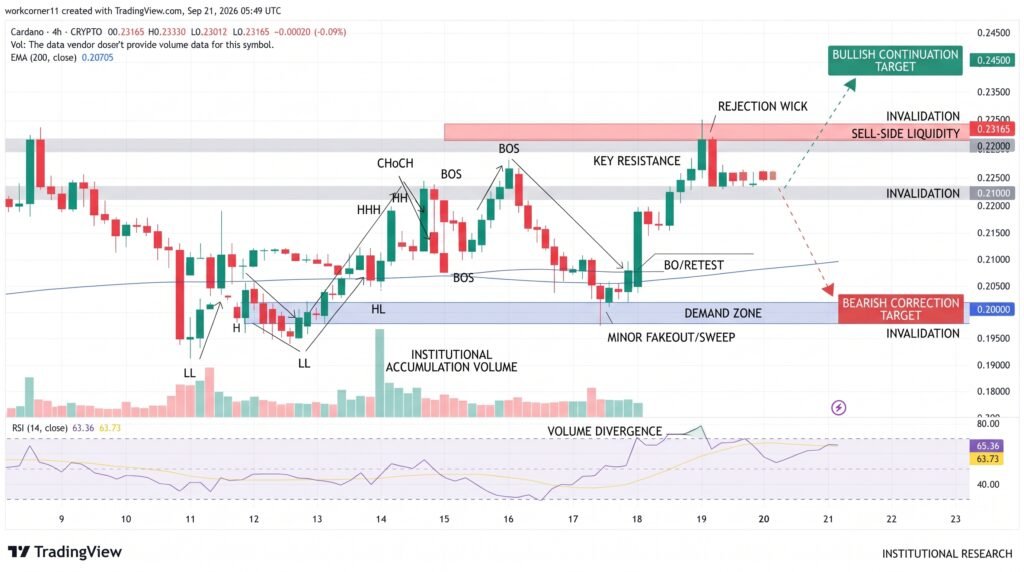
On the downside, the 50% Fibonacci retracement near $0.2084 provides the first major reference point. Below it, the $0.2038-$0.2029 EMA cluster becomes important for determining whether the recent recovery remains intact.
The combination of payment-industry engagement and Leios development has improved the fundamental narrative around Cardano, but neither development guarantees higher ADA prices. For now, price action around the $0.2401 200-day EMA and the $0.2632 resistance area provides the clearest test of whether the latest recovery can continue.
Cardano Outlook Remains Focused on $0.2401
Cardano’s recovery is being supported by renewed network-development activity and its participation in Mastercard’s Crypto Partner Program. However, the technical structure still requires confirmation above the 200-day EMA near $0.2401. A sustained break could shift attention toward the $0.2632 resistance zone, while a failure to hold the $0.2084 Fibonacci level would weaken the recovery structure. With RSI near 64 and MACD momentum improving, ADA remains at a key technical decision point as traders assess whether the latest gains can develop into a broader move.
Sources & Methodology
Primary-source standard: Market-moving facts should link to original data releases, regulator notices, company filings or official project announcements whenever available. Secondary reporting is used for additional context, not as a substitute for original evidence.
Page last reviewed: