
Bitcoin remained under pressure on Tuesday, trading near $60,000 after a weekend sell-off pushed the largest cryptocurrency to its lowest level in more than two years. The decline came despite a recovery in technology shares, highlighting the growing gap between demand for equities and digital assets. Persistent concerns about Federal Reserve interest-rate policy, U.S. regulation and institutional fund withdrawals continued to weigh on sentiment. Bitcoin’s latest losses have also erased the gains it recorded after Donald Trump’s November 2024 election victory.
Bitcoin struggles near $60,000
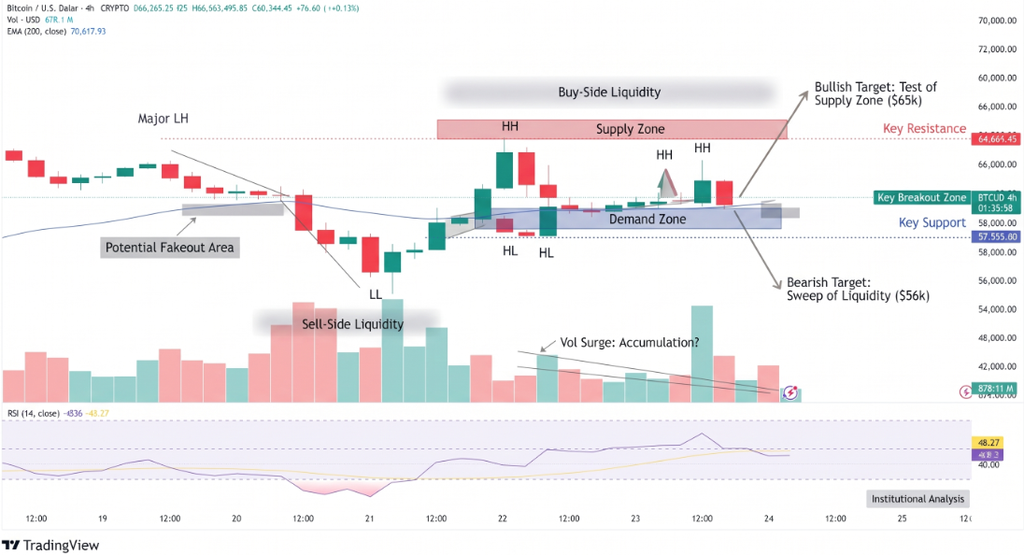
Bitcoin fell 1.7% to $60,435.30 by 01:03 ET (06:03 GMT) on Tuesday. The token had dropped below $60,000 over the weekend, reaching a 26-month low before recovering modestly on Monday.
The retreat marks a significant reversal from the optimism that followed Trump’s election in November 2024. His administration was widely expected to adopt a more supportive approach toward digital assets, helping fuel expectations of stronger institutional participation and a friendlier regulatory environment.
However, the market has struggled to sustain those gains. Investors have become increasingly concerned that the Federal Reserve could raise interest rates in December. Higher borrowing costs generally reduce the appeal of speculative investments by making cash and interest-bearing assets more attractive.
Regulatory uncertainty is another source of pressure. Democrats are expected to take control of Congress in 2027, potentially complicating efforts to advance crypto-friendly legislation. The political shift does not guarantee stricter rules, but it has added uncertainty to the sector’s outlook.
Meanwhile, technology stocks recovered after Nvidia reinstated Jensen Huang as chief executive. The equity rebound did little to support cryptocurrencies, suggesting that investors are directing capital toward assets they consider to have more established earnings and business fundamentals.
Bitcoin ETFs extend withdrawal streak
Institutional investment flows have provided another warning sign. U.S. spot Bitcoin exchange-traded funds (ETFs) recorded nearly $570 million in net outflows on Monday, according to the figures cited in the market report.
The withdrawal followed four consecutive weeks of ETF outflows that removed more than $4 billion from the products. Sustained redemptions can weaken demand for Bitcoin exposure, although ETF outflows do not necessarily translate into an equal amount of immediate spot-market selling.
Investor attention has also shifted toward other opportunities, including expectations surrounding Anthropic’s planned initial public offering. Competition for capital may be making it harder for crypto funds to attract fresh investment while market sentiment remains weak.
Key pressures facing Bitcoin include:
- Expectations of a possible December Fed rate increase.
- Continued withdrawals from spot Bitcoin ETFs.
- Uncertainty surrounding the future U.S. regulatory framework.
- Competition from equities and major technology-sector investments.
Altcoins remain under pressure
Most major cryptocurrencies traded lower or posted limited gains as investors found few reasons to increase exposure to the sector.
Ether, the second-largest cryptocurrency, declined 1.5% to $1,699.96. XRP gained 1.3%, while Solana slipped 0.6%.
Cardano advanced 1.7%, whereas BNB lost 0.8%. In the meme-token market, Dogecoin rose 1.7%, while the TRUMP token fell 2.7% to a record low, according to the supplied market figures.
Conclusion
Bitcoin’s recovery remains fragile as ETF withdrawals, interest-rate expectations and regulatory uncertainty constrain demand. A sustained improvement will likely require stronger institutional inflows and greater clarity on U.S. monetary and regulatory policy. Until those conditions improve, the $60,000 area remains an important psychological level for traders.
Sources & Methodology
Primary-source standard: Market-moving facts should link to original data releases, regulator notices, company filings or official project announcements whenever available. Secondary reporting is used for additional context, not as a substitute for original evidence.
Page last reviewed: