
Cardano struggled to sustain a recovery near $0.147 on Tuesday after falling to a new yearly low of $0.133 last week. Selling by large holders is adding pressure, with Santiment data indicating that whale wallets have reduced their combined holdings by 110 million ADA since Friday. Weak derivatives positioning and a bearish moving-average structure are also limiting the token’s recovery prospects, leaving $0.142 as an important near-term support level.
Cardano whales reduce ADA holdings
Supply Distribution data from Santiment points to declining exposure among Cardano’s largest holders. Wallets containing between 1 million and 10 million ADA and those holding between 10 million and 100 million ADA collectively reduced their balances by approximately 110 million tokens over the reported period.
The movement suggests that larger investors have been reducing their exposure while ADA trades close to its yearly lows. However, wallet-balance changes do not necessarily establish that all transferred tokens were sold on exchanges. Some assets may have moved between wallets or into other forms of custody.
Mid-sized holders, with balances between 100,000 and 1 million ADA, showed little change during the same period, according to the supplied data. Their lack of significant accumulation offers little evidence that this investor group is stepping in to offset selling by larger wallets.
For traders, the key issue is whether whale distribution continues. Persistent reductions in large-wallet balances could weaken confidence in a recovery, particularly if broader market demand remains subdued.
Derivatives signal bearish ADA sentiment
Cardano’s derivatives market also reflects caution. Data from CoinGlass showed an ADA long-to-short ratio of 0.77 on Tuesday. A reading below 1 indicates that short positions outweigh long positions within the metric’s measured accounts.
The funding rate stood at -0.014%. In perpetual futures markets, negative funding generally means short-position holders pay long-position holders. This can indicate stronger demand for bearish exposure, although funding rates can change quickly and do not guarantee further price declines.
Together, the figures suggest that derivatives traders remain defensive. If spot demand does not improve, this positioning could leave ADA vulnerable to additional selling. Conversely, a sharp price recovery could force some short sellers to close positions, potentially accelerating a temporary rebound.
ADA technical outlook points to resistance
ADA traded near $0.147, well below its 50-day, 100-day and 200-day exponential moving averages (EMAs). These indicators stood at $0.184, $0.196 and $0.226, respectively, forming a substantial resistance zone above the current price.
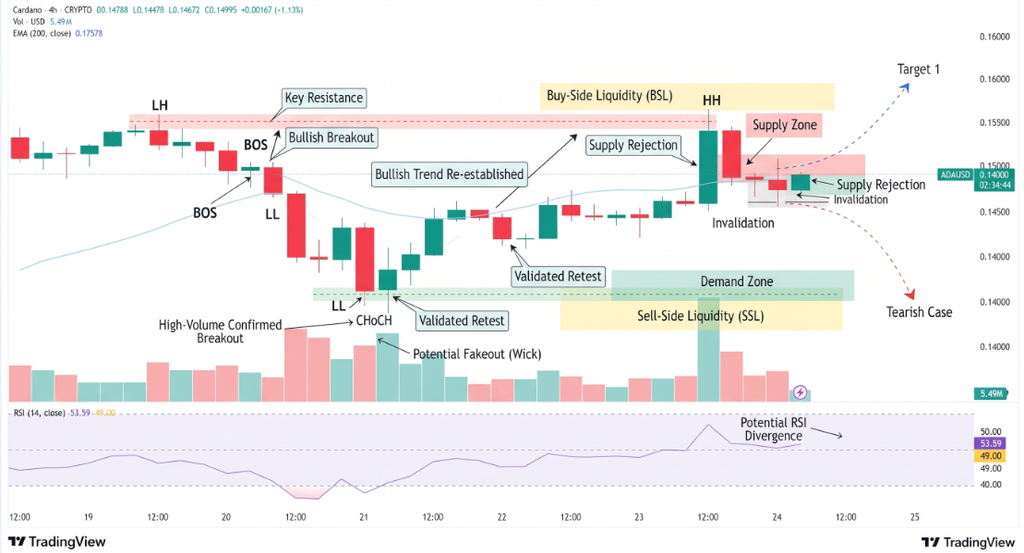
The Relative Strength Index (RSI) hovered around 30, indicating weak momentum near the conventional oversold threshold. Meanwhile, the MACD had turned marginally positive, offering an early sign that downside momentum may be easing. However, one improving indicator does not confirm a trend reversal.
Key technical levels include:
- $0.142: Immediate support; a sustained break could deepen losses.
- $0.184: First major resistance at the 50-day EMA.
- $0.196–$0.226: Higher resistance at the 100-day and 200-day EMAs.
- $0.236–$0.245: Additional horizontal resistance.
Conclusion
Cardano’s recovery remains fragile as large-wallet distribution and bearish derivatives positioning weigh on sentiment. A hold above $0.142 could provide a base for consolidation, but buyers would need to reclaim $0.184 to improve the short-term technical outlook. Until then, ADA remains exposed to renewed downside pressure.
Sources & Methodology
Primary-source standard: Market-moving facts should link to original data releases, regulator notices, company filings or official project announcements whenever available. Secondary reporting is used for additional context, not as a substitute for original evidence.
Page last reviewed: