
Dogecoin (DOGE) extended its recovery on Monday, trading around $0.089 after gaining roughly 6% over the previous week. The move follows a rebound from the $0.078 area reached in mid-September. Current market data shows DOGE trading above its 50-day and 100-day exponential moving averages, while the 200-day EMA near $0.093 remains a significant technical barrier. Recent Dogecoin market data also shows a neutral-to-positive momentum setup, with RSI near 57. The recovery is supported by renewed ETF activity and buying among some large wallet groups, although derivatives positioning remains mixed.
Dogecoin ETF Inflows Return
Interest in spot Dogecoin exchange-traded funds has improved after a period of muted activity. The latest report from FXStreet cited SoSoValue data showing $284,510 of net inflows into spot DOGE ETFs during the previous week. The figure is modest, but it marks a change from the weaker flow conditions reported in mid-September.
ETF flows can provide an additional source of demand because the products give investors exposure to DOGE without directly holding the cryptocurrency. However, one week of relatively small inflows does not establish a sustained institutional trend. Traders will need to watch whether positive flows continue and expand in subsequent sessions.
The latest flow data therefore provides a supporting signal rather than confirmation of a major change in market positioning.
- Weekly DOGE ETF inflow: $284,510
- Recent DOGE price: around $0.089
- Weekly gain: roughly 6%
Whale Activity Sends Mixed Signals
Large-wallet activity is also attracting attention. Data cited from Santiment indicates that some DOGE whale cohorts have increased their holdings, while another group has reduced its exposure. The distribution is important because movements by large holders can affect available supply and short-term market liquidity.
The reported data showed wallets holding between 10 million and 100 million DOGE and those holding between 100,000 and 1 million DOGE accumulating about 120 million tokens. At the same time, wallets holding between 1 million and 10 million DOGE reduced their holdings by about 90 million. The result is a mixed distribution pattern rather than a uniform accumulation trend.
Derivatives markets add another layer of caution. Recent analysis has pointed to sell-side pressure and uneven positioning, suggesting that whale activity alone has not produced a broad-based bullish signal.
DOGE Tests Key Technical Levels
DOGE’s chart has improved, but the recovery is approaching an important resistance zone. Current technical data places the 50-day EMA near $0.082 and the 100-day EMA around $0.083, leaving both below the current market price. The 200-day EMA, however, sits near $0.093 and remains above DOGE.
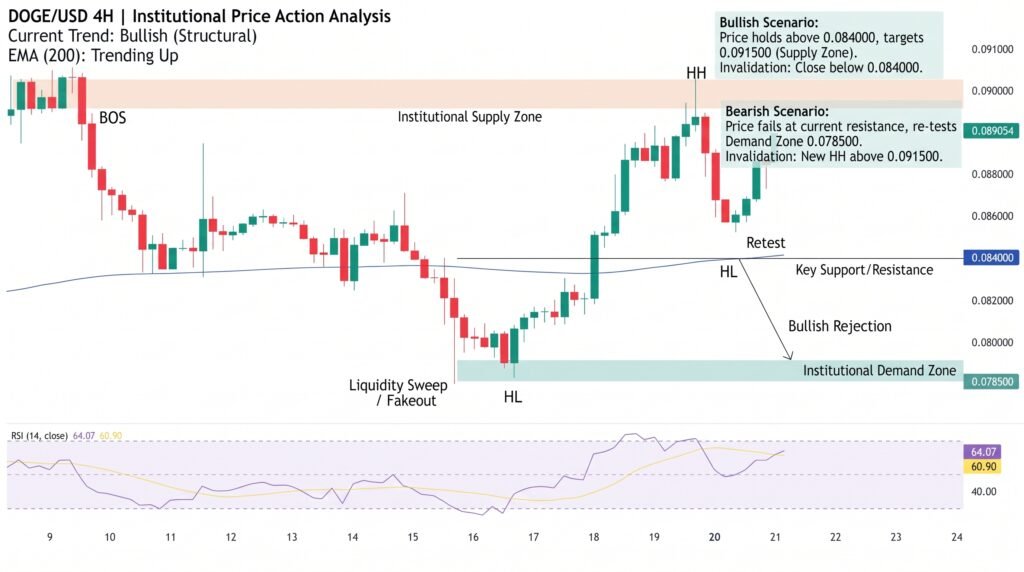
The Relative Strength Index is around 57, which indicates positive momentum without reaching the commonly watched 70 overbought threshold. The MACD is also marginally positive, although the signal remains relatively weak.
The key levels are:
- Resistance: $0.093, followed by about $0.102
- Near-term support: $0.082-$0.083
- Deeper support: around $0.070
A sustained move above $0.093 would place greater focus on the $0.102 area. Conversely, a break below the $0.082-$0.083 support zone would weaken the current recovery structure.
Conclusion
Dogecoin’s latest rebound combines improving price action with modest ETF inflows and selective whale accumulation. Those factors provide evidence of renewed market interest, but they do not yet establish a decisive trend. DOGE remains below its 200-day EMA near $0.093, making that level an important test for the recovery. Continued ETF inflows and sustained support above $0.082 could strengthen the technical setup, while a loss of that support would increase the risk of another pullback. For now, DOGE’s outlook remains dependent on whether buying demand can carry the token through its longer-term resistance.
Sources & Methodology
Primary-source standard: Market-moving facts should link to original data releases, regulator notices, company filings or official project announcements whenever available. Secondary reporting is used for additional context, not as a substitute for original evidence.
Page last reviewed: