
The EUR/USD pair trades near 1.1375 in early European trading Friday, remaining within Thursday’s range as the U.S. dollar extends its recent advance. The U.S. Dollar Index is holding close to its recent eight-week high near 101.40, supported by expectations that the Federal Reserve could raise interest rates again. The euro has its own policy support after the European Central Bank raised rates by 25 basis points earlier this month, but near-term price action remains tilted lower.
Dollar Strength Keeps EUR/USD Under Pressure
The dollar has gained momentum as investors reassess the path for U.S. monetary policy. The Fed raised its benchmark interest-rate target by 25 basis points on September 16, taking the federal funds range to 3.75%-4%. The central bank said economic activity was expanding at a solid pace while inflation remained elevated.
Recent comments from Fed officials have reinforced the possibility of additional tightening. Governor Michael Barr said on September 23 that further policy adjustments were likely to be needed if inflation does not return to the Fed’s 2% objective in a timely manner.
That policy outlook has supported the dollar because higher U.S. rates can increase the relative return available on dollar-denominated assets.
- DXY recent high: 101.40
- EUR/USD: around 1.1375
- Fed funds target: 3.75%-4.00%
- Fed rate increase in September: 25 basis points
ECB Policy Limits Euro Downside
The euro is not without fundamental support. The ECB raised its three key interest rates by 25 basis points on September 10, citing persistent inflation pressures linked partly to higher energy costs. Its deposit facility rate now stands at 2.50%.
The ECB expects euro-area headline inflation to average 3.0% in 2026 before easing to 2.5% in 2027 and 2.1% in 2028. The central bank also raised its 2026 growth forecast to 0.9%, reflecting stronger-than-expected economic resilience.
However, the interest-rate differential between the United States and euro area remains significant. That gap can continue to favor the dollar if markets expect the Fed to tighten policy further while the ECB provides less aggressive guidance.
1.1350 Is Critical for EUR/USD
Technically, EUR/USD is trading below its 20-period exponential moving average at approximately 1.1501, keeping the short-term structure bearish. The pair has declined steadily from its recent highs, while the 14-period Relative Strength Index is near 25.
An RSI below 30 indicates that selling pressure has pushed momentum into technically oversold territory. However, an oversold reading alone does not confirm a reversal and can remain depressed during a sustained downtrend.
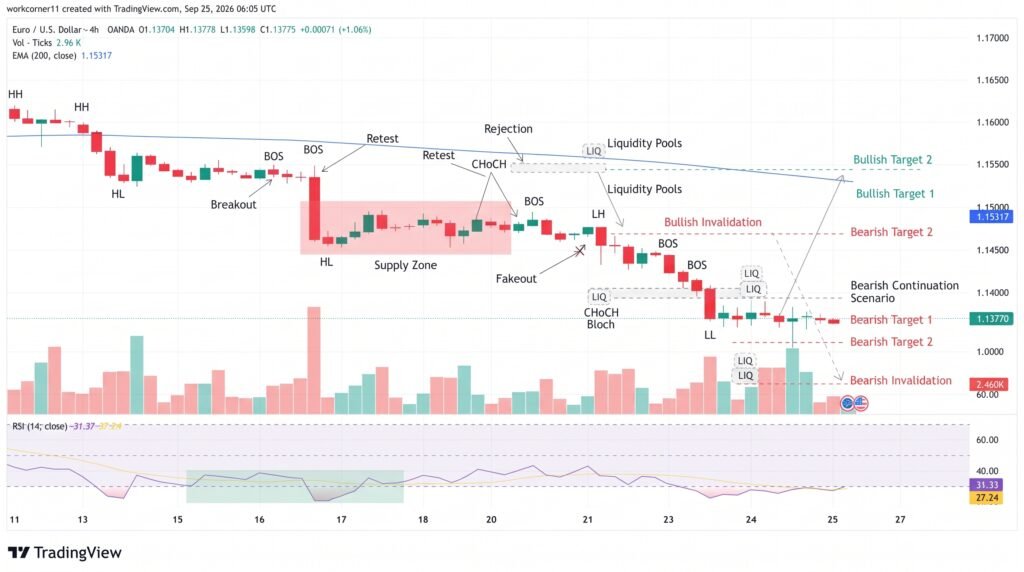
EUR/USD Price Chart – Source: Tradingview
The immediate technical levels are therefore closely watched
- Initial hurdle: 1.1400
- Key support: 1.1350
- Major upside barrier: 1.1501
A sustained break below 1.1350 could expose EUR/USD to another leg lower, while a recovery above 1.1400 would reduce immediate downside pressure. A move back above the 20-period EMA near 1.1501 would provide stronger evidence that the short-term bearish structure is losing momentum.
Conclusion
EUR/USD remains caught between a strengthening U.S. dollar and renewed ECB support for the euro. The Fed’s 3.75%-4% policy range and officials’ comments about further adjustments are keeping the dollar supported, while the ECB’s September rate increase provides a counterweight. For traders watching the chart, 1.1350 is the immediate downside level, while 1.1501 remains the key resistance zone. The pair’s next directional move will likely depend on shifts in Fed expectations, U.S. economic data and the euro-area inflation outlook.
Sources & Methodology
Primary-source standard: Market-moving facts should link to original data releases, regulator notices, company filings or official project announcements whenever available. Secondary reporting is used for additional context, not as a substitute for original evidence.
Page last reviewed: