
Silver traded around $60.76 on the five-hour chart, confined to a consolidation range between $58.73 and $62.45. The narrow trading band reflects a market struggling to establish a clear direction. Although the Moving Average Convergence Divergence (MACD) has edged above its signal line and price is holding slightly above the 20-period moving average, the broader technical picture remains cautious. A bearish SuperTrend indicator and a low Average Directional Index (ADX) reading suggest that traders may face further false breakouts before a sustained move develops.
Silver Price Stays Inside Rectangle
Silver remains trapped between established support and resistance, leaving both buyers and sellers without a confirmed advantage. The lower boundary at $58.73 marks the key downside threshold, while $62.45 caps the upper end of the range. Until either level gives way convincingly, the market may continue to move sideways.
The modest improvement in MACD offers a tentative sign that buying momentum is recovering. Trading above the 20-period moving average also suggests that short-term price action has stabilized. However, these signals are not sufficient to confirm a bullish reversal while the SuperTrend remains bearish and the wider trend structure continues to weigh on prices.
The ADX reading near 13 reinforces the lack of directional strength. ADX measures the intensity of a trend, not whether the market is moving higher or lower. Readings below 15 generally indicate weak momentum, making trend-following signals less reliable and increasing the possibility of prices reversing within the established range.
Key XAG/USD Breakout Levels
Silver traders are monitoring the rectangle’s boundaries for evidence that the current stalemate is ending. A decisive breakout or breakdown, supported by stronger volume, would offer more meaningful confirmation than an isolated move beyond resistance or support.
The key levels to watch are:
- Current price: $60.76 on the five-hour chart.
- Major resistance: $62.45, the upper boundary of the range.
- Major support: $58.73, the lower boundary.
- Short-term caution zone: $59.50–$61.66, where price fluctuations may generate misleading signals.
- Momentum confirmation: Stronger ADX readings and expanding volume could help validate a directional move.
A sustained close above $62.45, accompanied by stronger trading volume, would improve the bullish outlook and suggest that buyers are gaining control. A decisive break below $58.73 would instead strengthen the bearish case and expose silver to further downside. These levels are technical reference points, not guaranteed turning points.
Low Momentum Raises Whipsaw Risk
The reported average true range (ATR) is around 1.11%, while trading volume is declining. ATR measures price volatility rather than market direction, so a relatively low reading suggests smaller typical price movements, not necessarily that a breakout is imminent.
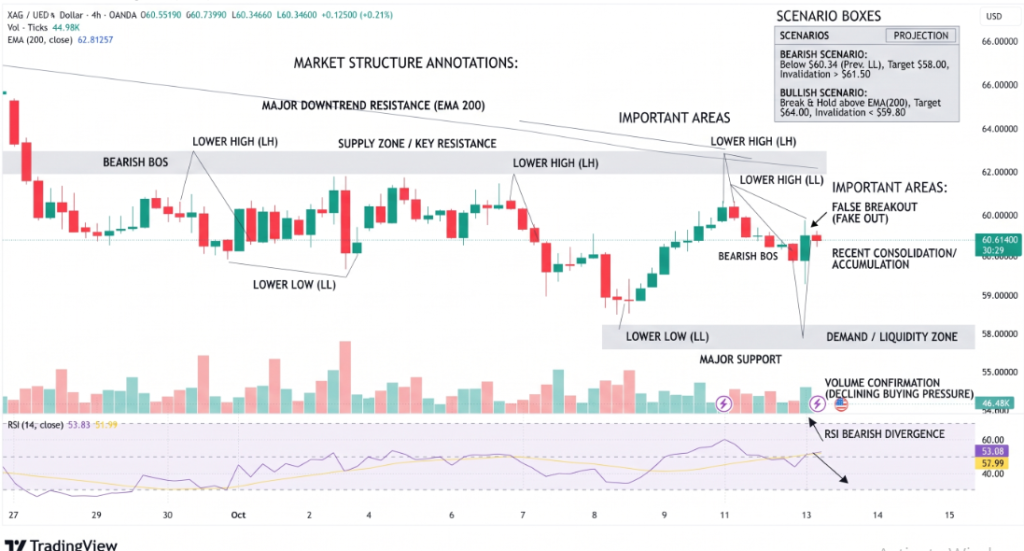
The $60.50–$61.50 area remains particularly vulnerable to short-lived price swings. Traders entering positions in the middle of the rectangle may face repeated reversals without a clear trend to support their decisions. Waiting for a confirmed move beyond the range can reduce exposure to some false signals, although it cannot eliminate trading risk.
Risk management remains important if a breakout develops. Traders can define invalidation levels in advance, size positions conservatively and consider stop-loss orders around their chosen technical thresholds.
Conclusion
Silver remains range-bound at $60.76, with $58.73 support and $62.45 resistance defining its immediate outlook. MACD suggests a modest improvement in momentum, but the bearish SuperTrend and ADX near 13 offer little evidence of a sustained trend. A volume-backed breakout above resistance or a breakdown below support would provide a clearer directional signal. Until then, the market favors patience over aggressive positioning.
Sources & Methodology
Primary-source standard: Market-moving facts should link to original data releases, regulator notices, company filings or official project announcements whenever available. Secondary reporting is used for additional context, not as a substitute for original evidence.
Page last reviewed: