
The EUR/USD pair traded near 1.1226 on Friday, with the euro heading toward its first weekly gain in more than a month as falling US Treasury yields and cautious comments from Federal Reserve Chair Kevin Warsh weighed on the dollar. However, the pair has struggled to break resistance at 1.1240 ahead of the final September Eurozone inflation report. The data could influence expectations for the European Central Bank (ECB) and determine whether the euro can extend its recovery or resume its broader decline.
Eurozone Inflation Puts Euro in Focus
Eurostat’s preliminary estimate showed annual Eurozone inflation rising to 3.8% in September from 3.2% in August, largely reflecting a sharp increase in energy prices. Core inflation, which excludes energy, food, alcohol and tobacco, edged up to 2.5% from 2.4%. The final September figures are scheduled for release on October 16.
The distinction between headline and core inflation matters for monetary policy. Higher energy costs can lift overall inflation quickly, while core inflation helps policymakers assess underlying price pressures. If the final data confirms persistent inflation, markets may reassess the ECB’s policy outlook. A softer reading, by contrast, could reduce support for the euro.
The dollar has weakened despite strong US price data. September US producer prices rose 1.3% month over month, while annual producer-price inflation reached 6.3%, according to reports published this week. These figures could reinforce concerns about inflation even as lower bond yields have recently weighed on the dollar
At the IMF and World Bank meetings in Bangkok, Warsh reiterated the Federal Reserve’s commitment to price stability but declined to signal whether rates would rise again. The Fed’s September increase brought its target range to 3.75%–4.00%, leaving investors focused on upcoming decisions and economic releases.
EUR/USD Technical Levels to Watch
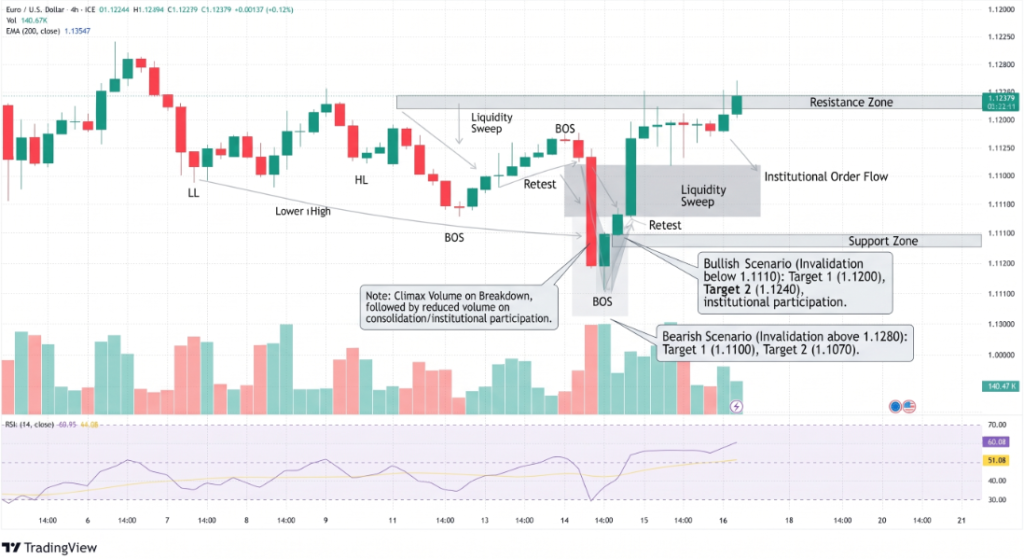
The pair’s rebound from 1.1113, a 17-month low recorded earlier in the week, suggests that buyers are attempting to establish a short-term base. On the four-hour chart, the Relative Strength Index (RSI) has moved above 50, while the Moving Average Convergence Divergence (MACD) remains above zero with a positive histogram. Both indicators point to improving momentum, although they do not yet confirm a sustained trend reversal.
Key levels for traders include:
- 1.1240: Immediate resistance and the first upside hurdle.
- 1.1290: October 2 high and a stronger confirmation level.
- 1.1190: Initial intraday support.
- 1.1113: Recent low and critical downside threshold.
- 1.1050: Potential support near the late-May 2025 lows.
A sustained break above 1.1240 could open the way toward 1.1290. Failure to clear resistance, however, would leave the recovery vulnerable to renewed selling.
Dollar Direction and Inflation Risks
The euro’s near-term outlook depends on both European inflation and US monetary-policy expectations. Falling US yields may continue to restrain the dollar, but persistent US inflation could revive expectations of tighter policy. That contrast leaves EUR/USD sensitive to incoming data on both sides of the Atlantic.
Conclusion
EUR/USD is attempting to recover but remains capped below 1.1240 ahead of the final Eurozone inflation figures. A confirmed move above 1.1290 would strengthen the bullish case, while a break below 1.1113 would undermine the rebound and expose 1.1050. Until either threshold gives way, inflation data and central-bank signals are likely to remain the main drivers.
Sources & Methodology
Primary-source standard: Market-moving facts should link to original data releases, regulator notices, company filings or official project announcements whenever available. Secondary reporting is used for additional context, not as a substitute for original evidence.
Page last reviewed: