Quick Answer
Spot trading means buying or selling an asset for immediate delivery at today’s price. Futures trading means agreeing today on a price for an asset to be bought or sold at a set date in the future, through a standardised contract traded on an exchange. Spot is simpler and suits investors who want to own the asset or trade short-term without expiry dates. Futures add leverage, expiry dates, daily settlement and exchange-set contract sizes, which makes them powerful for hedging and active trading but more demanding to manage.
Many beginners meet the words “spot” and “futures” for the first time on a crypto exchange, where both tabs sit side by side and look almost identical. They are not the same product. The difference affects how much you can lose, what you pay to hold a position and whether your trade has an expiry date. Once you understand it, a lot of market news, from gold prices to bitcoin funding rates, starts to make more sense.
This guide explains how spot and futures markets work, their key differences, real examples in forex, commodities and crypto, and how to decide which suits you. It sits under our beginner guide on what trading is.
What Is Spot Trading?
A spot trade is a transaction for immediate delivery at the current market price, called the spot price. When you buy bitcoin on an exchange’s spot market, the coins are credited to your account. When you buy shares through a stockbroker, you own the shares. In traditional currency markets, spot FX deals normally settle within two business days, but they are still priced and agreed “on the spot.”
Spot trading is usually unleveraged for investors buying the asset outright, though margin accounts can add borrowing. There is no expiry date: you can hold the asset as long as you like.
What Is Futures Trading?
A futures contract is an agreement to buy or sell a specific quantity of an asset at a set price on a future date. The US Commodity Futures Trading Commission explains that futures are typically traded on organised exchanges that set standardised terms for the contracts, including contract size and delivery months, and that positions are marked to market every day, with gains added to and losses taken from the trader’s margin account.
Most futures traders never take delivery of the underlying asset. They close or roll their position before expiry. Futures exist on currencies, stock indices, interest rates, commodities such as oil and gold, and cryptocurrencies. The CME’s Euro FX futures contract, for example, represents 125,000 euros against the US dollar, which shows how large standard contract sizes can be compared with a retail spot trade.
Spot vs Futures: Key Differences
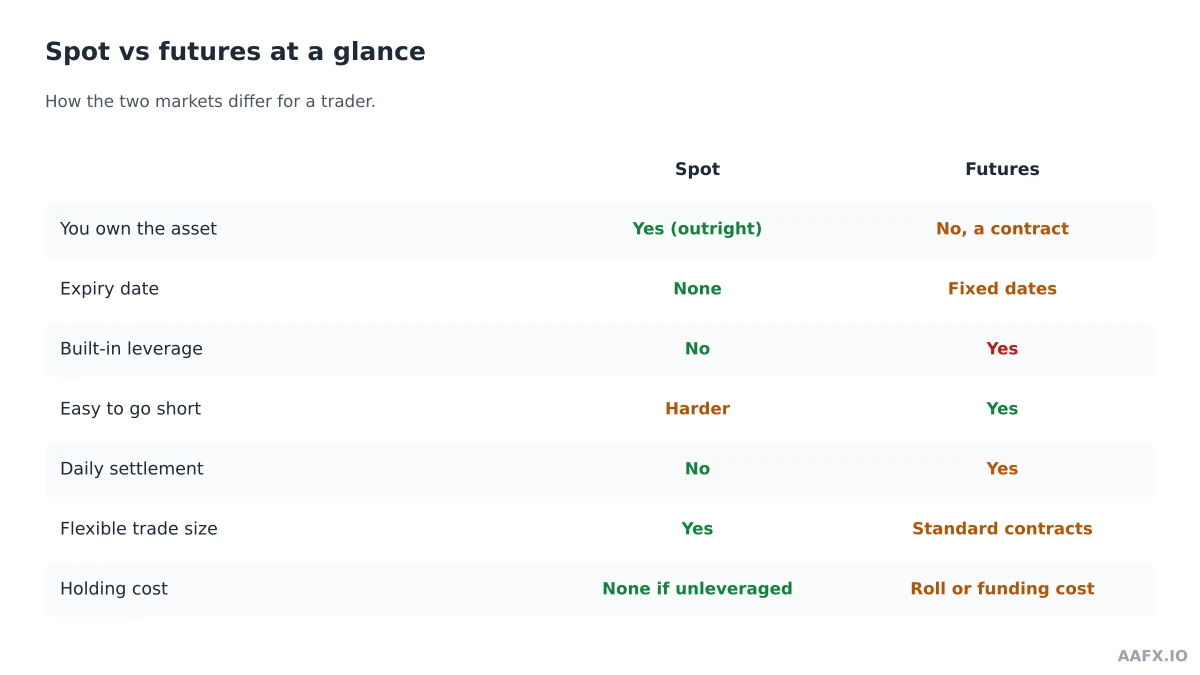
| Feature | Spot | Futures |
|---|---|---|
| What you trade | The asset itself, for immediate delivery | A contract to buy or sell at a future date |
| Ownership | Yes, when buying outright | No, you hold a contract |
| Expiry | None | Fixed expiry dates; positions must be closed or rolled |
| Leverage | None for outright purchases; optional via margin | Built in through margin requirements |
| Price | Current market (spot) price | Spot price adjusted for interest, storage, dividends and expectations |
| Daily settlement | No | Yes, gains and losses settled daily |
| Short selling | Harder; requires borrowing the asset | Simple; sell the contract |
| Contract size | Flexible, can be very small | Standardised by the exchange, often large |
| Main users | Investors, short-term traders | Hedgers, active traders, institutions |
Why Futures Prices Differ From Spot Prices
A futures price is not a forecast. It mostly reflects the spot price plus the cost of carrying the asset until expiry. For currencies, that cost comes from the interest rate difference between the two currencies. For commodities, it includes storage and financing. For stock indices, it reflects interest rates minus expected dividends.
When futures trade above spot, the market is in contango. When they trade below spot, it is in backwardation. As expiry approaches, the futures price converges with the spot price. This is why oil traders talk about the “curve” and why rolling a long futures position in a contango market can quietly cost money over time.
Crypto Perpetual Futures
Crypto exchanges popularised a variation called the perpetual futures contract, which has no expiry date. Instead of converging at expiry, perpetuals use a funding rate: periodic payments between long and short traders that keep the contract price close to spot. When the perpetual trades above spot, longs usually pay shorts, and vice versa. Funding can add up quickly for positions held for days or weeks, so it is a real cost to factor in, much like swaps in forex.
Spot and Futures in Forex
Most retail forex traders never trade currency futures directly. They trade spot FX, or more often spot-based CFDs, through a broker. Currency futures are traded on exchanges such as the CME, with standardised contract sizes and expiry months. CFDs, which we explain in our guide to CFD trading, sit in between: they track spot or futures prices without expiry (for spot-based CFDs) but are leveraged and carry overnight financing.
| Spot FX via broker / CFD | Exchange-traded FX futures | |
|---|---|---|
| Where it trades | Over the counter with a broker | On a regulated exchange |
| Trade size | Flexible, down to micro lots | Fixed contract sizes |
| Cost of holding | Overnight swap | Built into the futures price; roll costs at expiry |
| Price transparency | Broker’s quotes | Central order book and published volume |
| Counterparty | Your broker | The exchange clearing house |
Pros and Cons
Spot trading
- Pros: simple to understand, no expiry, you can own the asset, no forced liquidation if you buy outright.
- Cons: shorting is harder, capital tied up in full, fewer tools for hedging.
Futures trading
- Pros: easy to go long or short, capital-efficient, transparent exchange pricing, effective for hedging.
- Cons: leverage magnifies losses, daily margin calls, expiry and roll management, larger contract sizes.
Which Should You Choose?
If you want to build a long-term position in an asset and are not using borrowed money, spot is the natural choice. If you need to hedge an existing exposure, want to go short easily, or trade actively with a clear plan for margin and risk, futures can be the better tool. For beginners, the most important point is that futures, perpetuals and CFDs are all leveraged products. A small move against you can trigger margin calls or liquidation, as we explain in our guides to leverage and forex trading risks.
My View: Learn on Spot, Graduate to Futures With a Plan
My view is that most new traders should start with spot positions sized so that no single move can force them out. Futures are excellent instruments, and professional desks rely on them, but they demand discipline around margin, expiry and roll costs that beginners rarely have on day one. What would change that advice is a specific need: if you already hold an asset and want to protect it, a short futures hedge can be simpler and cheaper than selling. Use futures for a defined purpose, not because the leverage is available.
Frequently Asked Questions
What is the difference between spot and futures trading?
Spot trading is buying or selling an asset for immediate delivery at the current price. Futures trading uses standardised exchange contracts to buy or sell an asset at a set price on a future date, with built-in leverage and daily settlement.
Is futures trading riskier than spot trading?
Usually yes, because futures are leveraged. A small price move can produce large gains or losses relative to your margin, and losses are settled daily. Spot purchases without borrowing cannot lose more than the amount invested.
Why are futures prices different from spot prices?
Futures prices reflect the spot price plus the cost of carrying the asset until expiry, such as interest rate differences, storage and dividends. The futures price converges with spot as expiry approaches.
What is a perpetual futures contract?
A perpetual futures contract, common in crypto, has no expiry date. It uses periodic funding payments between longs and shorts to keep its price close to the spot price.
Do you own the asset when trading futures?
No. You hold a contract, not the asset. Most traders close or roll futures positions before expiry and never take delivery.
Is spot forex the same as forex futures?
No. Spot forex is traded over the counter, usually through a broker in flexible sizes. Forex futures are standardised exchange-traded contracts with fixed sizes and expiry dates.
Risk warning: Trading futures, forex, CFDs and cryptocurrencies on margin carries a high level of risk and may not be suitable for all investors. You can lose some or all of your capital. This guide is for educational purposes only and is not investment advice.
Sources & Methodology
Primary-source standard: Market-moving facts should link to original data releases, regulator notices, company filings or official project announcements whenever available. Secondary reporting is used for additional context, not as a substitute for original evidence.
Page last reviewed: