Quick Answer
Forex trading risks are the ways a currency trade can cost you more than you planned. The biggest ones for retail traders are leverage risk, sudden price gaps, liquidity shocks, central bank surprises, overnight swap costs, broker or counterparty failure, poor execution and, often underrated, your own decision-making under pressure. None of these can be removed completely, but each one can be measured and controlled with position sizing, stop-loss orders, sensible leverage, a regulated broker and a written trading plan.
The currency market is the deepest market in the world. The Bank for International Settlements put average daily turnover at $9.6tn in April 2025, up 28% from 2022. That depth makes it easy to get in and out of a trade. It does not make it safe. In my years watching FX desks and writing daily analysis, the traders I see blow up rarely pick the wrong direction on every trade. They usually take one oversized position into one bad event, and that single trade undoes months of work.
This guide walks through the ten risks that matter most, shows the math behind them with real examples, and ends with a practical checklist you can use before every trade. If you are completely new, start with our Forex Trading for Beginners guide and come back here before you place your first live order.
What Are Forex Trading Risks?
A forex trading risk is any factor that can produce a loss, or a bigger loss than expected, on a currency position. Some risks come from the market itself, such as a currency pair moving against you. Others come from the structure of retail trading: borrowed money through leverage, the broker sitting on the other side of your trade, and the platform that sends your orders.
It helps to sort them into three groups. Market risks are about price: direction, volatility, gaps and liquidity. Structural risks are about how you trade: leverage, overnight financing, execution quality and the broker you choose. Personal risks are about you: discipline, emotions and whether you follow your own rules when a trade goes wrong. Most beginners focus only on the first group. Most losses I see come from the second and third.
| Risk | What it means | Main way to control it |
|---|---|---|
| Leverage risk | Small price moves create large gains or losses on your equity | Lower effective leverage, size positions by risk |
| Market risk | The pair moves against your position | Stop-loss orders, defined risk per trade |
| Gap risk | Price jumps past your stop, often over a weekend | Smaller size into weekends and major events |
| Liquidity risk | Thin markets cause sharp, erratic moves and wide spreads | Trade liquid pairs and sessions |
| Event risk | Central bank or data surprises reprice a currency instantly | Check the economic calendar, reduce exposure |
| Interest rate and swap risk | Overnight financing costs eat into returns | Know the swap rate before holding positions |
| Counterparty risk | Your broker fails or mishandles client money | Use a well-regulated broker with segregated funds |
| Execution risk | Slippage, requotes and spread widening | Compare brokers, avoid trading into spikes |
| Technology risk | Platform, internet or device failures | Server-side stops, mobile backup |
| Psychological risk | Fear, greed and revenge trading override your plan | Written rules, trade journal, daily loss limits |
1. Leverage Risk: The Risk Behind Most Losses
Leverage lets you control a large position with a small deposit, called margin. With 30:1 leverage (often written as 1:30), $1,000 of margin controls a $30,000 position. That sounds like a feature, and it is, until you look at what it does to your account when price moves. Leverage does not change how far EUR/USD moves. It changes how much of your equity each pip represents.
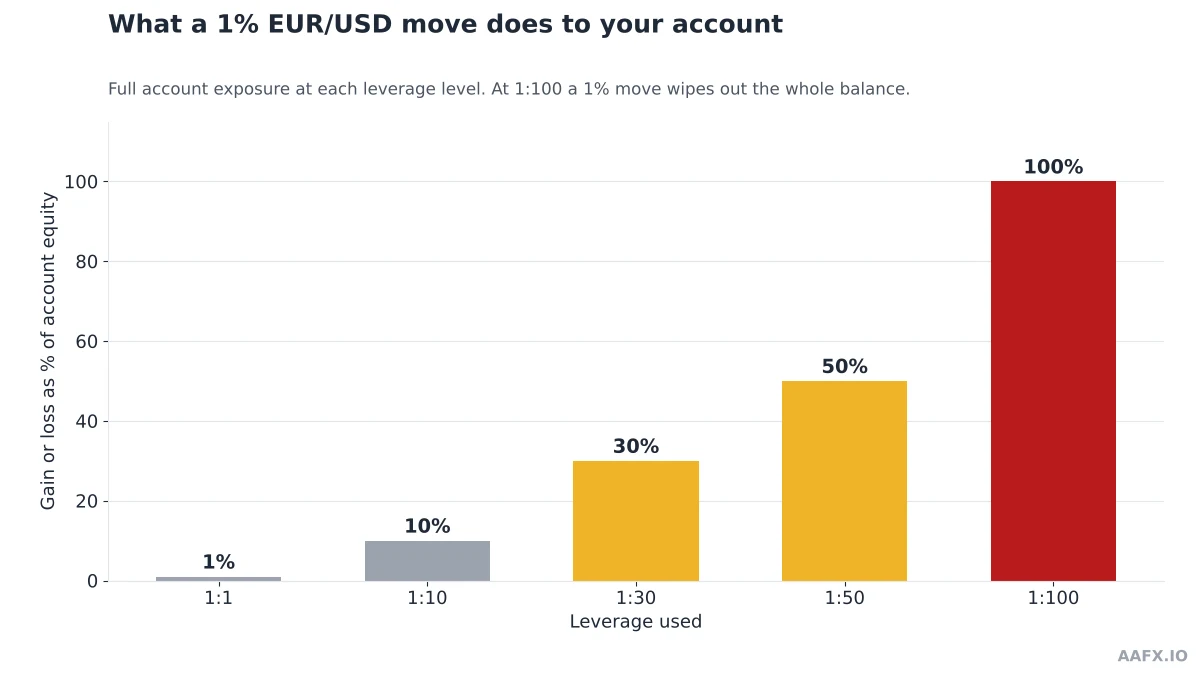
The chart assumes you use your full available leverage. At 1:1, a 1% move in the pair is a 1% change in your account. At 1:30 it is 30%. At 1:100, a perfectly ordinary 1% daily move in a major pair is enough to erase the entire balance. Many offshore brokers still advertise 1:500 or even higher, which means a move of just 0.2% can do the same damage. You can read a fuller breakdown in our guide to what leverage in trading really means.
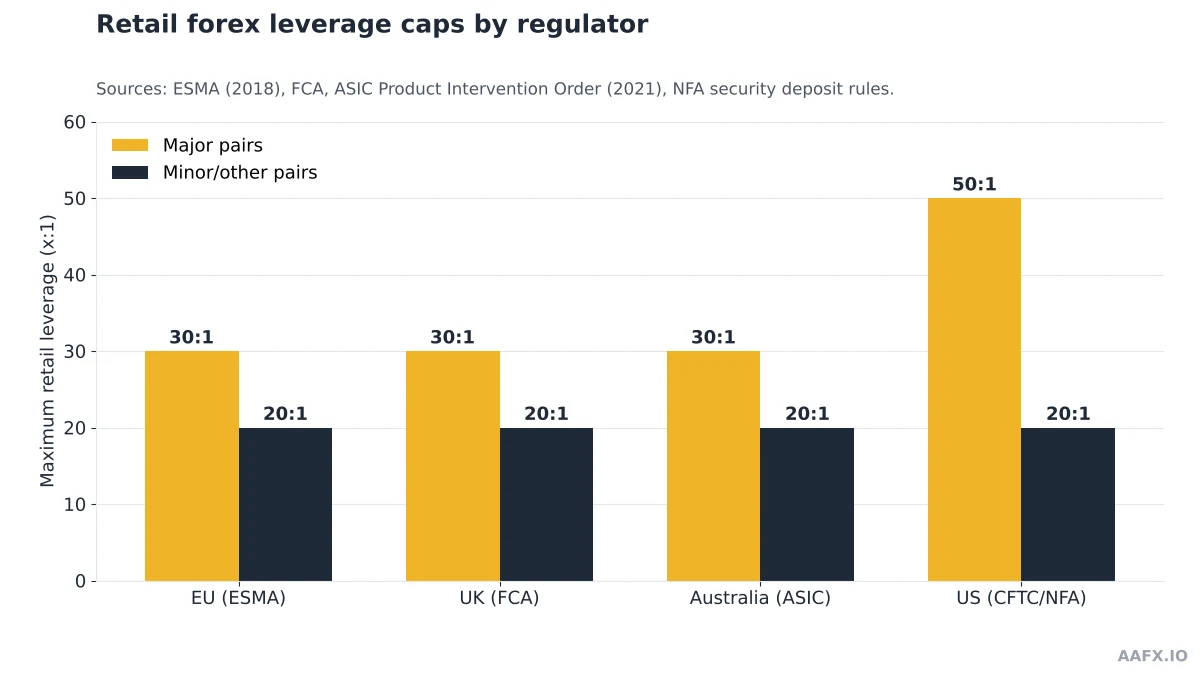
Regulators know this, which is why the main retail markets cap leverage. In 2018 the European Securities and Markets Authority limited retail CFD leverage to 30:1 on major currency pairs and 20:1 on non-major pairs, gold and major indices, alongside a 50% margin close-out rule and negative balance protection. Australia’s regulator applied the same 30:1 and 20:1 caps from 29 March 2021. In the US, NFA rules require a minimum security deposit of 2% on major currencies and 5% on other pairs, which works out to 50:1 and 20:1.
A practical point that beginners miss: the leverage your broker offers is not the leverage you have to use. What matters is your effective leverage, which is your total position size divided by your account equity. A trader with a $10,000 account holding a single $20,000 EUR/USD position is running 2:1 effective leverage, even on a platform that allows 30:1. Keeping effective leverage low is the single most powerful risk control available to a retail trader.
2. Market Risk: When the Pair Simply Moves Against You
Market risk is the obvious one. You buy GBP/USD expecting the pound to rise and it falls. Every trader faces this on every trade, and no analysis method removes it. Good technical analysis and fundamental analysis can improve your odds, but they never turn a probability into a certainty.
The answer is not to find a strategy that never loses. It is to decide in advance how much you will lose when you are wrong. That is what a stop-loss order does: it sets an exit level based on where your trade idea is proven wrong, not on how much pain you can tolerate in the moment. Placing stops at logical levels, such as just beyond a support or resistance zone, gives the trade room to breathe without leaving the downside open-ended.
3. Gap Risk: When Your Stop Does Not Protect You
A stop-loss order becomes a market order once its price is reached. If price jumps straight past that level without trading in between, you are filled at the next available price, which can be far worse than your stop. This is gap risk, and it is most common at the weekly open on Sunday evening, after major political news over a weekend, and in the seconds after a big data release.
Most retail traders treat their stop as a guaranteed maximum loss. It is not. Some brokers sell guaranteed stop-loss orders for a premium, which do lock in the exit price. For everyone else, the practical controls are simple: hold smaller positions into weekends and scheduled high-impact events, and avoid placing tight stops right before a release you know can move the pair 50 pips or more in seconds.
4. Liquidity Risk and Flash Moves
The forex market is liquid on average, but liquidity is not constant. It thins out between the New York close and the Tokyo open, around holidays and on less traded pairs. When liquidity thins, spreads widen and a relatively small order flow can push price much further than normal.
The clearest example is the sterling flash event. In the early Asian hours of 7 October 2016, GBP/USD fell by nearly 10% within around 40 seconds before recovering most of the move over the next ten minutes, according to Bank of England staff research. The BIS Markets Committee pointed to the time of day and mechanical amplifiers, such as options-related hedging, as key factors. Traders with stops below the market were filled at levels that only existed for seconds.
Exotic pairs carry this risk all the time, not just during flash events. Their spreads are wider and their moves less orderly than the majors. If you trade them, read our guide to exotic forex pairs first and size positions accordingly. It also helps to know when the main trading sessions overlap, since that is when liquidity is usually deepest.
5. Event Risk: Central Banks and Data Surprises
Currencies are priced largely on interest rate expectations, so central bank decisions and major data releases such as inflation and employment reports can reprice a pair in seconds. Most of the time these moves are large but orderly. Occasionally they are historic.
On 15 January 2015 the Swiss National Bank removed the 1.20 floor it had held on EUR/CHF since 2011. The franc rose as much as 41% against the euro that day. FXCM, then the largest US retail forex broker, said clients owed about $225mn in negative balances. Alpari UK entered insolvency and Global Brokers NZ shut down. Traders who believed the floor made short franc positions “safe” learned that a policy commitment is not a guarantee.
Two lessons have stayed with me from that episode. First, any market held in place by a policy promise carries hidden gap risk. Second, the broker’s financial strength matters as much as your own trade. Today, most regulated retail accounts in the EU, UK and Australia include negative balance protection, which would have capped those client losses at the account balance.
6. Interest Rate and Overnight Swap Risk
Every currency pair is really a trade in two interest rates. When you hold a position past the daily rollover, your broker credits or debits a swap based on the rate difference between the two currencies, plus its own markup. Holding a long position in a low-yielding currency against a high-yielding one usually costs you money every night, with a triple charge typically applied midweek to cover the weekend.
For day traders this barely matters. For swing and position traders it can quietly turn a winning idea into a losing trade. Check the swap rates in your platform’s contract specifications before holding anything for more than a few days. Traders who cannot pay or receive interest for religious reasons can look at swap-free forex accounts, though these often carry other fees instead.
7. Counterparty and Broker Risk
When you trade retail forex, you are not trading on an exchange. Your counterparty is your broker. If the broker is poorly capitalised, mixes client money with its own, or simply disappears, your funds are at risk no matter how good your trading is. The 2015 franc shock showed how quickly a broker’s balance sheet can fail.
This is where regulation becomes a practical risk control rather than a box to tick. Strong regulators require client money to be held in segregated accounts, set capital requirements and supervise how firms handle orders. Before opening an account, check the licence on the regulator’s own register. Our guides to forex, crypto and stock market regulators, ASIC regulation and CySEC regulation explain what each licence actually protects. It is also worth understanding how brokers make money, because a broker’s business model shapes how it handles your orders.
8. Execution Risk: Slippage, Requotes and Spreads
Execution risk is the gap between the price you see and the price you get. Slippage happens when your order fills at a worse price than requested, usually in fast markets. Requotes happen on some dealing-desk platforms when the broker rejects your price and offers a new one. Spread widening means the cost of entering and exiting a trade jumps, often around news or at the daily rollover.
Each of these is small on a single trade but adds up quickly for active traders. A strategy that targets 10 pips per trade cannot survive an average 2 pip spread plus 1 pip of slippage for long. Compare typical spreads and execution policies across brokers, and avoid placing market orders in the first seconds after major releases. Our comparison of forex trading platforms covers how MT4, MT5, cTrader and TradingView handle order execution.
9. Technology and Platform Risk
Platforms freeze, internet connections drop and phones run out of battery, usually at the worst possible moment. If your stop-loss exists only in your head or in a mental note to “close it at 1.0850,” a connection failure leaves your position unmanaged.
The fix is mostly procedural. Always place stop-loss orders on the broker’s server when you open a trade, not later. Keep a mobile app logged in as a backup. Save your broker’s dealing desk phone number. If you run automated strategies or expert advisors, host them on a virtual private server rather than a home computer, and test what happens to open trades if the connection drops.
10. Psychological Risk: The Risk You Bring With You
The final risk is the one no regulator can cap. Fear makes traders close winners too early. Hope makes them move stops further away. A losing streak leads to revenge trading, where position sizes grow precisely when judgment is weakest. In my experience, most blown accounts end with a series of trades the trader would never have taken on a calm day.
The defence is structure. A written plan with fixed entry criteria, a maximum risk per trade and a daily loss limit takes the biggest decisions out of the heat of the moment. A trade journal shows you which mistakes repeat. Our full guide to trading psychology covers the common biases in more depth.
How Retail Traders Actually Lose Money
Retail CFD providers in Europe, the UK and Australia must publish the share of their retail accounts that lose money, and the numbers are sobering. When ESMA introduced its restrictions, national regulators’ analysis found that 74% to 89% of retail accounts typically lose money, with average losses per client of €1,600 to €29,000.
Those losses rarely come from one big mistake on the first day. They come from a combination of high leverage, no fixed risk per trade, and the drawdown math shown below. Once an account is down heavily, the gain needed just to get back to break-even grows much faster than the loss itself.
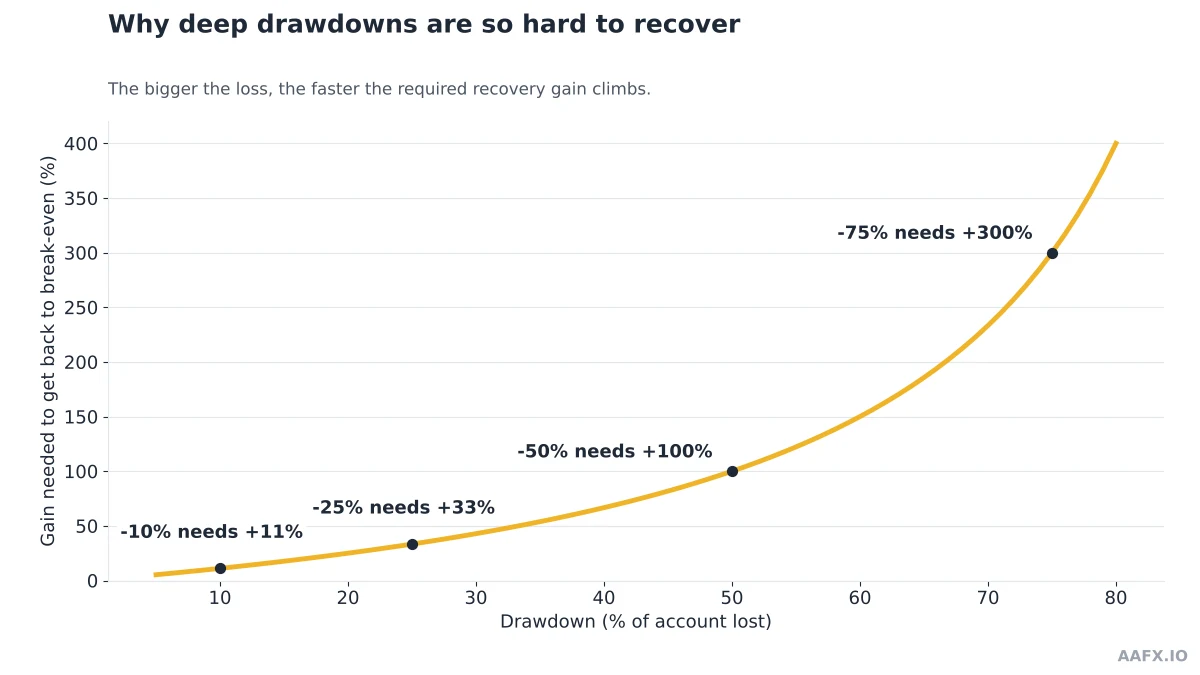
A 10% drawdown needs an 11% gain to recover. A 50% drawdown needs 100%. A 75% drawdown needs 300%, which in practice means the account is finished. This is why professional risk management focuses on keeping losses small and survivable rather than on maximising any single trade.
How to Manage Forex Trading Risks: A Practical Framework
Risk management is not a single tool. It is a set of rules that work together. The framework below is the one I recommend to beginners because it is simple enough to follow on every trade. For a deeper walkthrough, see our guide to risk management and position sizing.
Fix your risk per trade
Decide the maximum percentage of your account you will lose on any single trade. Many traders use 0.5% to 2%, and 1% is a common starting point. The number matters less than applying it every time, including after a winning streak.
Size the position from the stop, not the other way round
Set your stop-loss where the trade idea is invalidated, then calculate the position size that keeps the loss within your risk limit. Here is a worked example on EUR/USD, where one standard lot is worth roughly $10 per pip:
| Input | Value |
|---|---|
| Account equity | $5,000 |
| Risk per trade (1%) | $50 |
| Stop-loss distance | 25 pips |
| Pip value per standard lot | $10 |
| Position size | $50 / (25 x $10) = 0.20 lots |
| Notional exposure | About $20,000, or 4:1 effective leverage |
Notice what happened. The trader’s broker may offer 30:1, but the risk rule kept effective leverage at around 4:1. That is the point of sizing from the stop: leverage becomes a by-product of a controlled risk decision rather than a number you pick.
Respect the calendar
Check the economic calendar every morning. Before central bank decisions, inflation releases and employment reports, either reduce size, widen stops with smaller positions, or stay flat. Our explainer on how global events move currency markets shows which releases matter most for each major currency.
Limit correlated exposure
Buying EUR/USD, GBP/USD and AUD/USD at the same time is not three trades. It is one large bet against the US dollar. Add up your exposure by currency, not by position, before opening new trades.
Set a daily and weekly loss limit
Stop trading for the day after losing, for example, 3% of the account, and for the week after 6%. These limits exist to stop one bad session turning into the kind of drawdown shown in the chart above.
Choose your broker as a risk decision
Regulation, client money protection, negative balance protection and execution quality are all risk controls. Pick a broker the way you would pick a bank, then judge spreads and platforms second. Our guide on how to choose the right forex broker walks through every check, and our comparison of market makers vs ECN brokers explains how execution models differ.
Forex Risk Checklist Before Every Trade
Run through these questions before you press buy or sell. If any answer is no, the trade can wait.
- Is my stop-loss placed on the server at a level that invalidates my idea?
- Does this trade risk no more than my fixed percentage of equity?
- Have I checked the economic calendar for the next 24 hours?
- Do I know the swap cost if I hold this overnight or over the weekend?
- Does this trade add to an existing exposure in the same currency?
- Am I within my daily and weekly loss limits?
- Would I take this trade if my last three trades had been winners, not losers?
My View: Survival First, Returns Second
After years of covering currencies, the pattern I keep seeing is that the traders who last are not the ones with the cleverest entries. They are the ones who never let a single trade, event or bad week threaten the account. The 2015 franc shock and the 2016 sterling flash crash were rare, but they were not unpredictable as categories: thin liquidity and policy-dependent prices will produce violent moves again. What would change my view on how cautious beginners need to be is simple. If retail traders could reliably access guaranteed stops at low cost and leverage stayed capped everywhere, gap and leverage risk would shrink considerably. Until then, keep effective leverage low, size from the stop and treat the broker you choose as part of your risk plan.
Frequently Asked Questions
What is the biggest risk in forex trading?
For most retail traders, leverage is the biggest risk because it multiplies the effect of normal price moves on your account. At 100:1, a 1% move in a major pair equals your entire balance. Keeping effective leverage low and sizing positions from your stop-loss controls most of this risk.
Can you lose more than you deposit in forex?
It depends on your broker and jurisdiction. Retail clients of brokers regulated under ESMA rules in the EU, the FCA in the UK and ASIC in Australia have negative balance protection, which limits losses to the account balance. Elsewhere, including at many offshore brokers, a large gap can leave you owing money, as happened to many traders during the 2015 Swiss franc shock.
Is forex trading riskier than stock trading?
Currency pairs usually move less day to day than individual stocks, but forex is typically traded with much higher leverage, which makes the outcome on your account more volatile. With the same leverage and position sizing, the risk can be comparable. The difference is mostly in how much borrowed exposure traders take on.
How much should I risk per forex trade?
Many traders risk between 0.5% and 2% of their account per trade, with 1% a common starting point for beginners. The key is to calculate position size from your stop-loss distance so the loss stays within that limit every time.
Does a stop-loss guarantee my maximum loss?
No. A standard stop-loss becomes a market order once triggered, so in a gap or fast market it can fill at a worse price. Only a guaranteed stop-loss order, which some brokers offer for a fee, locks in the exact exit price.
How do I know if my forex broker is safe?
Check that the broker holds a licence from a strong regulator, verify the licence number on the regulator’s own website, and confirm that client funds are held in segregated accounts. Negative balance protection and a clear, published execution policy are additional signs of a safer broker.
Risk warning: Trading forex and CFDs on margin carries a high level of risk and may not be suitable for all investors. You can lose some or all of your capital. This article is for educational purposes only and is not investment advice. Past events described here do not predict future market behaviour.
Sources & Methodology
Primary-source standard: Market-moving facts should link to original data releases, regulator notices, company filings or official project announcements whenever available. Secondary reporting is used for additional context, not as a substitute for original evidence.
Page last reviewed: