Quick Answer
Offshore forex brokers are firms licensed, or simply registered, in small jurisdictions with lighter financial regulation, often serving clients in countries where they hold no local licence. They attract traders with high leverage, low deposits and fewer restrictions. The trade-off is weaker protection: retail leverage caps, negative balance protection, strict client money rules, compensation schemes and an independent complaints service are often missing or uncertain. Some offshore brokers are well-run subsidiaries of large regulated groups; others are outright scams. The safest approach is to use a broker regulated by a strong authority, and if you do use an offshore entity, understand exactly which protections you are giving up.
Not every offshore broker is a scam, and I want to be fair about that. Plenty of large, well-known brokering groups run an offshore entity alongside their UK, EU or Australian licences, mainly to serve clients in countries without a local regime or to offer higher leverage. But in my experience, almost every serious complaint I see from readers, frozen withdrawals, vanished account managers, sudden “taxes” on profits, involves a firm with an offshore registration or none at all.
This guide explains what offshore brokers are, why they exist, what you give up, how to tell a legitimate offshore entity from a dangerous one, and when it might be a reasonable choice. Start with our main guide on how to choose the right broker if you have not read it yet.
What Is an Offshore Forex Broker?
An offshore broker is a firm that serves clients from a jurisdiction other than the one where those clients live, typically one with lighter rules, lower costs and faster licensing. Common examples include small island states and territories in the Caribbean, Pacific and Indian Ocean. Some have a dedicated securities or financial services regulator that issues licences with real conditions. Others offer little more than company registration.
That difference matters. The Financial Services Authority of St Vincent and the Grenadines, for example, has warned investors that it does not issue licences to forex brokers, because it has no regulatory framework for that activity. Yet many brokers still list a St Vincent company number on their website, which can look like regulation to an inexperienced trader.
Why Do Offshore Brokers Exist?
Since 2018, retail traders in the EU and UK have been limited to 30:1 leverage on major currency pairs, with negative balance protection and other safeguards. Australia applied similar rules in 2021. These restrictions reduced how much traders could borrow and how aggressively firms could market leveraged products.
Offshore entities fill the gap in three ways. They offer high leverage, often 500:1 or more. They accept clients from countries with no local forex regime. And they allow lower capital and compliance costs for the broker. For some traders that flexibility is the attraction. For many, it is exactly where the risk sits, as we explain in our guide to forex trading risks.
What You Give Up With an Offshore Broker
The table below compares typical protections for retail clients. The details depend on the specific entity and your client classification, but the pattern is consistent.
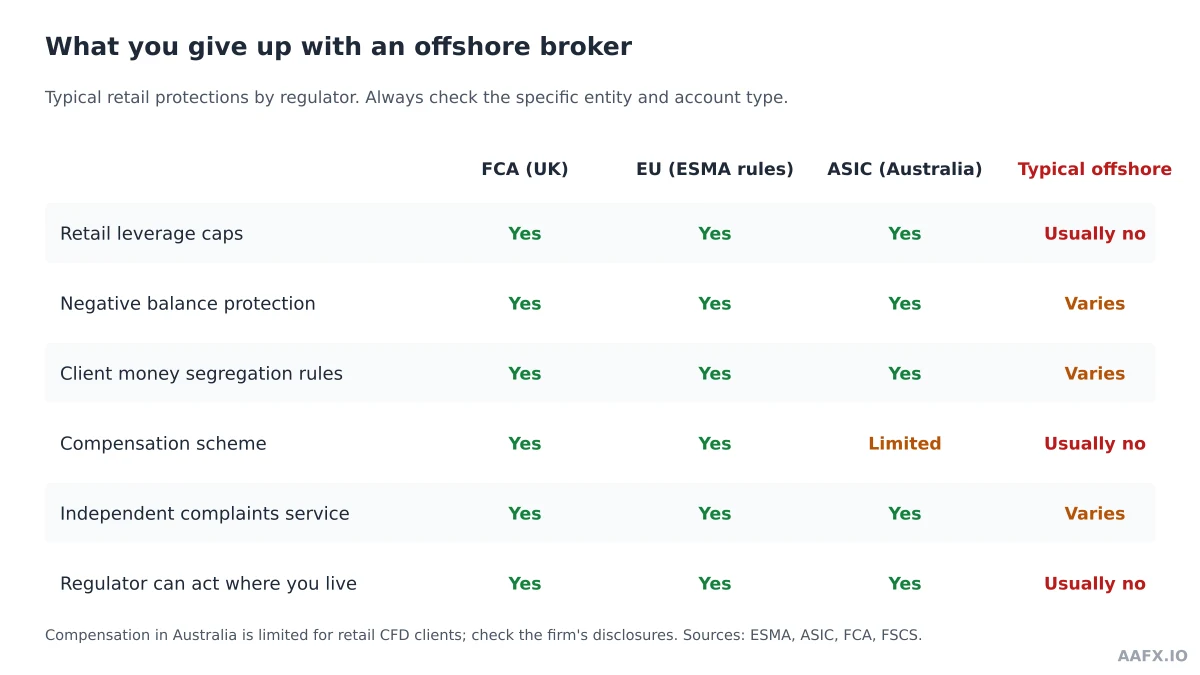
Leverage caps. At 500:1, a 0.2% move against you can wipe out your margin on a fully leveraged position. Caps exist to prevent exactly that.
Negative balance protection. Without it, a sharp gap can leave you owing the broker more than you deposited. Some offshore entities offer it voluntarily, but it is a policy, not a legal guarantee.
Client money rules. Strong regulators require client funds to be held separately from the firm’s own money, with audits and reconciliations. Offshore rules on this vary and are harder to verify.
Compensation and complaints. In the UK, the Financial Services Compensation Scheme covers eligible clients of failed firms up to £85,000 per person per firm. Offshore clients usually have no equivalent scheme and may have no independent ombudsman to escalate a dispute.
Enforcement where you live. If an offshore broker refuses a withdrawal, your home regulator may have no power to act, and pursuing a firm through courts in another country is slow and expensive.
Legitimate Offshore Entity or Scam? How to Tell the Difference
There is a big difference between a regulated group’s offshore subsidiary and a standalone offshore shell. These questions help separate them.
| Question | Lower-risk sign | Higher-risk sign |
|---|---|---|
| Is the group regulated elsewhere? | Same group holds FCA, ASIC or EU licences you can verify | No strong licence anywhere in the group |
| What does the offshore registration actually cover? | A securities dealer licence from an authority that supervises brokers | Company registration only, or a regulator that says it does not license forex |
| Are the legal entity and address clear? | Client agreement names the entity, address and licence number | Vague “global” branding, no entity named in the terms |
| How are you contacted? | You found the broker yourself | Cold calls, social media messages, “account managers” |
| How do withdrawals work? | Clear policy, back to your own payment method | New fees, “taxes” or deposits required to unlock withdrawals |
| Track record | Years of operation, audited group accounts, listed parent | Recently registered, frequent rebrands, copied website content |
Common Offshore Broker Red Flags
Some patterns appear again and again in complaints. Treat any of these as a reason to stop:
- Leverage of 1,000:1 or more combined with large deposit bonuses.
- Guaranteed profits, “risk-free” trades or managed accounts promising fixed monthly returns.
- Pressure from an “account manager” to deposit more after a winning trade.
- A licence number that does not appear on the regulator’s own register, or leads to a different company.
- Requests to pay a fee, tax or “insurance” before a withdrawal is released.
- Deposits only accepted in crypto or to personal bank accounts.
The scale of the problem is large. The UK Financial Conduct Authority issued 2,240 alerts about unauthorised firms and individuals in 2024. Before you deposit anywhere, search the firm’s name on your own regulator’s warning list as well as its claimed regulator’s register.
Why “Professional Client” Status and Reverse Solicitation Matter
Some brokers try to move retail traders outside the protections of strong regulation in two ways.
The first is opting you up to professional client status. Professional clients can access higher leverage but lose retail protections such as negative balance protection and, in some cases, compensation scheme eligibility. Genuine professional status requires meeting specific criteria on trading activity, portfolio size or professional experience. If a broker encourages you to tick boxes you do not genuinely meet, walk away.
The second is reverse solicitation, where a non-local firm claims that you approached it on your own initiative, so local rules do not apply. The European Securities and Markets Authority has made clear that when a firm solicits clients or markets its services in the EU, the service “should not be deemed as a service provided at the own exclusive initiative of the client”, regardless of any contractual clause or disclaimer. ESMA also warned that investors using unauthorised providers may lose protections, including investor compensation.
Is It Ever Reasonable to Use an Offshore Broker?
There are situations where an offshore entity is the only practical option, for example if you live in a country with no local forex licensing regime and well-regulated brokers do not accept clients from there. In that case, the goal is to reduce risk, not eliminate it:
- Choose an offshore entity that belongs to a group with strong licences elsewhere, and verify those licences yourself.
- Confirm in writing whether negative balance protection applies to your account.
- Use low effective leverage regardless of what is offered.
- Keep only the trading capital you need on the account and withdraw profits regularly.
- Test a small withdrawal before depositing more.
- Complete identity verification properly. A broker that never asks for KYC is a warning sign, as we explain in our guide to KYC and AML in trading.
How to Check a Broker’s Licence
Never rely on a licence number shown on the broker’s own website. Go to the regulator’s official register yourself, search the legal entity name, compare the website domain and contact details, and check what activities the licence actually permits. Our guides to financial regulators, ASIC regulation and CySEC regulation explain what each major licence covers. AAFX.IO applies the same checks in our broker vetting standards and our broker reviews.
My View: Offshore Is a Trade-Off, and Usually a Bad One
My view is that most traders who choose an offshore broker do it for leverage, and leverage is the one thing they least need. The extra borrowing rarely improves results, while the missing protections matter precisely when something goes wrong: a market gap, a broker failure or a withdrawal dispute. Where an offshore entity belongs to a well-supervised group and is used with low effective leverage, the risk can be acceptable. What would change my view of any offshore broker immediately is friction on withdrawals or pressure to deposit more. At that point, stop funding the account and escalate.
Frequently Asked Questions
Are offshore forex brokers legal?
An offshore broker may be legally registered where it is based, but it may not be authorised to offer services in your country. Using one is not necessarily illegal for you, but you are likely to lose local regulatory protections and complaint routes.
Are offshore brokers safe?
Some are subsidiaries of well-regulated groups and operate responsibly; others are scams. Offshore brokers generally offer weaker protections, such as no leverage caps, uncertain negative balance protection and no compensation scheme, so the risk is higher even with a legitimate firm.
Why do offshore brokers offer higher leverage?
Because they are not bound by the retail leverage caps imposed by regulators such as the FCA, ESMA rules in the EU or ASIC, which limit major currency pairs to 30:1 for retail clients. Higher leverage increases both potential gains and the speed at which an account can be wiped out.
How can I check if an offshore broker is regulated?
Search the broker’s legal entity name and licence number on the official register of the regulator it claims, and confirm the licence covers dealing in forex or CFDs. Also search your home regulator’s warning list. Be aware that some offshore authorities register companies without licensing forex activity.
What happens if an offshore broker refuses my withdrawal?
Your options are limited. Contact the broker in writing, complain to the regulator that licenses it, report it to your home regulator and, if you paid by card, ask your bank about a chargeback. Recovery can be difficult, which is why testing withdrawals early matters.
Is it better to use an offshore broker for higher leverage?
For most traders, no. The protections lost usually outweigh the benefit of extra leverage, and high leverage is one of the main reasons retail accounts lose money.
Risk warning: Trading forex and CFDs on margin carries a high level of risk and may not be suitable for all investors. You can lose some or all of your capital. This guide is for educational purposes only and is not legal or investment advice. AAFX.IO may earn a commission from some brokers mentioned on this site; see our affiliate disclosure.
Sources & Methodology
Primary-source standard: Market-moving facts should link to original data releases, regulator notices, company filings or official project announcements whenever available. Secondary reporting is used for additional context, not as a substitute for original evidence.
Page last reviewed: