Quick Answer
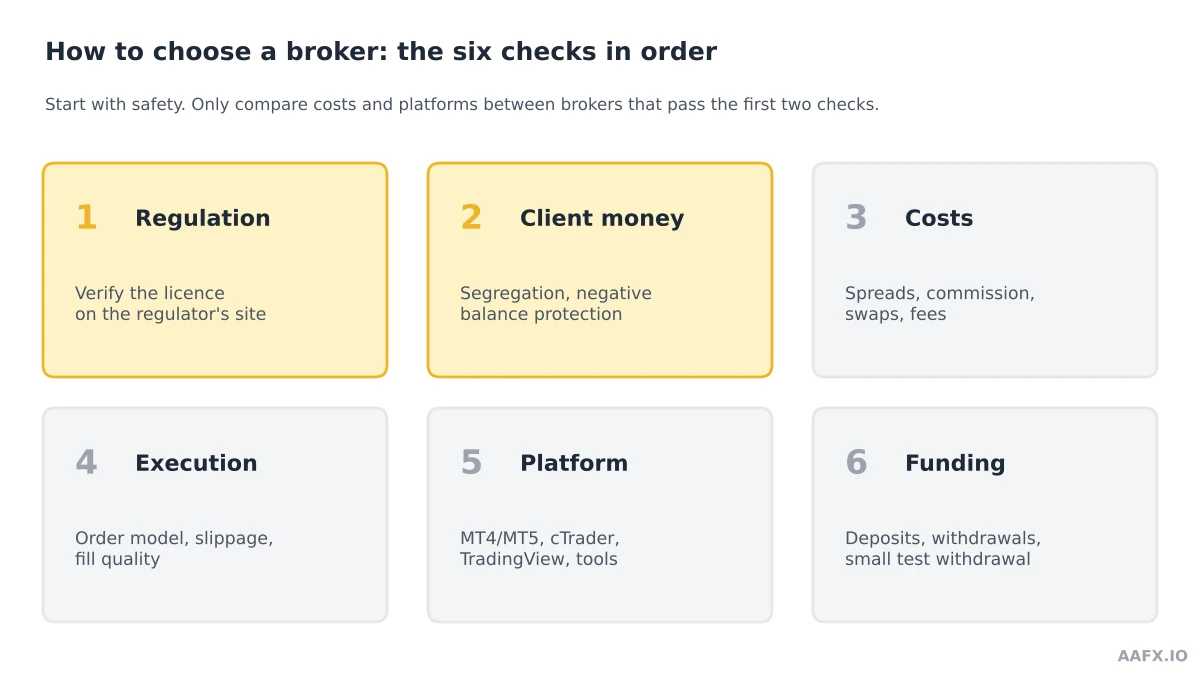
To choose the right broker, check safety first and price second. Start by verifying the broker’s licence directly on the regulator’s own website, then confirm how client money is protected: segregated accounts, negative balance protection and any compensation scheme. Only after a broker passes those checks should you compare total trading costs (spreads, commissions and swaps), execution quality, platforms, deposit and withdrawal terms, and customer support. The best broker is the one that is safe, transparent about costs and suited to the way you actually trade, not the one with the biggest bonus or the highest leverage.
I spent the early part of my career on the dealing side of forex, and the lesson that stuck with me is simple: traders spend hours choosing an entry and minutes choosing the company that holds their money. That is backwards. Your broker is the counterparty to your trades, the custodian of your deposit and the gatekeeper of your withdrawals. A poor choice can cost you more than any losing trade.
This guide is the hub for everything AAFX.IO publishes on brokers. It walks through ten checks in the order I would run them, explains the red flags that should end the conversation, and shows how we score brokers in our own broker reviews. If you are new to the idea of a broker at all, read what a broker does in trading first.
Why Choosing a Broker Is a Risk Decision
Most comparison sites rank brokers by spreads. Spreads matter, but they are the last thing that can hurt you badly. The things that can wipe out an account have nothing to do with a few tenths of a pip: a firm that is not properly licensed, client money mixed with company funds, withdrawals that suddenly take weeks, or a broker that fails during a market shock.
That last scenario is not theoretical. When the Swiss National Bank removed its EUR/CHF floor in January 2015, at least one UK broker entered insolvency and others reported millions in negative client balances. We cover that episode in detail in our guide to forex trading risks. The point here is that a broker’s strength and the rules it operates under are part of your risk management, in the same way a stop-loss is.
So the order of this guide is deliberate. Checks one and two are pass or fail. Checks three to ten help you choose between brokers that pass.
Check 1: Is the Broker Properly Regulated?
Regulation is the foundation of every other protection. A licence from a strong regulator means the firm has to meet capital requirements, keep client money separate, follow rules on how it treats customers and handle complaints through a formal process. An unregulated or weakly regulated broker can promise all of that and deliver none of it.
Which regulators carry the most weight?
Not all licences are equal. At AAFX.IO we give the most weight to regulators that combine strict capital rules, retail leverage limits, client money rules and active enforcement. Our guide to forex, crypto and stock market regulators covers each in depth. The table below is a practical summary.
| Regulator | Jurisdiction | Retail leverage on major pairs | Negative balance protection |
|---|---|---|---|
| FCA | United Kingdom | 30:1 | Yes, for retail clients |
| ASIC | Australia | 30:1 | Yes, for retail clients |
| CySEC and other EU regulators (ESMA rules) | European Union | 30:1 | Yes, for retail clients |
| CFTC and NFA | United States | 50:1 | Not required in the same way |
| Offshore regulators | Various small jurisdictions | Often 500:1 or higher | Varies, often not required |
Many large brokers run several entities, for example one licensed in the UK, one in Cyprus and one offshore. The entity you sign up with decides which rules protect you, not the brand name on the website. Always check which legal entity is named in your client agreement. You can read more about the EU route in our guide to CySEC regulation and the Australian rules in our guide to ASIC regulation.
How to verify a broker’s licence
Never rely on a licence number shown on the broker’s own website. Clone firms copy the names, addresses and reference numbers of real authorised companies. The UK Financial Conduct Authority has warned that scammers often copy a genuine firm’s reference number and even tell victims to check the register, and reported that consumers lost more than £78mn to clone firm scams in 2020 alone. A proper check takes five minutes:
- Find the regulator’s official register yourself through a search engine or the regulator’s homepage, not through a link the broker sends you.
- Search the firm’s legal name and licence number and confirm both match.
- Compare the website address, email domain and phone number on the register with the ones you are using. Small differences are a warning sign.
- Check the regulator’s warning list for the brand name and any similar names.
- Confirm which permissions the firm holds. Some are licensed for advice or payments but not for dealing in derivatives.
Check 2: How Is Your Money Protected?
A licence tells you the broker is supervised. Client money protection tells you what happens to your deposit if something goes wrong. Look for three things.
Segregated client accounts. Your funds should be held in accounts separate from the broker’s own operating money, so they cannot be used to pay the firm’s bills and are easier to return if the firm fails. Reputable brokers name the banks they use.
Negative balance protection. This caps your loss at the money in your account, so a price gap cannot leave you owing the broker. Retail clients of brokers operating under ESMA rules in the EU, FCA rules in the UK and ASIC rules in Australia receive it as standard.
A compensation scheme. Some jurisdictions run a fund that pays out to eligible clients if a regulated firm fails and cannot return client money. These schemes do not cover trading losses, and coverage differs widely:
| Scheme | Applies to | Coverage |
|---|---|---|
| Financial Services Compensation Scheme (FSCS) | Eligible clients of failed UK firms | Up to £85,000 per person per firm; poor investment performance is not covered |
| Investor Compensation Fund (ICF) | Retail clients of Cyprus-regulated investment firms | Eligible funds counted up to €20,000 |
| SIPC | US securities brokerage accounts | Does not protect foreign exchange trades or commodity futures |
The practical takeaway: if you hold more than a scheme’s limit with one broker, the excess is exposed if the firm fails. Some traders split larger balances across two well-regulated brokers for that reason.
Check 3: What Will Trading Really Cost You?
Once a broker passes the safety checks, cost becomes the biggest long-term factor in your results. Brokers charge in several ways, and the headline spread is only one of them. Our explainer on how brokers make money covers each revenue stream; here is what to compare.
| Cost | What it is | Where to find it |
|---|---|---|
| Spread | Difference between bid and ask price | Live platform quotes, broker’s average spread page |
| Commission | Fixed fee per lot, usually on raw spread accounts | Account type comparison page |
| Swap or rollover | Overnight financing on open positions | Contract specifications in the platform |
| Deposit and withdrawal fees | Charges for moving money in or out | Funding page, client agreement |
| Currency conversion | Fee when your deposit currency differs from the account currency | Fee schedule |
| Inactivity fee | Monthly charge on dormant accounts | Fee schedule |
The easiest way to compare is to convert everything into a cost per standard lot traded. On EUR/USD, one pip on a standard lot is worth about $10. The chart below shows how much the account type alone can change your monthly bill for exactly the same trades.
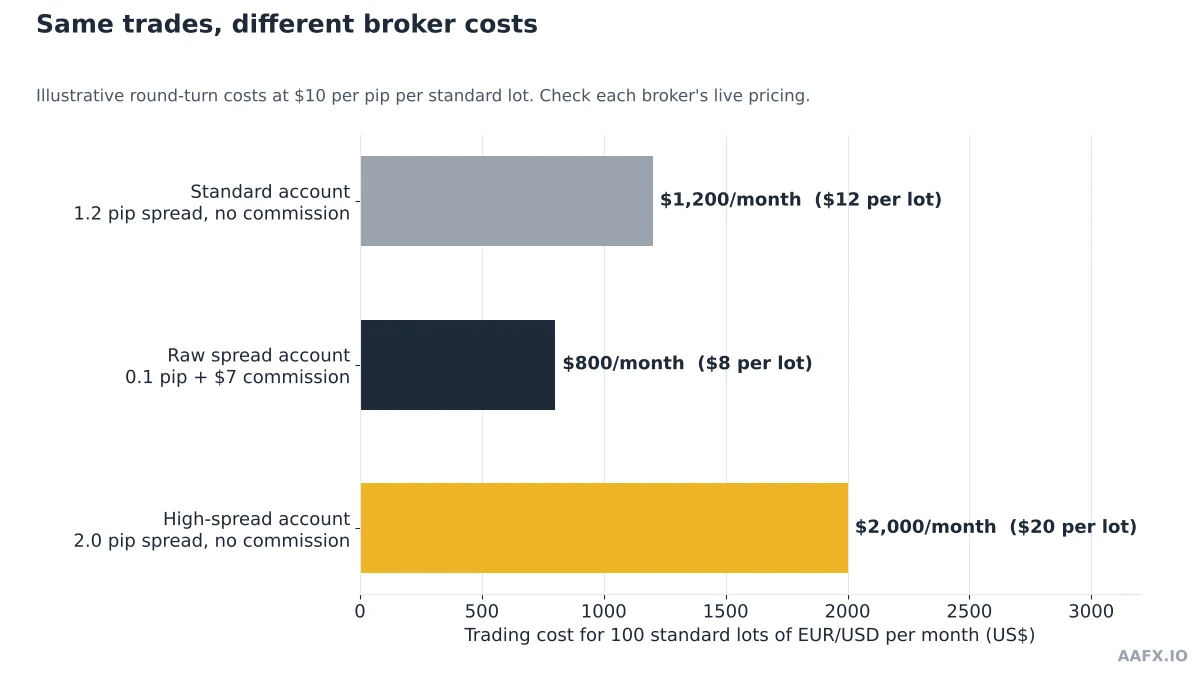
In this illustrative example, a trader doing 100 lots a month pays $2,000 at a 2.0 pip broker, $1,200 on a 1.2 pip standard account and $800 on a raw spread account charging $7 per round turn. Advertised “from 0.0 pips” spreads are a minimum, not an average, so compare typical spreads during the hours you actually trade. If you hold positions overnight, also compare swap rates, or look at swap-free account options if you need them.
Check 4: How Does the Broker Execute Your Orders?
Brokers broadly handle orders in two ways. A market maker (dealing desk) takes the other side of your trade itself and quotes its own prices. An agency model, often marketed as STP or ECN, passes your orders on to liquidity providers and usually charges a commission on top of tighter raw spreads. Many brokers use a mix, internalising some flow and hedging the rest.
Neither model is automatically good or bad. Market makers can offer fixed or stable spreads and smaller trade sizes. Agency brokers can offer tighter pricing and are often preferred by scalpers and high-volume traders. What matters is transparency. A good broker publishes an order execution policy, discloses whether it acts as principal, and does not restrict strategies like scalping or news trading without saying so upfront.
Practical checks: read the execution policy, look for statistics on slippage if the broker publishes them, and test the platform on a demo account during a busy session to see how orders are filled when the market is moving.
Check 5: Which Platforms and Tools Do You Get?
The platform is where you will spend every trading hour, so it needs to fit your style. MetaTrader 4 and MetaTrader 5 remain the most widely supported, especially for automated strategies. cTrader appeals to traders who want depth-of-market and a cleaner interface. TradingView integration lets you trade directly from charts many traders already use. Our full comparison of forex trading platforms covers the differences in detail.
Beyond the platform itself, look at what comes with the account: economic calendars, research, risk tools and calculators. You can also use the free AAFX.IO tools, including our position size calculator and pip calculator, with any broker.
Check 6: Account Types, Minimum Deposit and Leverage
Most brokers offer two or three account types: a standard account with wider spreads and no commission, a raw or ECN account with tight spreads plus commission, and sometimes a swap-free account. Minimum deposits range from nothing to several thousand dollars. A low minimum is convenient but tells you nothing about safety.
Be careful with leverage marketing. A broker offering 500:1 or 1,000:1 is almost always operating through an offshore entity without retail leverage caps or, often, negative balance protection. Higher available leverage is not an advantage for most traders; it simply removes a safety rail. Our guide to leverage in trading explains why effective leverage, not the maximum on offer, is the number that matters.
Check 7: Deposits and Withdrawals
A broker that makes deposits instant and withdrawals painful is telling you something. Check which funding methods are supported in your country, whether withdrawals go back to the original payment method, typical processing times and any fees.
My standard advice: after opening an account, deposit a small amount, place a trade or two, then request a small withdrawal before funding the account fully. How the broker handles that first withdrawal, including the identity checks, the timing and the communication, is the most honest preview of the relationship you will get.
Check 8: Customer Support and Local Presence
Support matters most at the worst moments: a frozen platform, a disputed fill or a delayed withdrawal. Test support before you fund the account. Ask a specific question, such as which legal entity you will be contracting with or how swaps are calculated, and judge both the speed and the quality of the answer.
A local office is not essential, but local regulation, local payment methods and support in your time zone and language often are. We look at this in more detail in does a forex broker need a local office.
Check 9: Range of Markets
If you only trade major currency pairs, almost every broker will do. If you also want gold, oil, indices, shares or crypto, check what is available, whether those instruments are offered as CFDs or as the underlying asset, and how their costs compare. Our guide to CFD trading explains how CFDs work, and our comparison of crypto brokers versus crypto exchanges explains when a dedicated exchange is a better fit.
Check 10: Reputation and Track Record
Finally, look at history. How long has the firm been operating? Has it been fined or sanctioned by a regulator? Is it publicly listed, which means published audited accounts? What do clients complain about? User reviews are noisy, since losing traders often blame the broker, but patterns such as repeated withdrawal complaints across months are worth taking seriously.
Red Flags That Should End Your Search
Some warning signs are serious enough that you should walk away regardless of anything else on offer:
- No licence you can verify on the regulator’s own register, or a licence number that leads to a different firm.
- Unsolicited calls or messages pushing you to deposit, especially with “account managers” who recommend trades.
- Guaranteed returns, “risk-free” trading or managed accounts promising fixed monthly profits.
- Large deposit bonuses with withdrawal conditions buried in the terms.
- Pressure to deposit more to “unlock” a withdrawal, or new fees appearing when you try to withdraw.
- Payment only by crypto transfer or to personal bank accounts.
How AAFX.IO Scores Brokers
Every broker we review is scored with the same 87-point framework, built around the checks in this guide: regulation and safety, costs, execution, platforms, funding, support and transparency. We publish the full criteria on our methodology page and our broker vetting standards, and we update scores quarterly. You can see the results in our forex broker reviews and our crypto exchange rankings.
We also want to be clear about how we are paid. Some brokers we review pay AAFX.IO a commission when readers open an account. That never changes a score, and brokers cannot buy a place in our rankings. Our how we make money page explains this in full.
Which Broker Fits Which Trader?
There is no single best broker for everyone. The right choice depends on how you trade. Use this as a starting point once you have a shortlist of brokers that pass the safety checks.
| Trader type | Prioritise | Be cautious about |
|---|---|---|
| Complete beginner | Strong regulation, low minimum deposit, good education, demo account | High leverage, bonuses, complex account structures |
| Scalper or day trader | Raw spreads, low commission, fast execution, no strategy restrictions | Fixed-spread accounts with wide average costs |
| Swing or position trader | Competitive swap rates, wide range of markets | High overnight financing on your main pairs |
| Islamic trader | Genuine swap-free accounts with clear fee terms | Hidden admin fees replacing swaps |
| Algorithmic trader | MT4/MT5 or cTrader support, VPS options, API access | Restrictions on expert advisors or order frequency |
| Multi-asset trader | Broad CFD range, competitive index and commodity pricing | Brokers strong in forex but expensive elsewhere |
Broker Comparison Checklist
Copy this list into a note and fill it in for each broker on your shortlist. If a broker fails any of the first three items, remove it.
- Licence verified on the regulator’s own register, matching the legal entity in my client agreement.
- Client funds held in segregated accounts with named banks.
- Negative balance protection confirmed for my account type.
- Total cost per standard lot calculated, including commission.
- Swap rates checked for the pairs I trade most.
- Execution policy read; no undisclosed restrictions on my strategy.
- Platform tested on demo during an active session.
- Small test withdrawal completed successfully.
- Support tested with a specific question.
My View: Boring Brokers Are Usually the Best Brokers
After years of covering this industry, my bias is towards brokers that look a little boring: long track records, strong licences, published financials, clear fee schedules and no flashy promotions. Those firms rarely offer the highest leverage or the biggest bonus, and that is precisely the point. What would change my view of a broker quickly is any sign of friction around withdrawals or vagueness about which entity holds client money. Once you have a safe shortlist, choose on costs and platform fit, then review the choice once a year as your trading changes.
Frequently Asked Questions
What is the most important factor when choosing a forex broker?
Regulation. A licence from a strong regulator such as the FCA, ASIC or an EU regulator applying ESMA rules brings capital requirements, client money segregation and, for retail clients, negative balance protection. Verify the licence on the regulator’s own website rather than trusting the number shown by the broker.
How can I check if a broker is regulated?
Go to the regulator’s official register yourself, search for the firm’s legal name and licence number, and check that the website, email and phone details match. Also search the regulator’s warning list, since clone firms often copy the details of genuine authorised companies.
Is a broker with higher leverage better?
No. Very high leverage usually means the broker is serving you through an offshore entity without retail leverage caps or negative balance protection. Most traders are better served by a well-regulated broker with lower maximum leverage and by keeping their own effective leverage low.
Are ECN brokers better than market makers?
Not automatically. ECN or agency-model brokers often offer tighter raw spreads plus commission, which can suit scalpers and active traders. Market makers can offer stable spreads and smaller trade sizes. Transparency about execution, costs and conflicts of interest matters more than the label.
What minimum deposit should I look for?
The minimum deposit says nothing about a broker’s safety. Choose a well-regulated broker first, then start with an amount you can afford to lose, and make a small test withdrawal before adding more funds.
Is my money protected if my broker goes bust?
It depends on where the broker is regulated. Segregated accounts help keep client money separate, and some jurisdictions add compensation schemes, such as the UK FSCS with cover of up to £85,000 per eligible person per firm. US SIPC protection does not cover foreign exchange trades. No scheme covers trading losses.
Risk warning: Trading forex and CFDs on margin carries a high level of risk and may not be suitable for all investors. You can lose some or all of your capital. This guide is for educational purposes only and is not investment advice. AAFX.IO may earn a commission from some brokers mentioned on this site; see our affiliate disclosure.
Sources & Methodology
Primary-source standard: Market-moving facts should link to original data releases, regulator notices, company filings or official project announcements whenever available. Secondary reporting is used for additional context, not as a substitute for original evidence.
Page last reviewed: