
Quick Answer
The major forex pairs are the seven most traded currency pairs that include the US dollar: EUR/USD, USD/JPY, GBP/USD, USD/CHF, AUD/USD, USD/CAD and NZD/USD. They have the deepest liquidity, the tightest spreads and the most analysis available, which is why they are usually the best starting point for beginners. EUR/USD is the single most traded pair in the world. For most new traders, one or two majors, traded during the busiest sessions, is a far better starting point than a long watchlist of exotic pairs.
When I look back at my own early days covering currencies, the traders who progressed fastest were rarely the ones watching twenty pairs. They picked one or two majors, learned how those pairs behaved around London open, US data and central bank meetings, and built from there. Majors reward that focus because their behaviour is well documented, their costs are low and their moves are driven by news you can actually follow.
This guide covers what makes a pair “major,” a profile of each one, what drives them, the best times to trade them and which majors suit beginners best. It is part of our Forex Trading for Beginners guide.
What Are Major Currency Pairs?
A currency pair shows the price of one currency in terms of another. In EUR/USD, the euro is the base currency and the US dollar is the quote currency, so a price of 1.1000 means one euro costs 1.10 dollars.
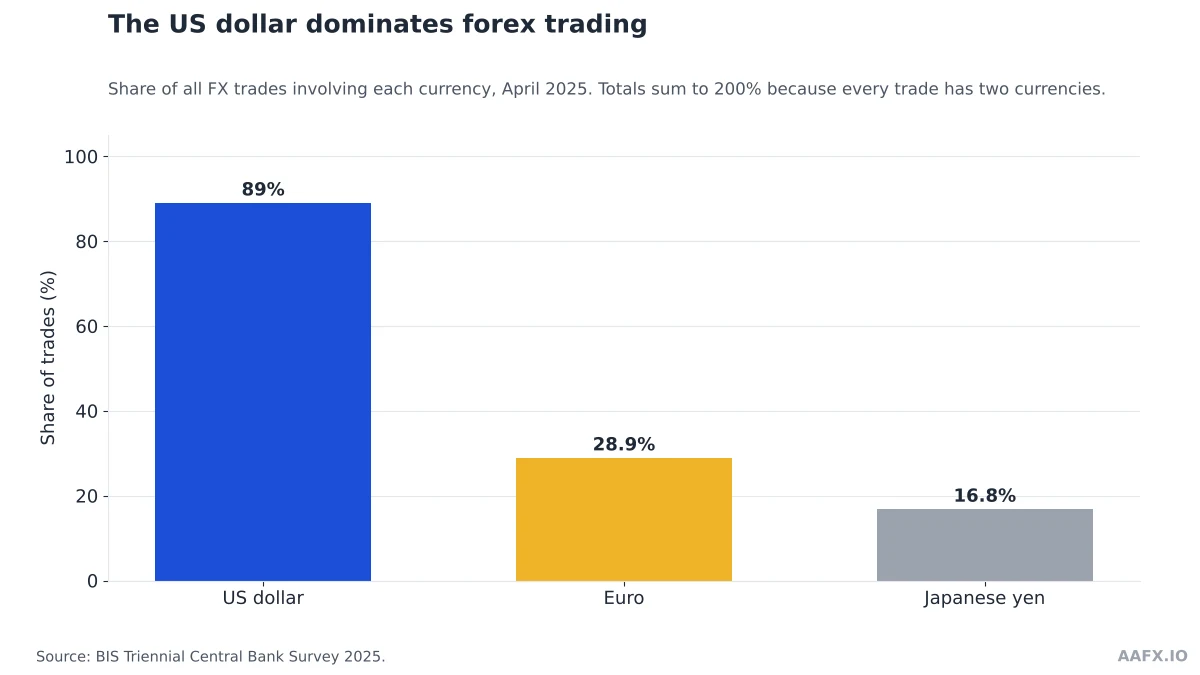
“Majors” are the pairs that combine the US dollar with the other most heavily traded currencies. The dollar’s central role is the reason. According to the Bank for International Settlements, the US dollar was on one side of 89% of all FX trades in April 2025, the euro 28.9% and the Japanese yen 16.8%. Because every trade involves two currencies, these shares add up to 200% across all currencies.
Pairs that combine two major currencies without the dollar, such as EUR/GBP or EUR/JPY, are called crosses or minors. Pairs that combine a major currency with a smaller or emerging-market currency, such as USD/TRY or USD/ZAR, are exotics, which we cover in our guide to exotic forex pairs.
The Seven Major Forex Pairs
| Pair | Nickname | Currencies | Main drivers | Character |
|---|---|---|---|---|
| EUR/USD | Fiber | Euro vs US dollar | ECB and Fed policy, eurozone and US data | Most liquid pair, tightest spreads, steady trends |
| USD/JPY | Gopher | US dollar vs Japanese yen | US yields, Bank of Japan policy, risk sentiment | Highly sensitive to interest rate differentials |
| GBP/USD | Cable | British pound vs US dollar | Bank of England, UK data, politics | More volatile than EUR/USD, sharp intraday moves |
| USD/CHF | Swissy | US dollar vs Swiss franc | Swiss National Bank, safe-haven flows | Franc often strengthens in risk-off periods |
| AUD/USD | Aussie | Australian dollar vs US dollar | RBA policy, commodity prices, China demand | Risk-sensitive, linked to metals and growth |
| USD/CAD | Loonie | US dollar vs Canadian dollar | Bank of Canada, oil prices, US-Canada trade | Often moves with crude oil |
| NZD/USD | Kiwi | New Zealand dollar vs US dollar | RBNZ policy, dairy and commodity exports | Smaller market, wider spreads than other majors |
EUR/USD
EUR/USD is the benchmark of the currency market. It reflects the relative strength of the two largest economic blocs and the policy gap between the European Central Bank and the Federal Reserve. Its depth means spreads are usually the lowest of any pair, which makes it a natural first pair for most traders.
USD/JPY
USD/JPY tends to follow the gap between US and Japanese interest rates. When US yields rise relative to Japanese yields, the pair often climbs. The yen is also a traditional safe haven, so the pair can fall sharply during market stress or when markets expect a shift in Bank of Japan policy.
GBP/USD
Cable gets its nickname from the transatlantic telegraph cable once used to transmit the exchange rate. It is liquid but noticeably more volatile than EUR/USD, reacting strongly to UK inflation data, Bank of England decisions and political news. That extra movement suits some traders and catches out others.
USD/CHF
The Swiss franc is a classic safe-haven currency. USD/CHF often moves in the opposite direction to EUR/USD and can see sudden moves when the Swiss National Bank intervenes. The removal of the EUR/CHF floor in 2015, covered in our guide to forex trading risks, is a reminder of how violent franc moves can be.
AUD/USD and NZD/USD
The Australian and New Zealand dollars are often called commodity or risk currencies. They tend to rise when global growth expectations improve and fall when investors turn cautious. AUD/USD is closely watched as a proxy for Chinese demand, since China is Australia’s largest export market.
USD/CAD
Canada is a major oil exporter, so the Canadian dollar often strengthens when crude prices rise. Because CAD is the quote currency in USD/CAD, a stronger Canadian dollar shows up as a falling USD/CAD price, which many beginners find confusing at first.
Why Trade the Majors?
- Lower costs. Majors usually have the tightest spreads, which matters for every trade you place. See our guide to how brokers make money for how spreads work.
- Deep liquidity. Orders are easier to fill at expected prices, reducing slippage outside major news.
- More information. Every major data release, central bank decision and analyst note is relevant to at least one major pair.
- Lower margin requirements. Regulators in the UK, EU and Australia allow up to 30:1 leverage on majors for retail clients, compared with 20:1 on minors, though lower effective leverage is safer.
Best Forex Pairs for Beginners
If you are just starting, I usually suggest beginning with one of these three:
- EUR/USD for its low costs, steady behaviour and huge volume of free analysis.
- USD/JPY for its clear link to interest rate expectations, which helps you learn how fundamentals move currencies.
- AUD/USD if you want to learn how risk sentiment and commodities feed into currency prices.
GBP/USD is popular, but its sharper swings can be unforgiving for new traders still learning position sizing. Whatever you choose, practise on a demo account first and size every trade from your stop-loss, as explained in our guide to risk management and position sizing.
Best Times to Trade the Major Pairs
Liquidity is highest when major financial centres overlap. The London session is the busiest single window, and the overlap between London and New York, roughly from early afternoon to late afternoon London time, typically brings the most volume in EUR/USD and GBP/USD. USD/JPY and AUD/USD are also active during the Asian session, when Tokyo and Sydney are open. Spreads usually widen in the hour around the daily rollover at the New York close and around major data releases.
| Pair | Most active window | Key releases to watch |
|---|---|---|
| EUR/USD | London and London/New York overlap | ECB decisions, US payrolls and inflation |
| GBP/USD | London and London/New York overlap | Bank of England decisions, UK inflation |
| USD/JPY | Tokyo and New York sessions | Bank of Japan decisions, US Treasury yields |
| AUD/USD, NZD/USD | Sydney, Tokyo and early London | RBA and RBNZ decisions, Chinese data |
| USD/CAD | New York session | Bank of Canada, US and Canadian jobs data, oil inventories |
| USD/CHF | London session | Swiss National Bank decisions, risk sentiment |
How Major Pairs Relate to Each Other
Because all majors share the US dollar, they often move together when the dollar itself moves. A broad dollar rally after strong US data can push EUR/USD, GBP/USD and AUD/USD down at the same time. That means buying all three is closer to one large bet against the dollar than three separate trades. Check your total exposure by currency before adding positions. For a broader view of the dollar, our guide to how global events move currency markets explains the main macro drivers.
My View: Master One Pair Before You Add Another
My view is that the biggest edge a beginner can build is familiarity. If you trade EUR/USD for six months, you will learn how it reacts to US payrolls, how it behaves at London open and how far it typically moves on a quiet day. That knowledge is worth more than any indicator. What would change my advice is your schedule: if you can only trade during Asian hours, USD/JPY or AUD/USD will serve you better than EUR/USD. Choose the major that is most active when you are actually at your screen, and learn it properly before adding a second.
Frequently Asked Questions
What are the 7 major currency pairs?
The seven majors are EUR/USD, USD/JPY, GBP/USD, USD/CHF, AUD/USD, USD/CAD and NZD/USD. Each pairs the US dollar with another heavily traded currency.
What is the most traded currency pair?
EUR/USD is the most traded currency pair in the world. The US dollar is involved in 89% of all FX trades and the euro in 28.9%, according to the BIS survey of April 2025.
Which forex pair is best for beginners?
EUR/USD is usually the best starting point because it has the tightest spreads, deep liquidity and the most available analysis. USD/JPY and AUD/USD are also good choices depending on when you trade.
What is the difference between major, minor and exotic pairs?
Majors include the US dollar and another major currency. Minors, or crosses, combine two major currencies without the dollar. Exotics combine a major currency with a smaller or emerging-market currency and usually have wider spreads.
Why are major pairs cheaper to trade?
Because they have the most buyers and sellers, liquidity providers compete to quote them, which keeps spreads tight. Lower liquidity in minors and exotics means wider spreads and more slippage.
When is the best time to trade major pairs?
Liquidity is usually highest during the London session and the London/New York overlap. Pairs involving the yen, Australian dollar and New Zealand dollar are also active during Asian hours.
Risk warning: Trading forex and CFDs on margin carries a high level of risk and may not be suitable for all investors. You can lose some or all of your capital. This guide is for educational purposes only and is not investment advice.
Sources & Methodology
Primary-source standard: Market-moving facts should link to original data releases, regulator notices, company filings or official project announcements whenever available. Secondary reporting is used for additional context, not as a substitute for original evidence.
Page last reviewed: