Quick Answer
A market maker broker quotes its own prices and can take the opposite side of your trade, either keeping the risk or hedging it. An ECN or STP broker acts mainly as an agent, routing your order to outside liquidity providers such as banks, non-bank market makers or an electronic matching pool, and usually charges a commission on top of tight raw spreads. Neither model is automatically better. Market makers tend to suit beginners who want simple pricing and small trade sizes. ECN-style accounts tend to suit active traders, scalpers and anyone whose costs are dominated by the spread. What matters most is regulation, transparency about how orders are handled and the all-in cost you actually pay.
“Is this broker ECN or a market maker?” is one of the most common questions I get from readers, and it usually comes with an assumption attached: ECN good, market maker bad. Having worked on the dealing side of forex early in my career, I can tell you the reality is more nuanced. Most large retail brokers run a mix of both models behind the scenes, and the label on the account type tells you less than the execution policy, the regulator and the numbers on your trade history.
This guide explains how each model works, where the conflicts of interest sit, how to compare costs properly and how to tell what your broker is actually doing. It is part of our wider guide on how to choose the right broker.
What Is a Market Maker Broker?
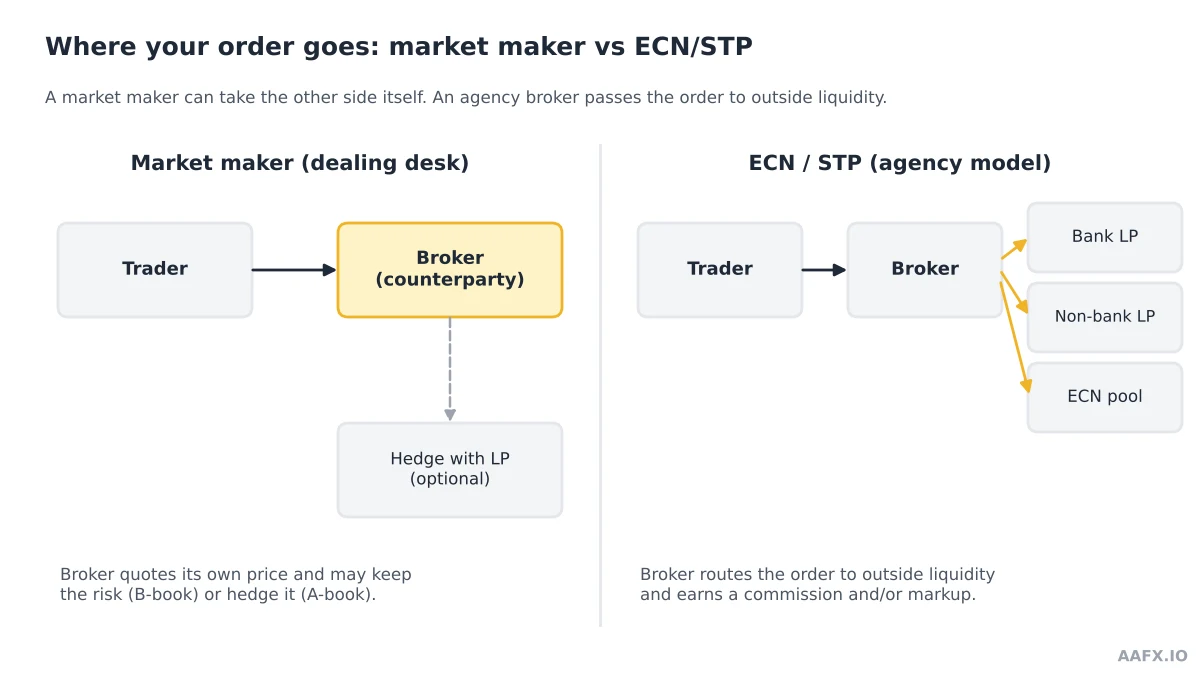
A market maker, also called a dealing desk broker, creates a market for its clients by quoting both a buy and a sell price. When you buy EUR/USD, the broker sells it to you from its own book. Your trade is with the broker, not with another trader or a bank.
From there, the broker has two choices for each client position. It can keep the risk on its own book, often called the B-book, in which case your loss is its gain and your gain is its cost. Or it can offset the risk with its own liquidity providers, often called the A-book. Most modern market makers do both, using software to decide which flow to internalise and which to hedge, usually based on trade size, instrument and the trading history of the account.
Market makers typically earn from the spread they quote, from overnight financing and, where they keep the risk, from net client losses. Our explainer on how brokers make money covers each revenue stream in more detail.
What Is an ECN Broker?
An electronic communication network (ECN) is a system that matches buy and sell orders electronically between multiple participants. In retail forex, “ECN broker” has become a marketing term for brokers that pass client orders through to external liquidity, display prices aggregated from several providers, and charge a separate commission rather than building their revenue into a wider spread.
Closely related is the STP (straight-through processing) model, where the broker routes your order automatically to one or more liquidity providers without manual intervention from a dealing desk. In practice, many brokers use “ECN” and “STP” loosely and interchangeably. The key feature of both is that the broker is acting more as an agent or riskless intermediary than as your direct counterparty.
Market Makers vs ECN Brokers: Key Differences
The table below sets out the typical differences. “Typical” matters here: individual brokers vary a lot, and a single broker can offer both models through different account types.
| Feature | Market maker (dealing desk) | ECN / STP (agency model) |
|---|---|---|
| Who is your counterparty? | The broker | External liquidity providers, via the broker |
| How prices are set | Broker quotes its own bid and ask | Aggregated from several liquidity providers |
| Spreads | Wider, sometimes fixed or stable | Raw, variable, can be near zero on majors |
| Commission | Usually none; cost is in the spread | Usually charged per lot |
| Minimum trade size and deposit | Often very small | Often higher |
| Requotes | Possible on some platforms | Rare; slippage instead |
| Spreads during news | Can be widened by the broker | Widen naturally as liquidity thins |
| Main conflict of interest | Broker can profit when clients lose | Markups and routing choices |
| Best suited to | Beginners, small accounts, simple pricing | Scalpers, high-volume and algorithmic traders |
The Conflict of Interest Question
The main criticism of market makers is obvious: if the broker keeps your trade on its own book, it profits when you lose. That creates an incentive to widen spreads, slow fills or reject trades from profitable clients. Regulators are well aware of this. In a December 2024 letter to CFD firm chief executives, the UK Financial Conduct Authority described the sector as firms “trading as principal to their clients”, flagged concerns about firms that internalise pricing of client trades, and announced a review of whether spreads, overnight funding charges and commissions deliver fair value. The same letter warned against marketing “zero commission” trading without transparency on other costs.
Under EU rules, every investment firm executing client orders must “take all sufficient steps to obtain the best possible result” for clients, considering price, costs, speed, likelihood of execution and settlement, size and other relevant factors. That best execution duty applies whether the broker is a market maker or an agency broker.
The practical point is that a well-regulated market maker is not automatically dishonest, and an “ECN” label is not automatically clean. Agency brokers can still add markups to raw prices, route orders to affiliated liquidity providers, or quietly internalise part of their flow. What protects you is strong regulation, a clear execution policy and your own records of the fills you receive.
Costs: Spread Plus Commission Versus Spread Only
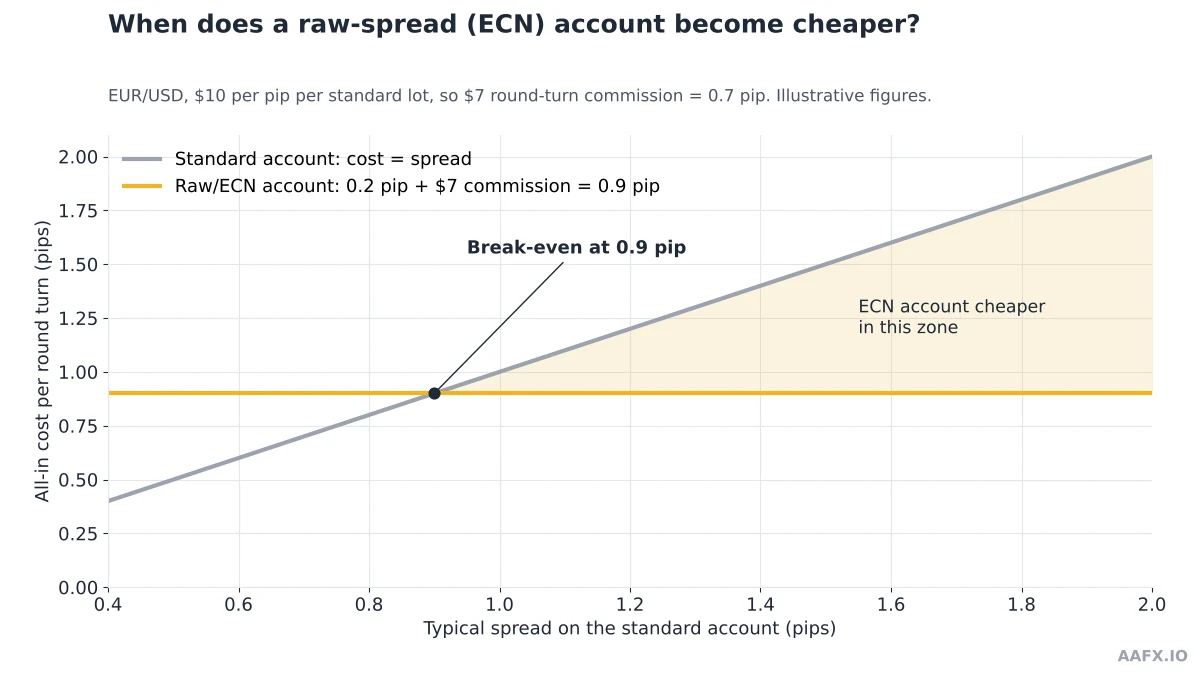
The fairest way to compare the two models is to convert everything into an all-in cost per round turn, in pips. On EUR/USD, one pip on a standard lot is worth about $10, so a commission of $7 per round-turn lot is equivalent to 0.7 pip.
Take a raw spread account averaging 0.2 pip plus $7 commission. Its all-in cost is 0.9 pip. A standard account with no commission is cheaper only if its typical spread is below 0.9 pip on the same pair at the same time of day. Above that, the raw spread account wins.
Two cautions when comparing. First, use typical or average spreads during the hours you trade, not the “from 0.0 pips” minimum in advertising. Second, include swaps if you hold positions overnight, since financing charges can outweigh spread savings for swing traders. Our guide to forex trading risks explains how overnight swaps quietly erode returns.
| Example (EUR/USD, 1 standard lot) | Spread | Commission | All-in cost | Cost in US$ |
|---|---|---|---|---|
| Standard account | 1.2 pips | None | 1.2 pips | $12 |
| Raw spread / ECN account | 0.2 pip | $7 round turn | 0.9 pip | $9 |
| Difference per lot | 0.3 pip | $3 |
Three dollars per lot sounds trivial. For a trader doing 200 lots a month, it is $600 a month, or $7,200 a year, which is why high-volume traders care so much about this choice. For someone placing a handful of micro-lot trades a week, the difference is small enough that platform, support and education may matter more.
Execution: Slippage, Requotes and Fill Quality
Execution quality is where the two models feel most different in practice.
On a dealing desk platform, you may occasionally see a requote: the broker rejects your requested price in a fast market and offers a new one. Some market makers also apply minimum distances for stop and limit orders, or restrict trading around major news.
On an agency model, orders are usually filled at the best available price from liquidity providers, so you are more likely to experience slippage, which can be positive as well as negative, rather than requotes. Spreads on raw accounts can be extremely tight in liquid hours but widen sharply around data releases and at the daily rollover, simply because liquidity providers pull back.
The fairest test is your own. Open a demo or small live account, trade during the London and New York overlap and during a scheduled release, and compare requested prices with fill prices. A broker that publishes execution statistics, including average slippage and the share of orders filled at or better than the requested price, is giving you useful evidence. You can also compare platform behaviour in our guide to forex trading platforms.
Hybrid Brokers: What Most Retail Brokers Actually Do
The clean split between market maker and ECN rarely exists in real life. Many of the largest retail brokers run a hybrid model. Small trades and certain client profiles may be internalised, while larger trades or consistently profitable accounts are hedged externally. The same broker might market a “Standard” account and a “Raw” or “ECN” account that share much of the same back-end infrastructure.
That is not necessarily a problem. Internalising offsetting client orders can reduce costs, and hedging larger exposures is prudent risk management for the broker. What matters is whether the broker is transparent about acting as principal, manages conflicts of interest properly and treats all clients fairly regardless of whether they win or lose.
How to Tell Which Model Your Broker Uses
Marketing pages are not reliable on their own. These steps give a clearer picture:
- Read the order execution policy. Look for wording such as “we act as principal” or “we are the counterparty to your trades.” Regulated firms are required to explain how they execute orders.
- Check the client agreement and key information documents. They usually state whether the firm deals on its own account.
- Look at the cost structure. Commission-based raw spread accounts suggest an agency model for that account type, but are not proof.
- Look at the depth of market. True ECN-style pricing often shows multiple price levels and volumes. A single bid and ask with no depth is more typical of a dealing desk.
- Ask support directly. Ask who the liquidity providers are and whether any of your orders are internalised. A vague answer tells you something too.
Which Is Better for You?
The right model depends on how you trade, not on which label sounds more professional.
| If you are… | Usually a better fit | Why |
|---|---|---|
| A beginner trading micro lots | Well-regulated market maker or standard account | Simple pricing, small minimums, cost difference is minor at low volume |
| A scalper or day trader | ECN / raw spread account | Lower all-in cost per trade and fewer restrictions on short-term trading |
| An algorithmic trader | ECN / raw spread account with VPS and API access | Consistent execution and depth of market data |
| A swing trader | Either; compare swaps first | Overnight financing often matters more than spread |
| A news trader | ECN, with caution | No requotes, but expect wide spreads and slippage on releases |
Red Flags in “ECN” Marketing
Because “ECN” has become a selling point, it is also misused. Be cautious when you see:
- “True ECN” or “100% no dealing desk” claims with no execution policy or liquidity provider details to back them up.
- Very high leverage, often 500:1 or more, combined with an ECN label. This usually signals an offshore entity rather than an institutional-grade setup.
- Zero spreads and zero commission at the same time. The cost has to come from somewhere, often a markup, swaps or other fees.
- Restrictions on withdrawing profits or terms that let the broker cancel “abusive” profitable trades without clear criteria.
My View: Judge the Fills, Not the Label
My view is that the market maker versus ECN debate gets more attention than it deserves. A strongly regulated market maker with transparent pricing, published execution statistics and fast withdrawals is a better choice than an offshore “ECN” broker with neither. Where the model genuinely matters is cost for active traders: once you trade enough volume, a raw spread account usually wins on numbers alone. What would change my view of a specific broker is evidence from my own fills. If requested and executed prices consistently drift against me only when trades are profitable, or if spreads widen far more than at comparable brokers around the same events, the label on the account no longer matters. Pick a well-regulated broker first, then use the cost math in this guide to choose the account type.
Frequently Asked Questions
What is the difference between an ECN broker and a market maker?
A market maker quotes its own prices and can act as the direct counterparty to your trades, either keeping the risk or hedging it. An ECN or STP broker routes your orders to external liquidity providers and usually charges a commission plus raw spreads. Many brokers use a hybrid of both.
Are ECN brokers better than market makers?
Not automatically. ECN accounts usually offer lower all-in costs for active traders and fewer requotes, but they can have higher minimums and wider spreads during news. A well-regulated market maker can be a sensible choice for beginners trading small sizes. Regulation and transparency matter more than the label.
Do market makers trade against their clients?
A market maker is the counterparty to your trade, so when it keeps the risk on its own book it gains when you lose. Regulated firms must manage this conflict of interest and meet best execution duties, and many hedge part of their client flow externally.
Do ECN brokers charge commission?
Usually, yes. ECN or raw spread accounts typically charge a fixed commission per lot traded on top of very tight spreads. Convert the commission into pips to compare it fairly with a spread-only account.
How can I tell if my broker is a market maker?
Read the order execution policy and client agreement for wording such as acting as principal or counterparty. Check whether the account shows depth of market, whether it charges commission, and ask support who the liquidity providers are.
Is an STP broker the same as an ECN broker?
They are closely related and often used interchangeably. STP describes automatic routing of orders to liquidity providers without dealing desk intervention, while ECN describes a network that matches orders between multiple participants. Both are agency-style models.
Risk warning: Trading forex and CFDs on margin carries a high level of risk and may not be suitable for all investors. You can lose some or all of your capital. This guide is for educational purposes only and is not investment advice. AAFX.IO may earn a commission from some brokers mentioned on this site; see our affiliate disclosure.
Sources & Methodology
Primary-source standard: Market-moving facts should link to original data releases, regulator notices, company filings or official project announcements whenever available. Secondary reporting is used for additional context, not as a substitute for original evidence.
Page last reviewed: