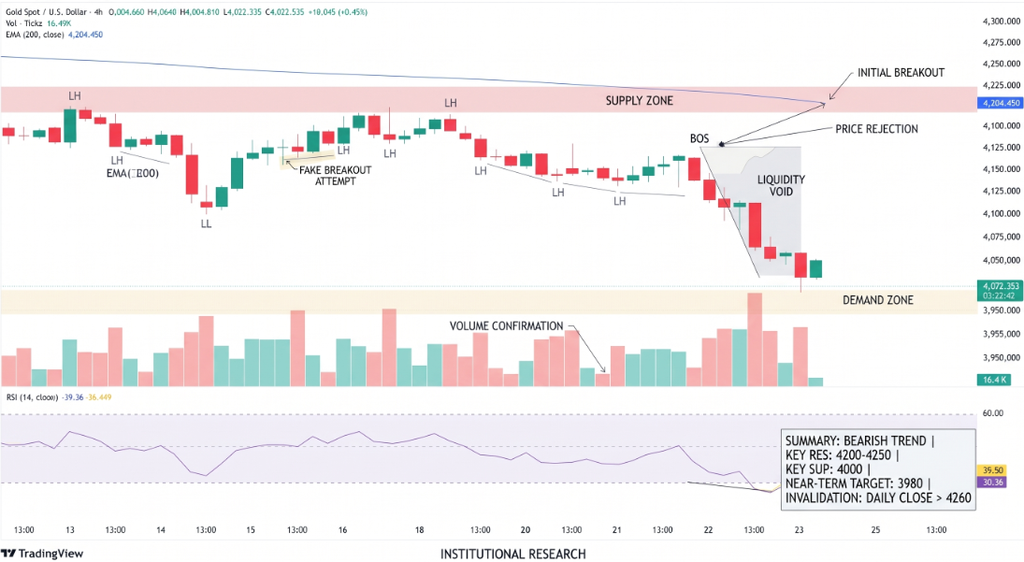
Gold prices fell to a three-month low on Friday, extending a sharp sell-off as rising oil prices revived inflation concerns and strengthened expectations that interest rates could remain elevated. Spot gold was recently quoted near $4,014 an ounce, while U.S. gold futures traded around $4,032. The metal dropped 2.8% on Thursday and was on track for a weekly decline exceeding 3.5%. Geopolitical tensions involving Yemen’s Houthi movement and Saudi Arabia pushed Brent crude toward $114 a barrel, increasing pressure on precious metals.
Oil Rally Revives Inflation Concerns
Brent crude climbed to a five-month high after attacks by Yemen’s Houthi group heightened fears of disruptions to energy supplies from the Middle East. Reuters reported Brent trading near $113.75 a barrel on Friday, following a sharp advance in the previous session.
Higher energy prices can feed into transportation, manufacturing and household expenses, making inflation more difficult for central banks to control. If price pressures persist, policymakers may delay rate cuts or consider further tightening.
That outlook is challenging for gold. Although investors often buy the metal to protect wealth during periods of inflation and geopolitical uncertainty, gold pays no interest. When markets expect borrowing costs to stay high, interest-bearing assets can become more attractive, increasing the opportunity cost of holding bullion.
The current sell-off illustrates how interest-rate expectations can outweigh gold’s traditional safe-haven appeal. Instead of rising alongside geopolitical risk, the metal has weakened as traders focus on the possible inflationary consequences of expensive oil.
Fed Rate Expectations Pressure Gold
Investors are assessing the Federal Reserve ahead of its October 27–28 policy meeting. Markets broadly expect the central bank to hold rates steady at that meeting, but expectations for a December increase have strengthened.
The CME FedWatch Tool indicated on October 22 that futures markets assigned roughly a 73% probability to a 25-basis-point December rate increase. That probability reflects market pricing, not a confirmed policy decision.
Recent U.S. consumer and producer inflation readings have added to concerns that price pressures remain persistent. A further rise in oil prices could complicate the Fed’s task by lifting headline inflation even if underlying demand begins to cool.
Key developments for gold traders include:
- Oil prices: Further gains could intensify inflation concerns.
- Fed guidance: A more hawkish message could weigh on non-yielding bullion.
- Inflation data: Evidence of easing price pressures could reduce rate expectations.
- Geopolitical risk: Escalation may support safe-haven demand, although rate concerns could offset it.
Silver and Platinum Extend Losses
Gold’s decline has spread across the precious-metals market. Spot silver fell nearly 6% on Thursday, while platinum declined 3.6% before stabilizing around $1,567 an ounce in the supplied market figures. These moves suggest investors are reducing exposure across the sector rather than selling gold alone.
Conclusion
Gold’s slide toward $4,014 reflects growing concern that higher oil prices could keep monetary policy restrictive for longer. The October Fed meeting and subsequent inflation signals will be crucial in shaping expectations. Unless oil prices retreat or rate-hike concerns ease, gold could remain under pressure despite continued geopolitical uncertainty.
Sources & Methodology
Primary-source standard: Market-moving facts should link to original data releases, regulator notices, company filings or official project announcements whenever available. Secondary reporting is used for additional context, not as a substitute for original evidence.
Page last reviewed: