The US Dollar Index (DXY) weakened on Monday, trading near 101.75 after sellers capped its rebound from the 101.60 area. The decline reflects easing demand for the US dollar as diplomatic efforts to end the US-Iran conflict raise hopes of reduced geopolitical risk. However, persistent military tensions and expectations of another Federal Reserve rate increase could limit further losses. With important US economic releases approaching, traders are assessing whether the dollar’s latest decline signals a deeper correction or a temporary pause.
Iran diplomacy weighs on the dollar
The dollar came under pressure as investors responded to renewed diplomatic activity between Tehran and Washington. Iranian officials held a third consecutive day of discussions with Qatari mediators on Sunday, focusing on a proposal to reopen the Strait of Hormuz within two days if the United States meets Iran’s conditions. No final agreement has been announced, leaving the outcome uncertain.
US President Donald Trump described the negotiations as progressing, supporting cautious optimism in financial markets. A lasting agreement could reduce demand for the dollar as a traditional safe-haven asset, particularly if it lowers the risk of further disruption to global energy shipments. The Strait of Hormuz is a critical shipping route, making developments there important for oil prices, inflation expectations and currency markets.
Nevertheless, diplomatic progress has not removed the threat of renewed military action. Trump has left open the possibility of further strikes, while Iranian officials have warned they remain prepared for escalation. The continuing Russia-Ukraine conflict also adds to geopolitical uncertainty.
Monetary policy offers another potential source of dollar support. Markets are watching expectations for a possible December rate increase by the Federal Reserve. Higher US interest rates can make dollar-denominated assets more attractive, although the outlook will depend on incoming economic data.
DXY remains below the 102.10 SMA
The short-term technical picture remains tilted to the downside. The index is trading below its 100-hour Simple Moving Average at 102.10, a level that now acts as immediate resistance.
Momentum indicators also point to fading upside strength. The MACD has moved slightly below zero, indicating weakening bullish momentum, while the Relative Strength Index sits near 41. The RSI remains above the conventional oversold threshold of 30, suggesting that selling pressure has increased without yet reaching an extreme.
Traders are monitoring these technical levels:
- Immediate resistance: 102.10, the 100-hour SMA.
- First support: 101.60, the recent rebound area.
- Next support: 101.45, near the October swing low.
- Deeper downside target: 100.70, around the 100-day SMA.
Dollar outlook hinges on key levels
A sustained move below 101.45 could expose the psychological 101.00 level, followed by the 100-day SMA near 100.70. Such a decline would strengthen the bearish technical outlook, particularly if US economic figures weaken expectations for tighter monetary policy.
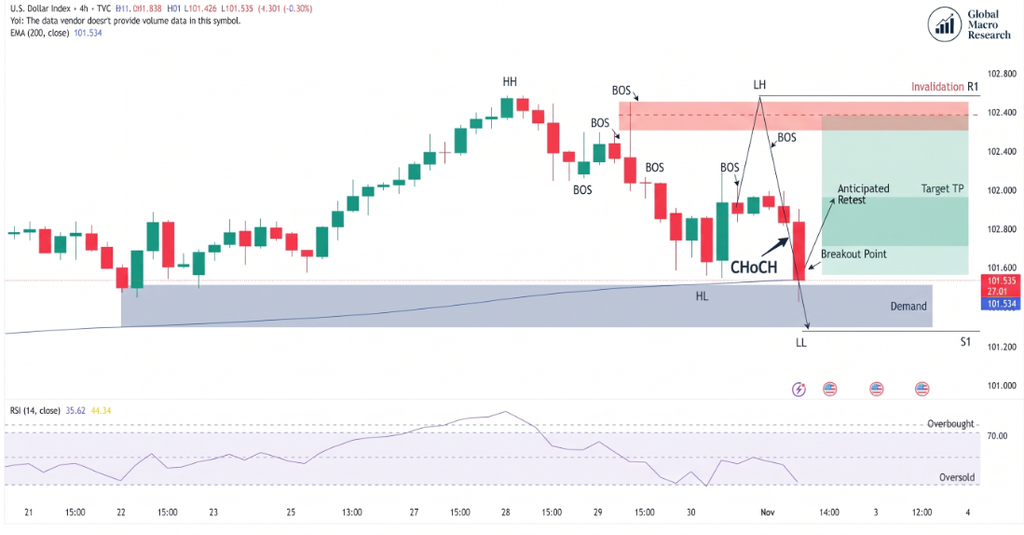
On the upside, reclaiming 102.10 would ease immediate selling pressure and suggest that buyers are regaining control. Until that level is recovered, rallies may encounter resistance.
Conclusion
The US Dollar Index maintains a bearish near-term bias while trading below the 102.10 moving average. A decisive break under 101.45 could accelerate selling toward 101.00 and 100.70, extending the current correction. However, the outlook remains sensitive to US-Iran negotiations, geopolitical developments and Federal Reserve rate expectations. A recovery above 102.10 would weaken the bearish case and signal that dollar buyers are returning. For now, traders are likely to watch the 101.45 support and 102.10 resistance levels for confirmation of the next major move.
Sources & Methodology
Primary-source standard: Market-moving facts should link to original data releases, regulator notices, company filings or official project announcements whenever available. Secondary reporting is used for additional context, not as a substitute for original evidence.
Page last reviewed: