
The AUD/USD pair extended its recovery for a second consecutive session on Thursday, November 5, holding above the psychological 0.7000 level as broad U.S. dollar weakness supported the Australian currency. The dollar retreated after Democrats secured victories in the U.S. midterm elections, while falling U.S. Treasury yields added pressure. However, gains in the Australian dollar remained limited by the Reserve Bank of Australia’s (RBA) increasingly cautious policy outlook following its latest interest-rate increase. With U.S. employment data approaching, traders are reluctant to make aggressive bets, leaving AUD/USD vulnerable below important technical resistance.
RBA caution limits Australian dollar gains
The AUD/USD exchange rate attracted buyers after recovering from the mid-0.6900 region, where it had reached a two-and-a-half-week low. Nevertheless, the pair struggled to establish stronger upward momentum above 0.7000 as investors assessed the implications of the Reserve Bank of Australia’s latest policy decision.
The RBA raised interest rates by 25 basis points but adopted a more cautious tone, suggesting that additional tightening is no longer its central policy priority. The central bank highlighted increasing risks to employment and removed explicit references to possible future rate increases from its statement.
This shift has reduced expectations of another rate increase in December, limiting demand for the Australian dollar despite the supportive decline in the U.S. dollar.
Analysts at OCBC believe the RBA may have reached the peak of its current tightening cycle. They point to slowing economic activity, declining housing prices and a rising unemployment rate as reasons for expecting no further increases.
OCBC also considers an eventual interest-rate cut more likely to be the next policy adjustment. Such expectations could restrict AUD/USD gains by reducing the Australian dollar’s yield advantage.
US dollar weakness supports AUD/USD
The U.S. dollar has faced renewed selling pressure following the Democratic election victory, which increased expectations of political constraints on President Donald Trump’s fiscal proposals.
Falling U.S. Treasury yields have added to the pressure. Lower yields generally reduce the appeal of dollar-denominated assets, encouraging investors to consider currencies offering relatively attractive returns.
However, traders remain cautious ahead of the U.S. monthly employment report, commonly known as Nonfarm Payrolls (NFP). The release will provide important information about hiring conditions, unemployment and wage growth, helping investors reassess the Federal Reserve’s interest-rate outlook.
Federal Reserve officials’ speeches and developments in the Middle East could also influence currency movements.
0.7024 resistance defines technical outlook
From a technical perspective, AUD/USD retains a mildly bearish near-term structure despite its recent recovery. The pair remains below its 200-day Simple Moving Average (SMA) at 0.7058 and the 38.2% Fibonacci retracement near 0.7024.
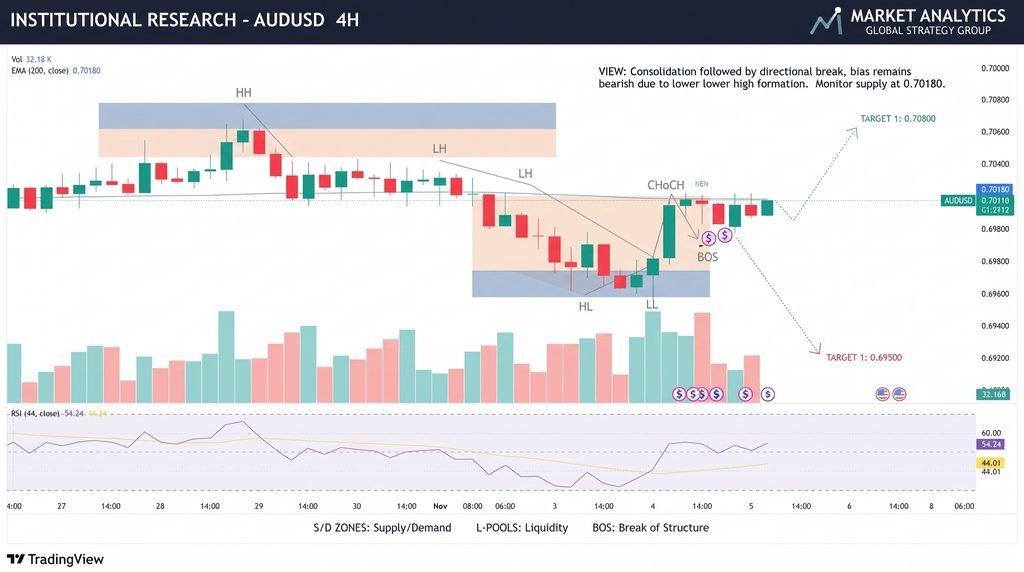
The Moving Average Convergence Divergence (MACD) indicator has turned modestly positive, while the Relative Strength Index (RSI) is hovering around 50. These readings suggest stabilizing momentum rather than a confirmed bullish reversal.
Important technical levels include:
- 0.7024: Initial resistance at the 38.2% Fibonacci level.
- 0.7058: 200-day SMA resistance.
- 0.7065: 50% Fibonacci retracement.
- 0.7105: 61.8% Fibonacci resistance.
- 0.6974: Initial downside support.
- 0.6893: Major structural support.
A sustained move above 0.7024 could expose 0.7058 and 0.7065, while further gains may target 0.7105 and 0.7163. The broader recovery would face another major test near the cycle high of 0.7236.
Conclusion
AUD/USD is benefiting from a weaker U.S. dollar, but the RBA’s cautious policy outlook is limiting Australian dollar demand. A decisive break above 0.7024 is needed to strengthen the recovery, while resistance at 0.7058 remains a major obstacle. Conversely, a decline below 0.6974 could expose the 0.6893 support region. U.S. employment figures and changing central-bank expectations are likely to determine the pair’s next directional move.
Sources & Methodology
Primary-source standard: Market-moving facts should link to original data releases, regulator notices, company filings or official project announcements whenever available. Secondary reporting is used for additional context, not as a substitute for original evidence.
Page last reviewed: