
The NZD/USD pair extended its recovery for a second consecutive session on Thursday, climbing toward 0.5655-0.5660 after finding support near 0.5575, its lowest level in three weeks. A weaker U.S. dollar and falling Treasury yields supported the New Zealand dollar, but gains faced resistance around the 100-period simple moving average (SMA) at 0.5649 on the four-hour chart. Traders remained cautious ahead of Friday’s U.S. employment report, while the Reserve Bank of New Zealand’s recent interest-rate decision continued to limit the currency’s upside potential.
NZD/USD Gains as U.S. Dollar Weakens
The NZD/USD currency pair benefited from broad-based weakness in the U.S. dollar following the Democratic Party’s strong performance in the U.S. midterm elections. Concerns that political divisions in Washington could constrain government spending and slow economic growth weighed on the Greenback.
Expectations of progress toward ending the Iran conflict also contributed to lower oil prices. The decline eased some inflation concerns and put pressure on U.S. Treasury yields, reducing support for the dollar. Because NZD/USD measures how many U.S. dollars one New Zealand dollar buys, a weaker Greenback can lift the exchange rate even without a significant improvement in New Zealand’s domestic outlook.
However, the New Zealand dollar faced its own policy-related headwind. On October 28, the Reserve Bank of New Zealand kept the Official Cash Rate at 2.75%. The decision was divided, with four policymakers supporting a hold and three favoring a 25-basis-point increase. The central bank indicated that further tightening could still be necessary, depending on economic conditions.
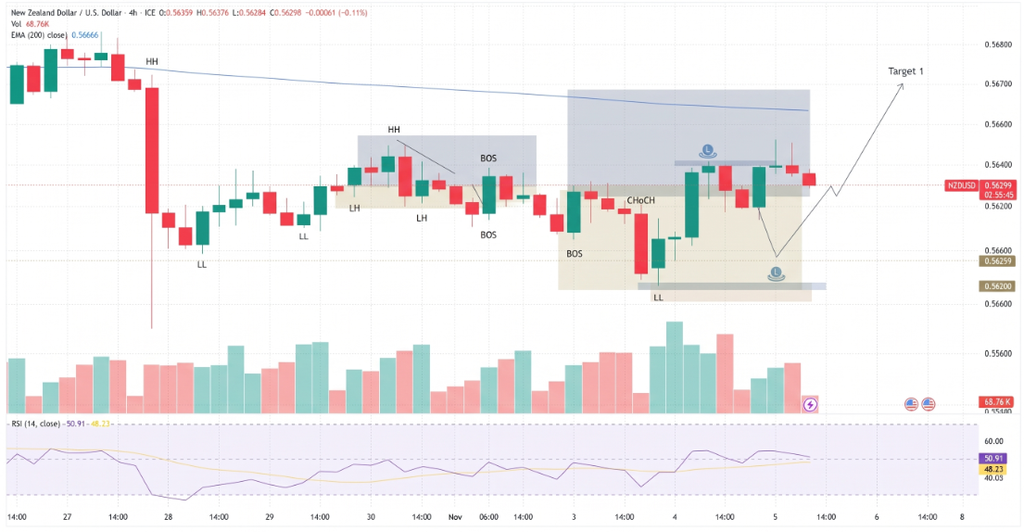
0.5650 Resistance Limits Technical Recovery
Despite the recent rebound, the four-hour technical structure remains cautious. NZD/USD struggled to sustain gains above its 100-period SMA near 0.5649, leaving the broader short-term recovery without convincing confirmation.
The Relative Strength Index (RSI) eased to approximately 55 after recently entering overbought territory. This suggests that buying momentum is cooling. Meanwhile, the Moving Average Convergence Divergence (MACD) histogram remains slightly positive but nearly flat, indicating limited upside acceleration.
The main technical levels are:
- Immediate resistance: 0.5649.
- Next resistance: 0.5664, the 23.6% Fibonacci retracement.
- Higher resistance: 0.5725 and 0.5775.
- Immediate support: 0.5580-0.5570.
- Recent recovery low: Around 0.5575.
A sustained break above 0.5664 could expose the 0.5725 and 0.5775 Fibonacci levels, while a confirmed move below 0.5570 would strengthen the bearish outlook.
U.S. NFP Report Could Set Next Direction
The next major catalyst is the U.S. October employment report, scheduled for Friday, November 6, at 8:30 a.m. Eastern Time, according to the U.S. Bureau of Labor Statistics. The Nonfarm Payrolls (NFP) figures, unemployment rate and wage growth could influence expectations for Federal Reserve policy and trigger fresh moves in the dollar.
Conclusion
NZD/USD has recovered from 0.5575, but resistance near 0.5650 continues to restrict the advance. The pair needs a sustained move above 0.5664 to establish a stronger bullish case and open the way toward 0.5725. On the downside, a decisive break below 0.5570 could revive the broader bearish trend. With U.S. employment data approaching and the RBNZ maintaining a cautious policy stance, the near-term outlook remains dependent on economic signals and confirmation from price action.
Sources & Methodology
Primary-source standard: Market-moving facts should link to original data releases, regulator notices, company filings or official project announcements whenever available. Secondary reporting is used for additional context, not as a substitute for original evidence.
Page last reviewed: