The U.S. dollar advanced against the Swiss franc for a third consecutive session on Monday, with USD/CHF trading near 0.8210 during Asian hours. Strong U.S. employment data and expectations of tighter Federal Reserve policy are supporting the greenback. However, easing oil prices and renewed hopes for progress in U.S.-Iran negotiations could limit its gains. Traders are also weighing potential safe-haven demand for the Swiss franc as political uncertainty in the United States adds another layer to the currency outlook.
Strong US Jobs Data Supports the Dollar
The dollar has found support from a stronger-than-expected U.S. labor market report, reinforcing expectations that the Federal Reserve may maintain a restrictive policy stance for longer.
According to the U.S. Bureau of Labor Statistics, nonfarm payrolls increased by 165,000 in October, comfortably exceeding the 65,000 forecast cited in the market report. September’s payroll gain was revised upward to 60,000 from 29,000, while the unemployment rate edged down to 4.1% from 4.2%.
Average hourly earnings also rose 0.4% in October, bringing annual wage growth to 3.1%. Strong employment and wage figures can sustain inflation concerns, giving policymakers less reason to reduce interest rates quickly.
Market pricing cited in the original report placed the probability of a 25-basis-point December rate increase above 78%, according to the CME FedWatch Tool. That probability is a market-implied estimate rather than a confirmed policy decision.
Investors now await two important inflation releases:
- Consumer Price Index (CPI): October data are scheduled for Tuesday, November 10.
- Producer Price Index (PPI): October figures are due Friday, November 13.
Both reports could influence expectations for the December Federal Open Market Committee meeting. Stronger inflation would reinforce the dollar’s rate advantage, while softer readings could weaken the case for further tightening.
Oil Prices and Politics Shape CHF Demand
The dollar’s advance faces a potential obstacle from declining energy prices. Brent crude fell 0.64% to $97.67 a barrel, while U.S. West Texas Intermediate dropped 0.40% to $90.51, according to Reuters reporting on Monday.
The pullback followed President Donald Trump’s comments that further U.S. strikes against Iran were highly unlikely if negotiations made progress. However, reports of attacks on shipping near the Strait of Hormuz show that supply risks have not disappeared.
Lower oil prices can ease inflationary pressure, potentially reducing expectations for aggressive Federal Reserve tightening. That would remove some support from the dollar.
Meanwhile, the Democratic sweep in the midterm elections may increase uncertainty over U.S. regulation and fiscal policy. Such concerns could encourage investors to seek traditional safe-haven currencies, including the Swiss franc. Still, the franc’s performance will also depend on global risk sentiment and the monetary-policy outlook of the Swiss National Bank.
UOB Identifies 0.8110 and 0.8205 Levels
Strategists at United Overseas Bank (UOB) maintain a cautious outlook on USD/CHF despite its recent rebound. Their medium-term assessment leaves room for another decline before a more durable recovery develops.
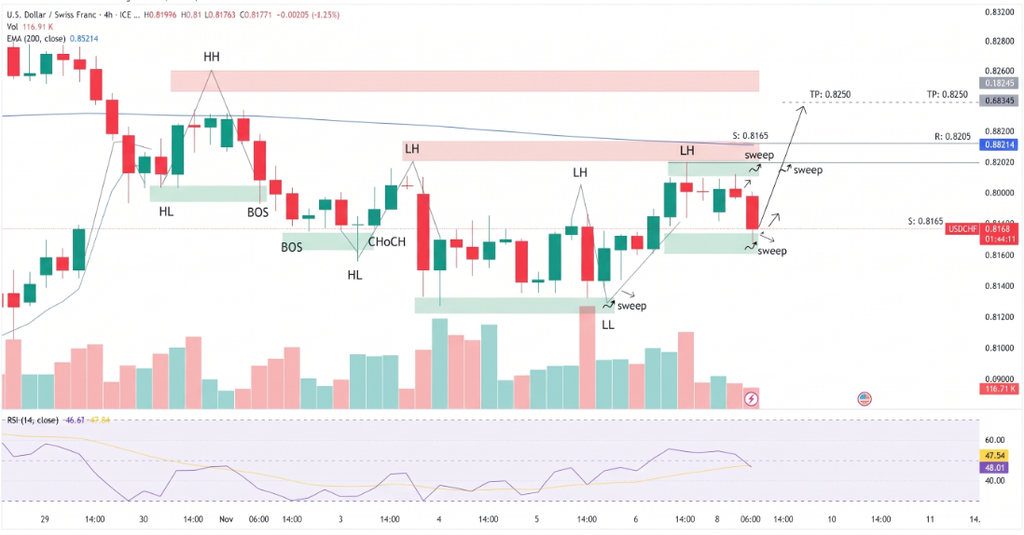
UOB identifies 0.8110 as a potential downside target over the coming one to three weeks. The bank also highlights 0.8205 as strong resistance. A sustained break above that threshold would suggest the dollar’s previous decline had run its course.
The key levels are:
- 0.8110: Potential downside test.
- 0.8205: Strong resistance and recovery signal.
- 0.8210: The approximate level around which the pair was trading in Monday’s Asian session.
Conclusion
USD/CHF faces competing forces as strong U.S. employment data and expectations of higher interest rates support the dollar, while easing oil prices and safe-haven demand could benefit the Swiss franc. The upcoming U.S. CPI and PPI reports may provide the next major catalyst for the pair. A sustained move above 0.8205 would strengthen the recovery outlook, whereas renewed selling could bring UOB’s 0.8110 downside target back into focus.
Sources & Methodology
Primary-source standard: Market-moving facts should link to original data releases, regulator notices, company filings or official project announcements whenever available. Secondary reporting is used for additional context, not as a substitute for original evidence.
Page last reviewed: