
The Australian Dollar weakened against the US Dollar on Tuesday, with AUD/USD trading near 0.6730 after touching its lowest level in 10 months. The release of Reserve Bank of Australia (RBA) meeting minutes added pressure to the currency as investors reassessed the outlook for further monetary tightening. Meanwhile, the US Dollar retreated slightly from a recent high ahead of October retail sales data. Despite the Greenback’s pullback, the Australian Dollar remains vulnerable, with technical indicators pointing toward 0.6660 as a potential downside target.
RBA minutes put Australian Dollar under pressure
The Australian Dollar extended its decline after the RBA published its latest monetary policy minutes on Tuesday. The discussion highlighted a difficult balance between persistent inflation and slowing economic conditions, leaving investors cautious about the central bank’s next policy move.
Policymakers acknowledged that inflation risks remained elevated, requiring restrictive monetary conditions. However, they also recognized that previous interest-rate increases had tightened financial conditions and weighed on economic activity, housing prices and employment.
The minutes indicated that policymakers remained attentive to incoming economic data rather than committing to another increase. This absence of explicit guidance for additional tightening contributed to the Australian Dollar’s weakness.
Analysts at OCBC Group Research interpret the central bank’s changing communication as evidence that its tightening cycle may be nearing completion. The bank expects no further increase during the current cycle, with the next policy adjustment potentially being a rate cut.
This outlook creates a disadvantage for the Australian Dollar because expectations of lower interest rates can reduce demand for Australian assets relative to currencies offering higher potential returns.
US Dollar retreats ahead of retail sales
The US Dollar Index (DXY), which measures the Greenback against six major currencies, declined 0.1% to approximately 103.48 after failing to maintain gains above 103.70.
Investors are focusing on US October retail sales data, scheduled for release at 13:30 GMT on Tuesday. The figures could provide fresh information about consumer spending and the strength of the American economy.
Stronger retail sales could reinforce expectations of additional Federal Reserve (Fed) interest-rate increases, potentially supporting the US Dollar. Conversely, weaker figures could encourage traders to reduce their expectations for monetary tightening and offer temporary relief to AUD/USD.
The latest market pricing also reflects expectations of further Fed action. According to the CME FedWatch figures cited in the market report, traders assigned a 95.7% probability to a 25-basis-point increase at the December meeting, compared with a 4.3% probability of a larger 50-basis-point move.
AUD/USD forecast: 0.6660 in focus
AUD/USD trades near 0.6733 on the daily chart, remaining significantly below its 20-day Exponential Moving Average (EMA) at 0.6893. This technical positioning reinforces the bearish near-term outlook.
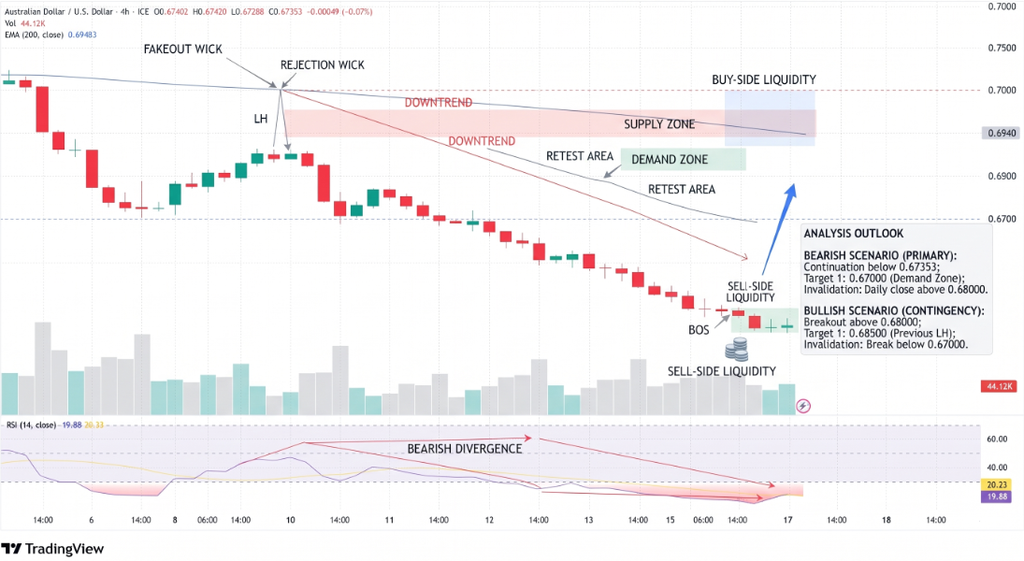
The Relative Strength Index (RSI) stands at 27.85, placing the pair in oversold territory. Although this suggests that selling momentum is becoming stretched, it does not confirm that a recovery is imminent.
Key technical levels include:
- Current price: 0.6733.
- Potential downside target: 0.6660.
- RSI: 27.85, indicating oversold conditions.
- Immediate resistance: 0.6893, the 20-day EMA.
A sustained decline toward 0.6660 would extend the current bearish trend. Conversely, a daily close above 0.6893 could ease selling pressure and provide an initial signal of improving momentum.
Conclusion
AUD/USD remains exposed to further losses as the RBA’s cautious policy outlook contrasts with expectations of additional Fed tightening. Although a weaker US Dollar could provide temporary support, the pair’s position below the 20-day EMA favors sellers. The 0.6660 level remains an important downside target, while 0.6893 represents the key resistance level buyers must reclaim to improve the outlook.
Sources & Methodology
Primary-source standard: Market-moving facts should link to original data releases, regulator notices, company filings or official project announcements whenever available. Secondary reporting is used for additional context, not as a substitute for original evidence.
Page last reviewed: