
The US Dollar Index (DXY) retreated on Tuesday after reaching 103.69, its highest level in 19 months. The index traded near 103.49 during the European session, giving back a small portion of its recent gains after five consecutive advances. However, expectations of further Federal Reserve rate increases and demand for the US Dollar as a safe-haven asset continue to support the broader trend. Traders are now watching US economic releases and the 103.45 technical support area for the next directional signal.
Fed rate bets support dollar momentum
The dollar’s advance follows stronger-than-expected US inflation data and increasingly hawkish signals from Federal Reserve policymakers. Markets have moved toward pricing in another 25-basis-point rate increase in December, reinforcing the appeal of dollar-denominated assets.
Recent reporting put the probability of a quarter-point increase close to certain, while the chance of a larger 50-basis-point move remained considerably lower. The shift in expectations has helped the dollar outperform several major currencies.
Geopolitical uncertainty is providing another source of support. Diplomatic efforts to end the conflict involving the United States, Israel and Iran have remained difficult, while concerns surrounding the Strait of Hormuz continue to keep energy-market risks in focus. Such uncertainty can encourage investors to favor currencies perceived as safer during periods of market stress.
Analysts at ING have also highlighted the dollar’s resilience during the recent technology-stock sell-off. Weakness across US and international equities has encouraged safe-haven demand, even as some short-term interest-rate expectations have moderated.
US retail sales put focus on data
Tuesday’s US calendar includes October retail sales and industrial production. Retail sales are expected to show slower monthly growth than September, while industrial production is forecast to increase by around 0.1%.
These releases could influence near-term trading, although equity-market movements may remain a more immediate driver of currency flows.
Key developments for dollar traders include:
- Retail sales: A stronger reading could reinforce expectations of further Fed tightening.
- Industrial production: The report will provide another indication of manufacturing and industrial demand.
- Equity-market sentiment: Continued technology-sector weakness could sustain demand for the dollar.
DXY forecast: 103.45 remains pivotal
The technical outlook remains moderately bullish while the index holds inside its ascending parallel channel. The lower channel boundary near 103.45 aligns with the 50-hour Simple Moving Average, making this level an important near-term support zone.
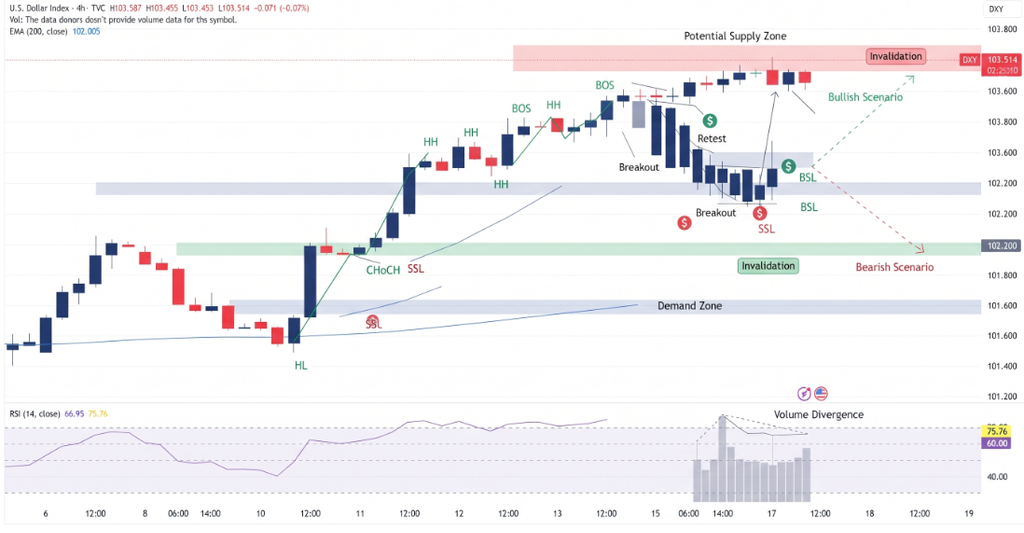
The Relative Strength Index near 52.5 signals neutral-to-positive momentum. Meanwhile, the slightly negative Moving Average Convergence Divergence reading suggests that upward momentum is losing some strength, rather than confirming a full bearish reversal.
A sustained break below 103.45 could expose the broader channel support near 102.75. On the upside, resistance stands around 103.79, close to the upper channel boundary. A decisive move above that level could restore momentum toward higher prices.
Conclusion
The DXY’s retreat from 103.69 does not yet signal a reversal in its broader advance. Federal Reserve rate expectations, geopolitical risks and equity-market volatility continue to favor the dollar. However, the 103.45 support confluence is critical: holding above it would preserve the bullish technical structure, while a confirmed breakdown could open the way toward 102.75. US economic data and changes in risk sentiment are likely to determine which level comes into focus next.
Sources & Methodology
Primary-source standard: Market-moving facts should link to original data releases, regulator notices, company filings or official project announcements whenever available. Secondary reporting is used for additional context, not as a substitute for original evidence.
Page last reviewed: