
Pi Network (PI) extended its decline on Friday, trading near $0.053 after hitting a fresh all-time low of $0.051 on Thursday. The token’s sell-off continued despite the completion of the three-day Pi Ecosystem Summit, which introduced developer tools, technical demonstrations and ecosystem initiatives. Pi’s market capitalization fell to approximately $607 million, reflecting weakening investor confidence. The latest price action suggests that announcements surrounding network development have failed to generate sufficient demand to counter persistent selling pressure. Technical indicators remain bearish, leaving PI exposed to further losses as it struggles to establish a reliable support level.
Pi Summit Fails to Revive PI Demand
The Pi Ecosystem Summit concluded on Thursday, November 19, following three days of developer presentations, technical demonstrations and application showcases. The event focused on expanding Pi Network’s utility by introducing new tools and opportunities for developers to build applications within its ecosystem.
The summit featured demonstrations of AI-assisted development tools, on-chain subscription functionality and payment integrations. The final day also introduced Pi Next, a hackathon offering a 200,000 USDT prize pool to developers building applications for the network.
Despite these developments, PI failed to attract sustained buying interest. The token recorded a fresh all-time low of $0.051 on Thursday, highlighting the disconnect between ecosystem announcements and market performance.
The cryptocurrency’s market capitalization declined to approximately $607.92 million on Friday, according to the figures provided, as traders continued reducing exposure to the digital asset.
The summit’s announcements could support longer-term development, but their impact on token demand remains uncertain. Investors are increasingly focused on whether these initiatives can translate into meaningful application usage, transaction activity and sustainable ecosystem growth.
PI Downtrend Extends to Fresh Lows
PI’s broader bearish trend has persisted since mid-May, with the token experiencing repeated declines and struggling to recover previous support levels.
At approximately $0.053, the cryptocurrency remains significantly below its major daily Exponential Moving Averages (EMAs), which track average prices while giving greater weight to recent trading activity.
The technical indicators currently highlight the extent of the weakness:
- 50-day EMA: $0.073
- 100-day EMA: $0.083
- 200-day EMA: $0.106
- Relative Strength Index (RSI): Near 22
- Market capitalization: Approximately $607 million
The RSI near 22 indicates deeply oversold conditions, suggesting selling momentum has become unusually intense. However, an oversold reading does not guarantee an immediate rebound, particularly when the broader trend remains negative.
The MACD indicator also remains below its zero line, reinforcing the bearish momentum. The combination of declining prices, negative MACD readings and weak market participation suggests that buyers have yet to establish control.
Pi Network Price Forecast: Resistance Ahead
PI faces initial resistance near the 50-day EMA at $0.073, followed by the horizontal barrier around $0.074. A sustained move above this region could improve the technical outlook and expose the 100-day EMA at $0.083.
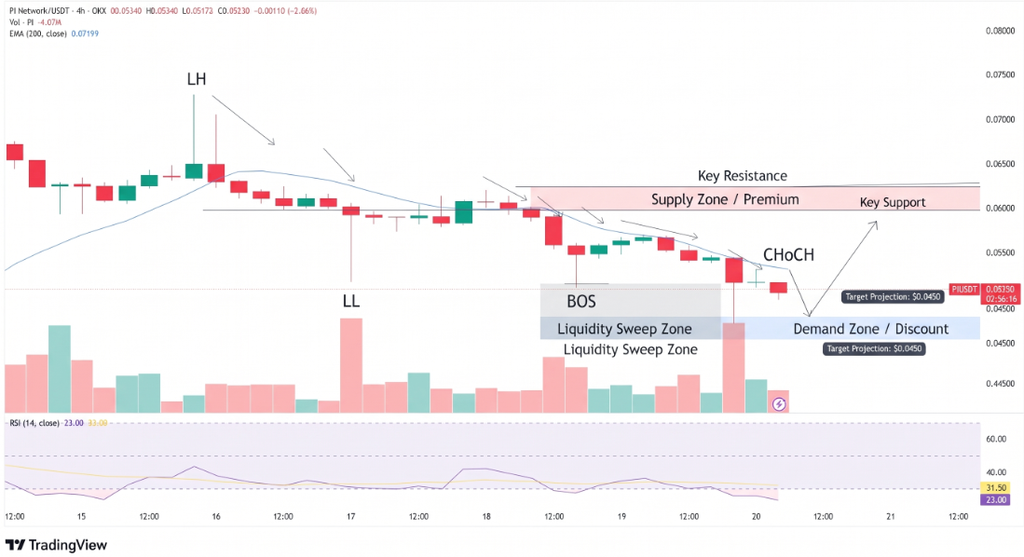
Further recovery targets include the $0.097 resistance level and the 200-day EMA near $0.106. However, reaching these levels would require a substantial reversal in market momentum and renewed buying interest.
On the downside, PI has no clearly established technical support beneath its latest record low of $0.051. A decisive break below this level could intensify selling pressure and expose the token to additional losses.
Conclusion
Pi Network’s ecosystem developments have yet to translate into stronger market demand. With PI trading near record lows, oversold momentum alone may not be enough to trigger a recovery. A sustained move above $0.073–$0.074 would provide the first meaningful indication that buyers are regaining control, while a breakdown below $0.051 could deepen the bearish outlook.
Sources & Methodology
Primary-source standard: Market-moving facts should link to original data releases, regulator notices, company filings or official project announcements whenever available. Secondary reporting is used for additional context, not as a substitute for original evidence.
Page last reviewed: