The US Dollar Index (DXY) trades near 103.75 on Monday, extending its decline for a second consecutive session after retreating from a 19-month high reached last week. The pullback reflects reduced expectations of aggressive Federal Reserve (Fed) tightening, although markets continue to anticipate another interest-rate increase in December. Escalating tensions involving Iran are also supporting demand for the US Dollar as a safe-haven asset. Investors now await US business activity figures and Wednesday’s Personal Consumption Expenditures (PCE) inflation report for fresh direction.
Fed rate expectations support the Dollar
The US Dollar Index, which measures the Greenback against six major currencies, remains close to its strongest level since April 2025 despite Monday’s decline.
Markets have moderated expectations for aggressive monetary tightening, limiting fresh Dollar buying. However, traders continue to fully price in a 25-basis-point rate increase at the Federal Open Market Committee’s December meeting. The CME FedWatch Tool also indicates growing expectations of additional increases in January and April 2027.
The prospect of higher borrowing costs remains supportive for the Dollar because elevated US interest rates can attract international investment into American assets. This outlook makes it difficult for the DXY to sustain a deeper correction, particularly while other major central banks face different economic and monetary conditions.
The next important catalyst will be the US economic calendar. November flash Purchasing Managers’ Index (PMI) figures could offer an early assessment of business activity, while Wednesday’s PCE Price Index will provide a more important indication of underlying inflation pressures.
Iran tensions preserve safe-haven demand
Geopolitical developments in the Middle East are providing another source of support for the Greenback. US President Donald Trump indicated that military action against Iran could resume in the new year if diplomatic negotiations fail, while the US naval blockade of Iranian shipping remains in place.
Iranian attacks on commercial vessels in the Strait of Hormuz and reported military operations involving US positions in Bahrain have heightened regional uncertainty. Iran-aligned Houthi forces have also continued attacks targeting Saudi Arabian energy infrastructure.
These developments keep a geopolitical risk premium in financial markets. During periods of heightened uncertainty, investors often increase exposure to the US Dollar because of its liquidity and international reserve-currency status.
Nevertheless, a reduction in tensions or progress toward a diplomatic agreement could weaken safe-haven demand and leave the DXY more exposed to its technical support levels.
DXY technical outlook shows bullish consolidation
On the four-hour chart, the Dollar Index remains above its 200-period Exponential Moving Average (EMA), suggesting that the broader bullish structure remains intact despite recent losses. The index is consolidating within a defined trading range.
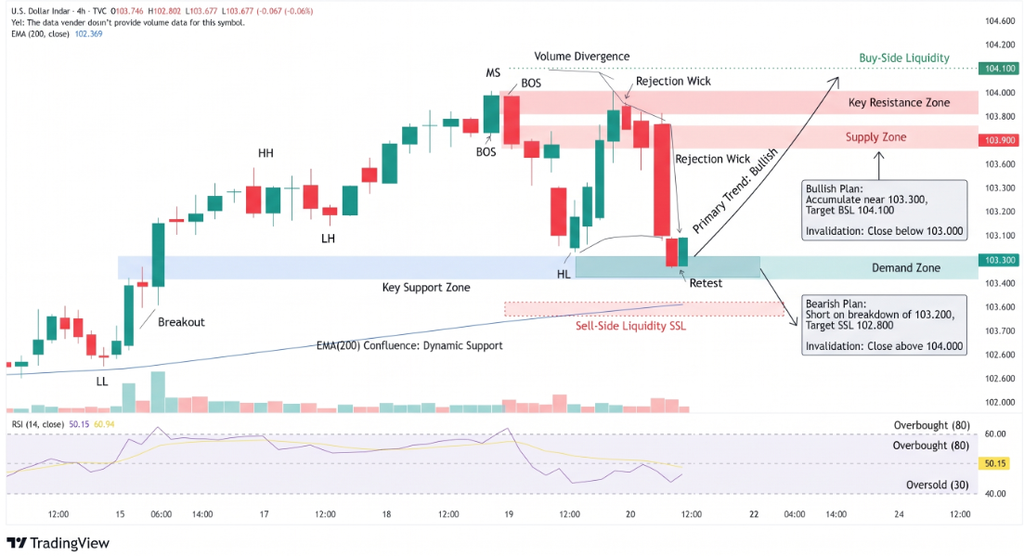
Key technical levels include:
- Current level: 103.75.
- Immediate support: 103.55–103.50, the range floor.
- Major support: 102.27, the four-hour 200-period EMA.
- Resistance: The recent 19-month high reached last week.
A sustained break below 103.50 could expose the 102.27 EMA, while a recovery from the range floor would preserve the current bullish consolidation structure.
Conclusion
The DXY faces short-term selling pressure, but expectations of further Fed tightening and persistent Middle East tensions continue to limit its downside. A break below 103.50 would increase the risk of a deeper correction toward 102.27. Conversely, stronger US inflation data or renewed geopolitical escalation could restore Dollar demand and support another attempt toward last week’s high.
Sources & Methodology
Primary-source standard: Market-moving facts should link to original data releases, regulator notices, company filings or official project announcements whenever available. Secondary reporting is used for additional context, not as a substitute for original evidence.
Page last reviewed: