
The Euro is attempting to recover against the US Dollar, but its broader outlook remains under pressure as investors anticipate further Federal Reserve interest-rate increases. EUR/USD recently traded near 1.0996, up 0.3% on the session, after approaching an 18-month low of 1.0953. Although the Dollar Index eased toward 103.64, the US currency remains supported by expectations of consecutive rate hikes. Traders are now watching whether buyers can defend the 1.0950 area and prevent another leg lower.
Fed Hike Expectations Support US Dollar
Expectations for tighter US monetary policy continue to limit the Euro’s recovery. Rabobank strategists say the overnight index swap (OIS) curve reflects a fully priced 25-basis-point increase in December, followed by nearly a 70% probability of another quarter-point move in January.
The shift follows hawkish signals from Federal Reserve officials, particularly Governor Christopher Waller. Waller has supported a December rate increase and indicated that policymakers should consider a larger 50-basis-point move if inflation remains elevated.
Higher US interest rates can strengthen the Dollar by increasing returns on dollar-denominated assets and widening the yield advantage over currencies whose central banks are moving more cautiously. This interest-rate gap remains a key obstacle for EUR/USD.
Nordea’s currency strategists also expect further Euro weakness. The bank maintains its year-end 2026 EUR/USD forecast at 1.10 and projects a decline toward 1.08 during the first half of 2027. Its outlook reflects wider rate differentials, US investment inflows and economic and political risks facing Europe.
November PMI Data in Market Focus
Investors are also preparing for preliminary November Purchasing Managers’ Index (PMI) releases from the Eurozone and United States. These surveys provide an early indication of business activity across manufacturing and services.
Stronger US readings could reinforce expectations that the Federal Reserve has room to tighten policy further, potentially supporting the Dollar. Conversely, improving Eurozone activity could help the single currency by reducing concerns about the region’s economic outlook.
The main developments traders are monitoring include:
- Fed policy: December and January rate expectations.
- US Dollar Index: Resistance near the recent 104.00 high.
- Eurozone activity: November preliminary manufacturing and services PMIs.
- US activity: Flash PMI readings and their implications for growth and inflation.
EUR/USD Technical Analysis: 1.0950 Key
On the weekly chart, EUR/USD trades below its 10-week exponential moving average (EMA) at 1.1155, preserving the broader bearish structure. The weekly Relative Strength Index (RSI) stands near 29.6, indicating oversold conditions. This suggests selling momentum is extended, although it does not guarantee an immediate reversal.
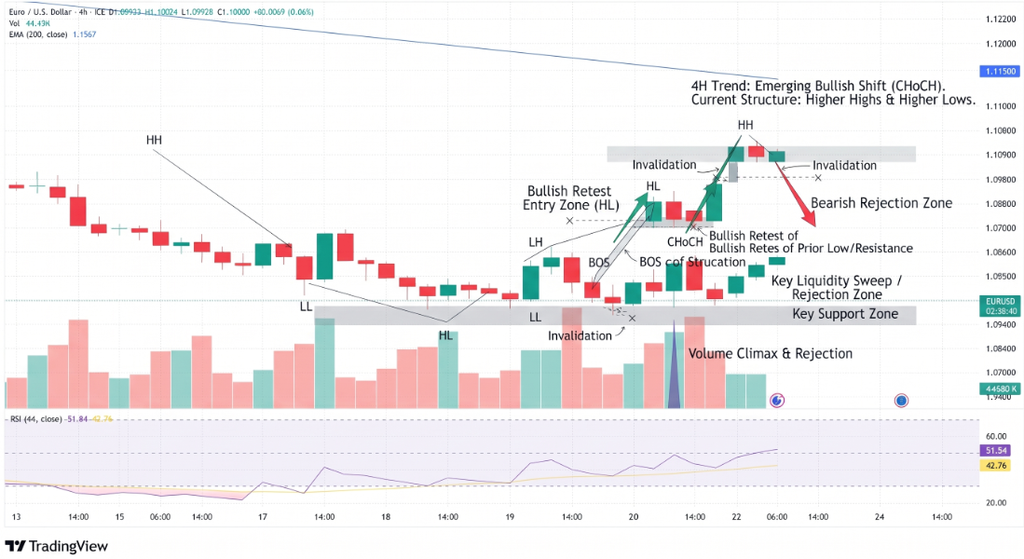
The 50.00% Fibonacci retracement at 1.1134 is the first major resistance, followed by the 10-week EMA at 1.1155. A sustained weekly close above this zone would weaken the immediate bearish outlook.
On the downside, traders are watching these levels:
- 1.0911: First major support at the 61.8% Fibonacci retracement.
- 1.0592: Next support at the 78.6% retracement.
- 1.0187: Deeper downside reference at the 100% retracement.
Conclusion
EUR/USD remains vulnerable while it trades below 1.1134–1.1155, with Fed tightening expectations supporting the Dollar. A decisive break below 1.0911 could expose 1.0592, while a sustained recovery above resistance would ease selling pressure. For now, the ability of buyers to defend the 1.0950 region remains central to the pair’s near-term direction.
Sources & Methodology
Primary-source standard: Market-moving facts should link to original data releases, regulator notices, company filings or official project announcements whenever available. Secondary reporting is used for additional context, not as a substitute for original evidence.
Page last reviewed: