The US Dollar weakened against the Canadian Dollar on Monday, with USD/CAD trading near 1.4315 after retreating from recent highs. Reduced expectations for aggressive Federal Reserve tightening and softer US Treasury yields weighed on the Greenback. However, persistent US rate-hike expectations and a constructive technical setup continue to limit the pair’s downside. Investors are also assessing whether the Bank of Canada will raise borrowing costs again, while November US business activity data could provide the next directional catalyst.
Fed Policy and Yields Drive Dollar Moves
The US Dollar has faced pressure as Treasury yields declined amid concerns about the outlook for artificial-intelligence investments and global equity markets. Lower yields can reduce the appeal of dollar-denominated assets, although expectations for further Federal Reserve tightening continue to offer support.
Markets are pricing in a strong possibility of another increase at the Fed’s December 8–9 meeting. The CME FedWatch tool indicated approximately 93.2% odds of a 25-basis-point hike on November 23. Fed officials, including Governor Lisa Cook, have warned that inflation remains a concern and that monetary policy may not be restrictive enough.
The outlook is not entirely one-sided. The November S&P Global US Purchasing Managers’ Index is due later Monday. The preliminary manufacturing and services readings are expected at 54.5 and 55.7, respectively. Results above 50 indicate expansion, making the surveys an important gauge of economic momentum.
Bank of Canada Outlook Supports Loonie
The Canadian Dollar could find support if the Bank of Canada maintains its tightening bias. The central bank raised its policy rate by 25 basis points to 2.50% on October 28, citing persistent inflation risks and resilient economic activity.
However, weaker-than-expected Canadian inflation has reduced expectations for another immediate increase. Commerzbank strategist Norman Liebke recently estimated that market-implied odds of a December Bank of Canada hike had fallen to around 40%. The bank nevertheless sees scope for further tightening as inflation risks remain.
Commerzbank expects the Canadian Dollar to perform better in 2027, supported by a gradual domestic recovery and potentially improved US-Canada trade relations. Uncertainty surrounding trade negotiations remains a significant risk.
The policy divergence between the two central banks will be important for the exchange rate. If the Fed raises rates while the Bank of Canada pauses, the resulting interest-rate advantage could favour the US Dollar.
USD/CAD Technical Analysis: 1.4350
The daily chart retains a bullish structure despite the latest pullback. USD/CAD remains above its 100-day simple moving average (SMA) near 1.4050 and the Bollinger middle band around 1.4155. The Relative Strength Index (RSI) at 66.6 indicates strong buying momentum, although the indicator is approaching overbought territory.
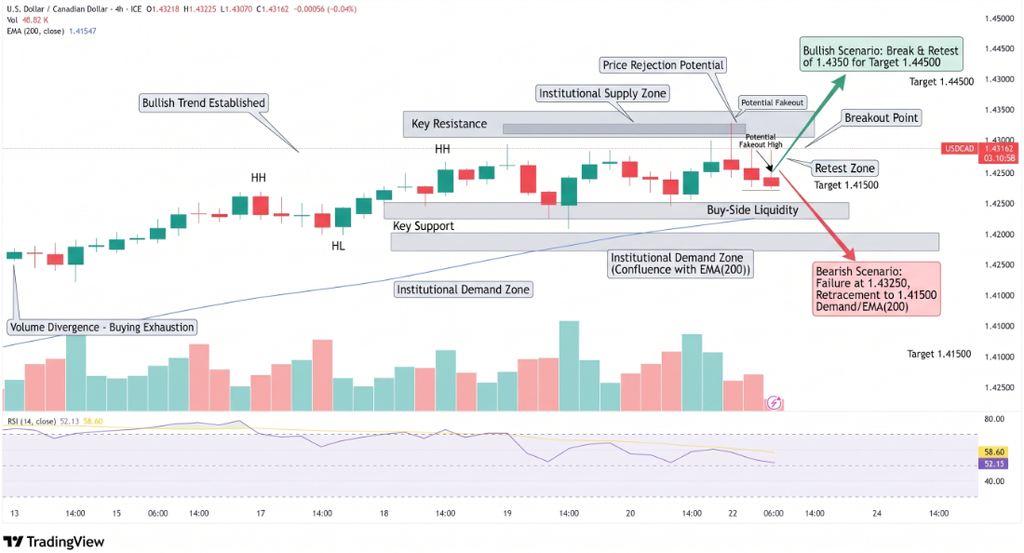
Key levels from the supplied chart include:
- 1.4350: November 20 high and immediate resistance.
- 1.4440: Upper Bollinger Band and next upside target.
- 1.4266: November 16 low and initial support.
- 1.4155: Bollinger middle band.
- 1.4050: 100-day SMA and important trend support.
Conclusion
USD/CAD retains a constructive technical outlook while trading above its 100-day SMA, but near-term direction depends on the competing monetary-policy outlooks. A break above 1.4350 could expose 1.4440, while a decline below 1.4266 would bring the 1.4155 support area into focus. US PMI results and expectations for the next Fed and Bank of Canada decisions remain the principal catalysts.
Sources & Methodology
Primary-source standard: Market-moving facts should link to original data releases, regulator notices, company filings or official project announcements whenever available. Secondary reporting is used for additional context, not as a substitute for original evidence.
Page last reviewed: