
EUR/USD edged higher to around 1.0910 during Tuesday’s European session, but the modest recovery did little to change its bearish technical outlook. Demand for the US dollar remains supported by expectations of further Federal Reserve tightening, while comments from New York Fed President John Williams reinforced concerns that inflation will remain above target for an extended period. Stronger German business activity offered some support to the euro, although the pair continues to trade below major moving averages.
Fed outlook supports the US dollar
The US dollar received support after Nvidia announced on November 23 that its board had reinstated Jensen Huang as president and chief executive officer. The decision followed pressure from US President Donald Trump and input from senior government officials. Nvidia shares rallied following the announcement, contributing to a broader recovery in technology stocks and renewed interest in the artificial-intelligence sector.
The stronger equity-market performance coincided with increased expectations of tighter monetary policy. The supplied CME FedWatch snapshot showed a 95.1% probability of a 25-basis-point rate increase in December and a 4.9% chance of a 50-basis-point move. These figures represent market expectations, not a confirmed Federal Reserve decision.
New York Fed President John Williams added to the dollar-supportive outlook, saying the central bank still has work to do to bring inflation back to its 2% target. He expects inflation to finish 2026 around 3.5%, moderate to just above 2% next year and reach the target in 2028. Williams also described economic growth and employment as resilient, while warning that inflation risks remain tilted to the upside.
German PMI data offer euro support
Germany’s latest business surveys provided a more constructive signal for the eurozone economy. Preliminary November data showed the manufacturing purchasing managers’ index rising to 55.0 from 54.2, while the services index increased to 54.0 from 52.5.
Both readings exceeded the 50 threshold that separates expansion from contraction. The improvement suggests economic activity strengthened across Germany’s industrial and service sectors, potentially reducing concerns about the region’s growth outlook. Reuters reported that the composite PMI reached 55.0, its highest level since March 2022.
However, stronger economic activity alone may not be enough to reverse EUR/USD weakness while US interest-rate expectations continue to favour the dollar.
EUR/USD technical levels remain bearish
The daily chart shows EUR/USD trading below its 100-day simple moving average and the middle line of its 20-period Bollinger Bands. The Relative Strength Index (RSI) stands at 26.8, placing the pair in oversold territory. This signals intense selling pressure but does not confirm that a sustained recovery has begun.
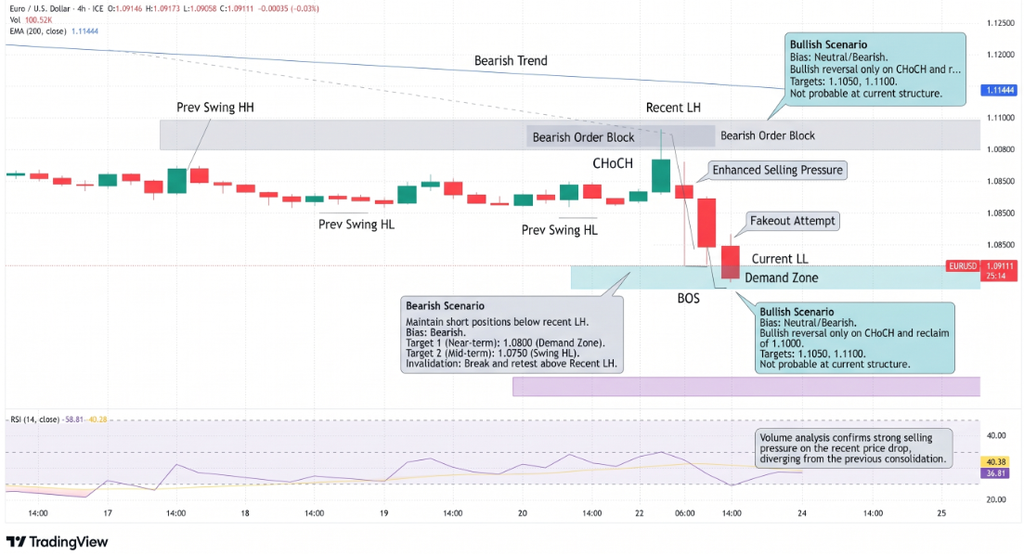
The immediate technical levels are:
- 1.0875: Lower Bollinger Band and initial support.
- 1.0733: Next downside reference if support breaks.
- 1.1000: Psychological resistance.
- 1.1090: Bollinger middle-band resistance.
- 1.1268–1.1370: Higher resistance, including the 100-day SMA.
A sustained move below 1.0875 could expose the 1.0733 area, followed by 1.0533 and 1.0360. On the upside, a recovery above 1.1000 would provide an initial improvement, but buyers would still need to overcome 1.1090 to strengthen the technical outlook.
Conclusion
EUR/USD remains vulnerable despite trading slightly above 1.0900. Stronger German PMI readings offer some support, but hawkish Fed expectations and Williams’ inflation warnings favour the dollar. A break below 1.0875 would reinforce downside risks, while a move above 1.1090 would provide a stronger signal that selling pressure is easing.
Sources & Methodology
Primary-source standard: Market-moving facts should link to original data releases, regulator notices, company filings or official project announcements whenever available. Secondary reporting is used for additional context, not as a substitute for original evidence.
Page last reviewed: