USD/CAD eased toward 1.4360 during Tuesday’s European session after approaching a recent high of 1.4385. Despite the pullback, the pair retains a bullish technical structure, supported by expectations of further Federal Reserve tightening. However, the Canadian dollar could find support from a more hawkish Bank of Canada and the possibility of improving US-Canada trade relations. Traders are therefore weighing diverging central-bank outlooks against an overbought US dollar rally.
Fed rate expectations support the US dollar
The US dollar remains supported by expectations that the Federal Reserve will raise interest rates in December. New York Fed President John Williams said on November 23 that inflation remains too high and that policymakers must continue working toward the central bank’s 2% target. He expects inflation to finish 2026 near 3.5%, ease to just above 2% next year and return to the target in 2028.
Markets have consequently increased expectations for another rate increase. The supplied CME FedWatch snapshot showed a 95.1% probability of a 25-basis-point hike and a 4.9% chance of a larger 50-basis-point move in December. These probabilities represent market pricing rather than a confirmed Federal Reserve decision.
The outlook for US monetary policy has also received attention following Nvidia’s announcement that its board reinstated Jensen Huang as chief executive. The decision helped lift technology shares and improve appetite for artificial-intelligence investments, although the stock-market recovery does not itself determine the Fed’s next move.
Bank of Canada outlook supports the loonie
The Canadian dollar could recover some ground if the Bank of Canada continues tightening monetary policy. The central bank raised its policy rate by 25 basis points to 2.50% on October 28, citing persistent inflation risks, higher energy prices and stronger economic activity. Officials said further increases could be necessary, while emphasizing that decisions would depend on incoming data.
Commerzbank expects the Canadian dollar to perform better in 2027, arguing that additional BoC tightening and potentially improved trade relations with the United States could support the currency. However, renewed trade tensions remain a significant risk for Canada’s export-dependent economy.
The bank also sees a possible divergence between Fed market expectations and its economists’ forecasts as a factor that could limit further US dollar strength. This outlook is conditional: differences in central-bank policy expectations can change quickly as inflation and growth data evolve.
USD/CAD technical outlook remains bullish
USD/CAD continues to trade above its 100-day simple moving average and the middle line of its Bollinger Bands, preserving the broader upward bias. However, the Relative Strength Index (RSI) near 71 indicates overbought conditions, increasing the possibility of a short-term correction.
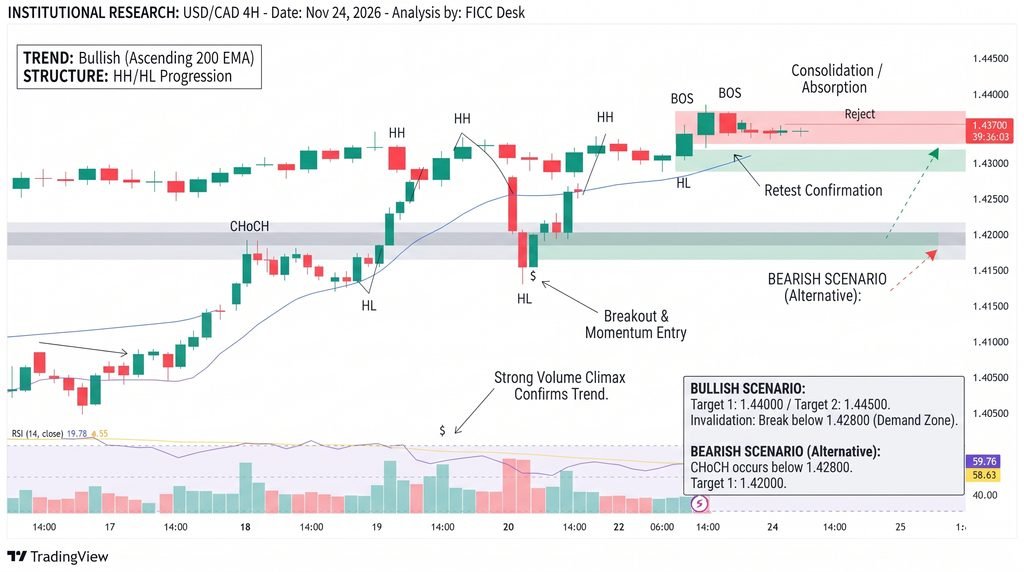
The main technical levels are:
- 1.4385: November 23 high and immediate resistance.
- 1.4475: Upper Bollinger Band and next upside hurdle.
- 1.4273: Initial support near the November 17 low.
- 1.4175: Bollinger middle-band support.
- 1.4055: 100-day SMA and deeper support.
A sustained break above 1.4385 could expose 1.4475. Conversely, a decline below 1.4273 would weaken near-term momentum and bring 1.4175 into focus.
Conclusion
USD/CAD retains a bullish technical bias, but elevated RSI readings suggest the rally may be vulnerable to consolidation. Further Fed tightening expectations support the US dollar, while the Bank of Canada’s hawkish stance could strengthen the loonie. The 1.4385 resistance and 1.4273 support levels are key to determining the pair’s next move.
Sources & Methodology
Primary-source standard: Market-moving facts should link to original data releases, regulator notices, company filings or official project announcements whenever available. Secondary reporting is used for additional context, not as a substitute for original evidence.
Page last reviewed: