The U.S. dollar held near a 20-month high on Tuesday, with the US Dollar Index (DXY) trading around 104.37 after reaching 104.57 on Monday. The rally has brought the index close to a key resistance level identified by analysts at 104.60. Stronger technology shares and expectations of elevated U.S. inflation have supported the currency, but stretched technical indicators and concerns about month-end trading flows raise the risk of a pause.
Dollar rally approaches 104.60 resistance
The dollar strengthened on Monday as global equities rebounded following Nvidia’s decision to reinstate Jensen Huang as chief executive. The move helped restore confidence in technology and artificial-intelligence investments, improving sentiment toward U.S. assets. Commerzbank described the equity recovery as a major overnight market theme, linking it to renewed confidence in the AI trade.
However, the dollar’s advance may have moved too quickly. Analysts at ING said the DXY had reached their previously identified 104.60 target. They cautioned that the index had covered considerable ground in a short period and that month-end currency flows, combined with thin holiday-market liquidity, may have amplified Monday’s gains.
ING considers 104.60 an important resistance area and expects it to be difficult for the index to sustain a decisive break above that level this week. That view does not rule out further gains, particularly if U.S. inflation data reinforces expectations that monetary policy will remain restrictive.
PCE inflation and Fed policy in focus
Investors are preparing for October’s Personal Consumption Expenditures (PCE) price index, the Federal Reserve’s preferred inflation measure. The supplied market estimates put headline PCE inflation at 3.8% year over year, up from 3.6% in September. Core PCE, which excludes food and energy, is expected at 3.2%, compared with 3.1% previously.
A stronger-than-expected reading could reinforce the case for keeping interest rates higher for longer, potentially supporting the dollar. Conversely, softer inflation could reduce pressure on the Fed to tighten policy and encourage investors to reassess dollar positions.
ING suggested that a more sustained dollar correction may depend on later economic releases and the Fed’s December 9 meeting. The bank also highlighted the November consumer price index report, scheduled in the supplied outlook for December 10, as a possible catalyst. These dates and forecasts should be checked against the latest official calendar before publication.
Key factors for dollar traders include:
- Wednesday’s October PCE inflation figures.
- Expectations for the Fed’s December policy decision.
- Month-end currency flows and holiday-market liquidity.
- Whether the DXY can sustain a break above 104.60.
DXY technical outlook remains bullish
On the weekly chart, the Dollar Index traded near 104.32, above its 20-week exponential moving average at 101.60. The 61.8% Fibonacci retracement at 104.65 is the immediate technical barrier, closely matching ING’s 104.60 resistance assessment.
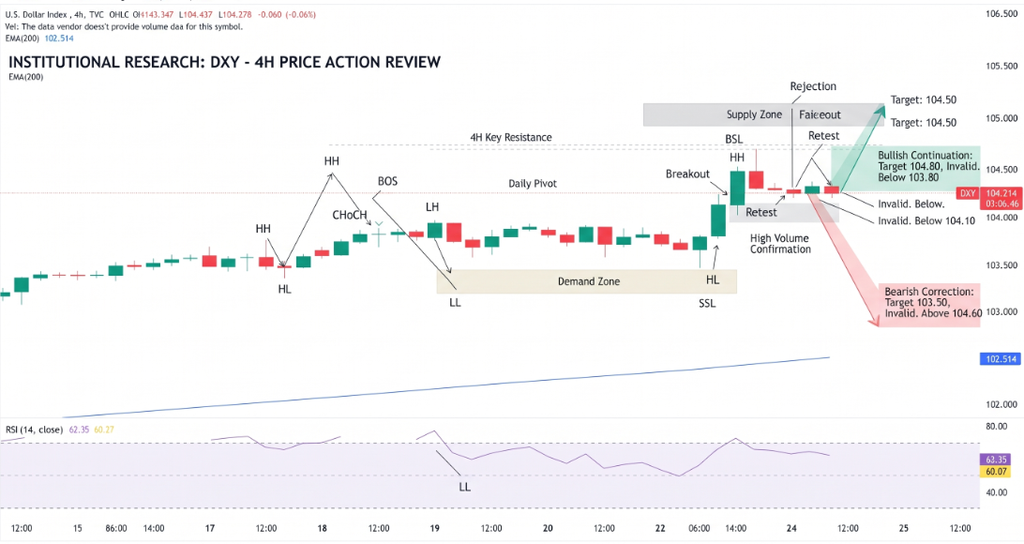
The weekly Relative Strength Index stood at 71.61, above the conventional 70 overbought threshold. This indicates strong momentum but also raises the possibility of consolidation or a pullback if buyers lose strength.
Above 104.65, the next Fibonacci resistance levels are 107.10 and 110.22. On the downside, initial support lies at 102.93, followed by the 101.60–101.21 area. Deeper declines could expose 99.08 and 95.64.
Conclusion
The dollar’s broader technical trend remains positive, but its approach toward 104.60–104.65 leaves limited room for error. A sustained breakout would strengthen the bullish outlook, while a rejection near resistance and softer inflation data could trigger profit-taking. The next move will depend heavily on whether U.S. economic figures justify the market’s expectations for continued monetary restraint.
Sources & Methodology
Primary-source standard: Market-moving facts should link to original data releases, regulator notices, company filings or official project announcements whenever available. Secondary reporting is used for additional context, not as a substitute for original evidence.
Page last reviewed: