
The Japanese yen weakened against the U.S. dollar on Tuesday, lifting USD/JPY by 0.15% to around 159.20 in early European trading. The pair is approaching a major resistance level at 160.40, which traders are watching for confirmation of another upward move. Stronger demand for U.S. assets, renewed enthusiasm for artificial-intelligence stocks and expectations of further Federal Reserve tightening have supported the dollar. In Japan, investors are turning their attention to Friday’s Tokyo inflation report for clues about the Bank of Japan’s policy outlook.
Dollar strength supports USD/JPY
The USD/JPY pair advanced as the U.S. dollar retained much of its recent strength. The US Dollar Index, which measures the dollar against six major currencies, traded near 104.53, close to a 20-month high.
Renewed interest in the artificial-intelligence sector helped support U.S. assets after Nvidia’s board reinstated Jensen Huang as chief executive. The recovery in technology shares improved market sentiment toward the United States, although equity-market gains alone do not establish the cause of currency movements.
Interest-rate expectations have also favored the dollar. According to the supplied CME FedWatch snapshot, traders see a strong possibility of a Federal Reserve rate increase at its December meeting, with further tightening also being considered for subsequent meetings. These probabilities reflect market pricing rather than a confirmed policy decision.
Higher U.S. interest rates relative to Japanese rates can support USD/JPY by making dollar-denominated assets more attractive. However, the pair remains sensitive to changes in Treasury yields, risk appetite and expectations for Japanese monetary policy.
Tokyo inflation puts yen in focus
Japan’s November Tokyo Consumer Price Index is scheduled for release on Friday. The measure excluding fresh food is forecast at 2.9% year over year, up from 2.6% in October, according to the supplied estimates.
Tokyo inflation is closely watched because it provides an early indication of price trends ahead of national data. A stronger reading could reinforce expectations that the Bank of Japan may consider further policy normalization, potentially supporting the yen. A softer result could have the opposite effect.
For currency traders, the key question is whether Japanese inflation strengthens the case for higher domestic interest rates while U.S. rates remain elevated. A narrowing gap between the two countries’ yields could reduce the dollar’s advantage against the yen.
USD/JPY technical levels to watch
On the daily chart, USD/JPY traded near 159.19, above its 20-day exponential moving average at 158.84. That position supports a constructive short-term outlook. The Relative Strength Index stood at 54.56, indicating modest positive momentum without showing overbought conditions.
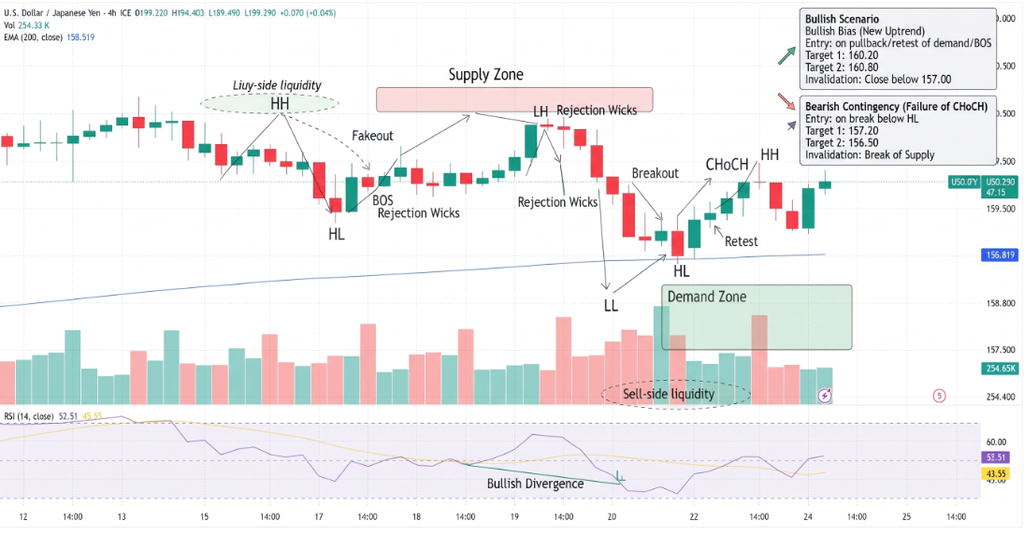
The September high near 160.40 is the immediate resistance level. A decisive daily close above it would provide stronger evidence that buyers are attempting to establish another upward leg.
The main technical levels are:
- Immediate support: 158.84, at the 20-day EMA.
- Breakout resistance: 160.40, near the September high.
- Next upside target: 162.00.
- Higher resistance: 163.74, the July 30 high.
A sustained move below 158.84 would weaken the near-term bullish setup and expose the pair to a deeper correction.
Conclusion
USD/JPY retains a modest bullish bias while trading above its 20-day EMA, but the 160.40 barrier remains decisive. A confirmed break could bring 162.00 and 163.74 into view. Failure to clear resistance, particularly alongside stronger Japanese inflation, could instead encourage yen buying and keep the pair range-bound.
Sources & Methodology
Primary-source standard: Market-moving facts should link to original data releases, regulator notices, company filings or official project announcements whenever available. Secondary reporting is used for additional context, not as a substitute for original evidence.
Page last reviewed: