
The US Dollar Index (DXY) traded almost unchanged near 103.75 on Thursday, November 26, as trading activity slowed during the Thanksgiving holiday. The index remained below 104.00 after retreating from a 19-month high near 104.53 earlier in the week. Strong US economic data have strengthened expectations of further Federal Reserve rate increases, but declining Treasury yields and concerns about an artificial-intelligence stock bubble continue to limit the dollar’s advance.
Strong GDP and inflation support the dollar
US economic figures released Wednesday reinforced the case for tighter monetary policy. The Bureau of Economic Analysis revised third-quarter GDP growth to an annualized 4.3%, up from 2.2% in the second quarter and above the previous estimate of 3.4%.
Inflation also remained elevated. The October Personal Consumption Expenditures (PCE) Price Index increased 3.8% from a year earlier, while core PCE, which excludes food and energy, advanced 3.3%. Both measures rose 0.3% month over month.
The figures indicate that inflation remains well above the Federal Reserve’s 2% target, even as economic activity continues to expand. Markets have consequently increased expectations of another quarter-point rate increase at the Fed’s December meeting, with the possibility of further tightening in early 2027.
Higher interest rates generally support the dollar by improving the returns available on US assets. However, the currency’s response has been restrained by developments in the bond and equity markets.
Falling Treasury yields and AI concerns weigh
Despite the stronger economic figures, the dollar struggled to extend its gains on Wednesday. The yield on the benchmark 10-year US Treasury note dropped to around 4.80% intraday, its lowest level in roughly two and a half months.
The decline reflected demand for government bonds as investors reassessed risks in the technology sector. Concerns that heavy artificial-intelligence investment may not deliver sufficient returns have increased volatility in technology shares and encouraged some investors to seek safer assets.
Lower Treasury yields can reduce the dollar’s appeal because they narrow the returns available to investors holding US government debt. This has created a conflict for currency markets: strong growth and inflation support higher interest rates, while falling yields weaken one of the dollar’s key sources of demand.
Trade policy added another layer of uncertainty. On November 25, the US Trade Representative announced proposed trade measures targeting 14 economies, including China, Japan and the European Union. The proposed duties are not expected to be added on top of the tariffs announced in July and may not take effect until 2027.
DXY levels and the Fed outlook
The dollar index’s immediate direction will depend on whether interest-rate expectations or weaker Treasury yields dominate investor positioning. The 104.00 level remains an important psychological threshold, while the recent high near 104.53 represents a more substantial resistance reference.
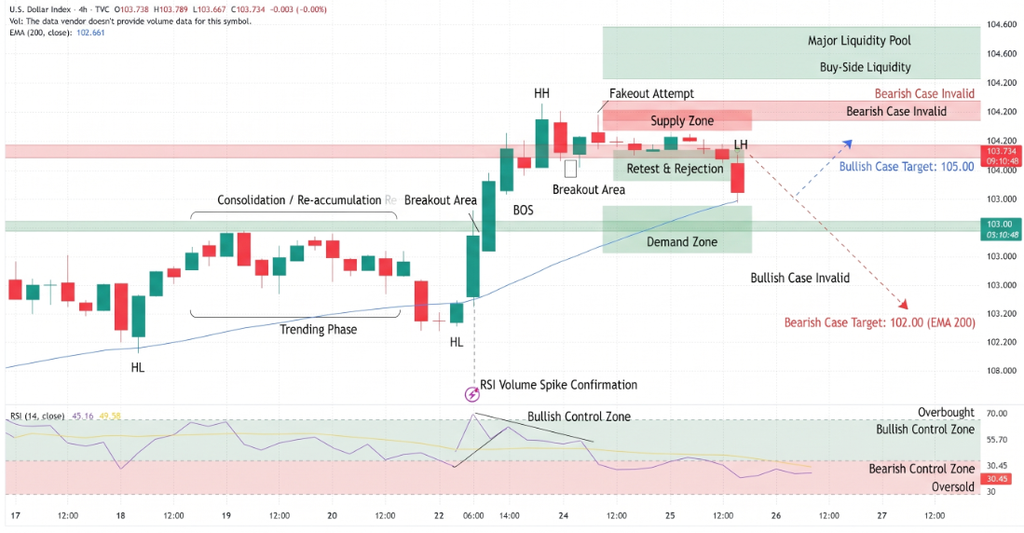
On the downside, the 103.55 area is an important near-term support level. A sustained move below it could signal further weakness, particularly if Treasury yields continue to decline.
Key factors influencing the next move include:
- Federal Reserve policy: Expectations for a 25-basis-point increase in December.
- Inflation: October headline PCE at 3.8% and core PCE at 3.3% annually.
- Economic growth: Third-quarter GDP revised higher to 4.3%.
- Treasury yields: The 10-year yield briefly touched 4.80%.
- Market sentiment: AI-sector volatility and uncertainty surrounding proposed US tariffs.
Conclusion
The DXY remains supported by resilient US growth and persistent inflation, both of which strengthen the case for further Federal Reserve tightening. However, falling Treasury yields and concerns about technology-sector valuations are preventing the dollar from converting those fundamentals into a decisive rally. A sustained break above 104.00 would improve the near-term outlook, while a move below 103.55 could expose the index to additional losses. Investors will continue watching bond yields, inflation expectations and Fed communication for clearer direction into 2027.
Sources & Methodology
Primary-source standard: Market-moving facts should link to original data releases, regulator notices, company filings or official project announcements whenever available. Secondary reporting is used for additional context, not as a substitute for original evidence.
Page last reviewed: