
The euro edged higher against the British pound on Thursday, November 26, with EUR/GBP trading near 0.8375. The pair has stabilised after several weeks of selling, with two recent lows around 0.8315 raising the possibility of a double-bottom reversal. However, buyers have struggled to overcome resistance around 0.8400. Weak German consumer confidence and shifting currency-hedging positions are shaping the outlook as traders assess whether the pound’s recent strength is losing momentum.
German sentiment offers limited euro support
Germany’s latest GfK consumer climate survey, released on November 26, showed a modest improvement in household sentiment heading into December. The index increased 0.7 points to -30.2 from a revised -30.9 in November. However, the reading missed the average market forecast of -29.9 and remained deeply negative.
The survey highlighted persistent pressure on German households. Income expectations improved to -13.9, while willingness to buy edged up to -11.5. However, economic expectations fell 3.7 points to -1.6, ending a six-month run of gains. Inflation concerns also increased, pointing to continued caution among consumers.
The figures provided little reason for investors to aggressively buy the euro. Germany remains a key driver of the eurozone economy, and prolonged weakness in consumer confidence could weigh on expectations for domestic demand.
Meanwhile, BNY analysts have highlighted an unusual shift in currency-hedging activity. The hedge ratio among GBP-based investors has moved above the equivalent ratio among EUR-based investors, creating the widest gap in more than three months. BNY argues that EUR/GBP is already heavily underheld, leaving limited scope for additional pound-related hedging unless expectations for a more hawkish Bank of England change.
Double bottom puts 0.8400 in focus
On the four-hour chart, EUR/GBP is trading near 0.8375, with the broader bearish trend still intact. However, lows recorded on October 30 and November 17 near 0.8315 suggest a potential double-bottom formation.
A double bottom develops when a market tests a similar support area twice and subsequently attempts to recover. The pattern can indicate that selling pressure is weakening, but it is not confirmed until price breaks above resistance separating the two lows.
Momentum indicators offer mixed signals. The 14-period Relative Strength Index (RSI) remains above 50, suggesting improving buying momentum. However, the Moving Average Convergence Divergence (MACD) remains below zero, indicating that the broader bearish momentum has not fully disappeared.
Key EUR/GBP levels to watch
The immediate resistance zone stretches from 0.8385 to 0.8402. A decisive break above 0.8402 would strengthen the double-bottom signal and expose the October 19 high near 0.8430.
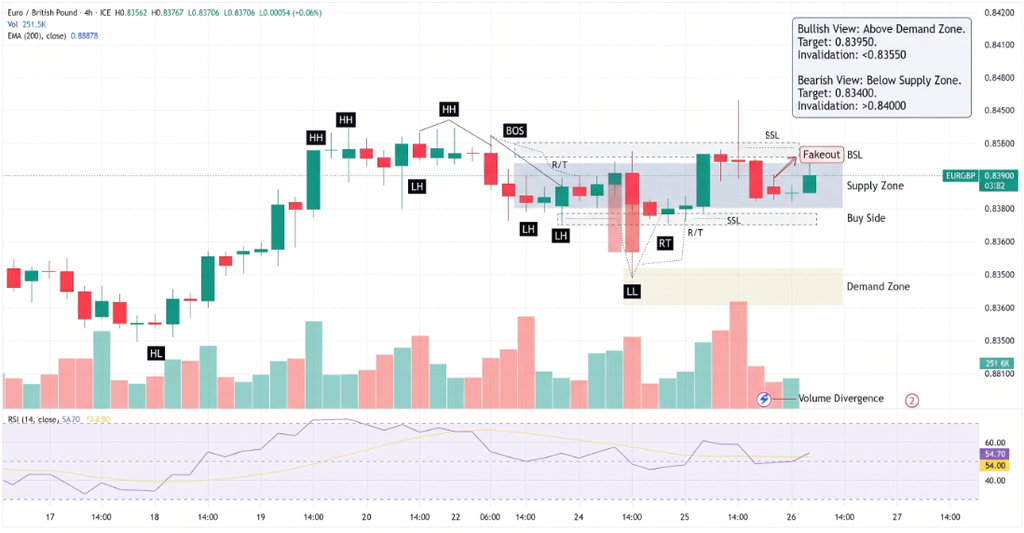
On the downside, Tuesday’s low at 0.8357 represents immediate support. A break below that level would weaken the recovery attempt and bring the 0.8315 support zone back into focus.
Important levels include:
- Resistance: 0.8385 and 0.8402.
- Next upside target: 0.8430.
- Immediate support: 0.8357.
- Major support: 0.8315.
Conclusion
EUR/GBP is showing early signs of stabilisation, but the recovery remains unconfirmed while the pair trades below 0.8402. Improving momentum and BNY’s positioning analysis suggest that the pound’s recent rally could be losing strength. Nevertheless, a sustained break above resistance is necessary to validate the double-bottom formation. Until then, the broader bearish trend remains a risk, with 0.8357 and 0.8315 serving as important downside levels.
Sources & Methodology
Primary-source standard: Market-moving facts should link to original data releases, regulator notices, company filings or official project announcements whenever available. Secondary reporting is used for additional context, not as a substitute for original evidence.
Page last reviewed: