
The US dollar traded near 159.15 against the Japanese yen on Thursday, November 26, as opposing monetary-policy expectations kept the currency pair confined to a narrow range. Strong US growth and persistent inflation are strengthening expectations of further Federal Reserve tightening, while increasingly hawkish signals from the Bank of Japan (BoJ) are supporting the yen. With USD/JPY holding close to its 20-day exponential moving average (EMA), traders are watching upcoming Japanese inflation data for a potential catalyst.
US inflation and GDP support the dollar
Recent US economic figures have reinforced the argument for maintaining restrictive monetary policy. October Personal Consumption Expenditures (PCE) inflation, the Federal Reserve’s preferred inflation measure, rose 0.3% month over month. Core PCE, which excludes food and energy, also increased 0.3%, taking its annual rate to 3.3%, above the 3.2% market forecast.
Economic growth provided another source of support for the dollar. The US third-quarter GDP estimate was revised upward to an annualized 4.3% from 3.4%. Stronger consumer spending and investment contributed to the improvement, highlighting the resilience of the US economy.
The US Dollar Index (DXY) traded near 103.70 after recovering from Wednesday’s low around 103.55. A stronger dollar could keep USD/JPY supported, although expectations of tighter BoJ policy are limiting further gains.
BoJ signals faster rate increases
The yen has received support from increasingly hawkish comments by BoJ board member Naoki Tamura. He has argued that policymakers should respond quickly to signs of inflation exceeding the central bank’s 2% target and consider accelerating the pace of interest-rate increases.
Tamura identified several risks that could push Japanese inflation higher, including the weak yen, rising import costs, Middle East tensions and strong demand for artificial-intelligence-related products. He also described the current 1.25% policy rate as remaining below a neutral level.
Markets are assigning roughly a 75% to 80% probability to a December increase to 1.50%, according to Danske Bank’s assessment. The next BoJ policy decision is scheduled for December 18.
Investors are also monitoring November Tokyo CPI, a regional inflation gauge that often provides an early indication of Japan’s nationwide price trends. The forecast calls for inflation excluding fresh food to accelerate to 3.0% annually from 2.6%.
USD/JPY technical levels to watch
On the daily chart, USD/JPY trades near 159.17, slightly above its 20-day EMA at 158.91. The average has flattened, reflecting a lack of strong directional momentum. The 14-day Relative Strength Index (RSI) stands at 54.20, indicating modest positive momentum without an overbought signal.
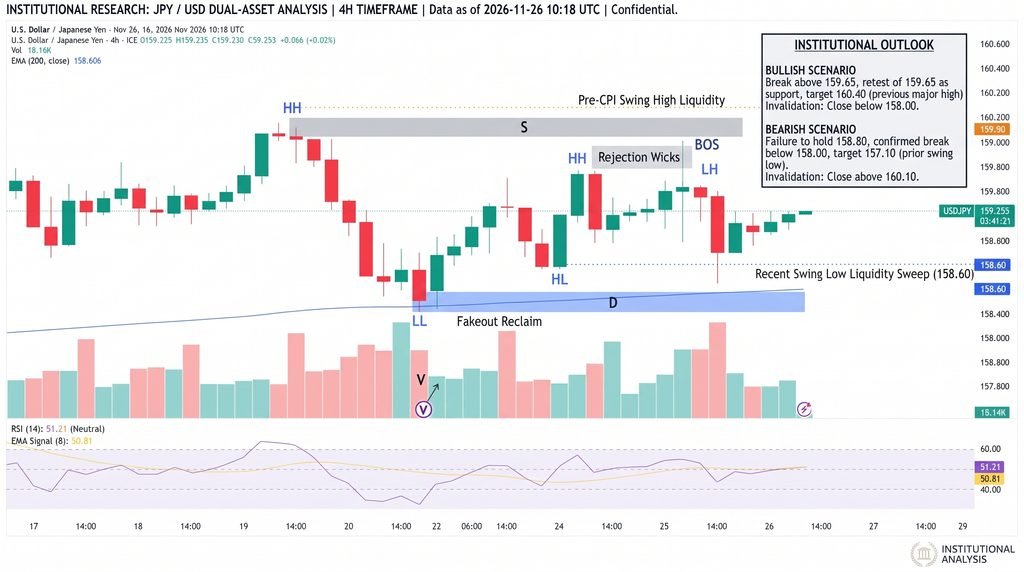
The immediate technical levels are:
- First support: 158.91, near the 20-day EMA.
- Major support: 157.26, the November 6 low.
- Key resistance: 160.39, the September high.
Conclusion
USD/JPY remains caught between strong US economic fundamentals and rising expectations of Japanese monetary tightening. Holding above 158.91 would preserve a mildly constructive near-term bias, while a break below 157.26 could deepen the correction. On the upside, a sustained move through 160.39 would be needed to establish a clearer bullish continuation. Tokyo inflation data and the BoJ’s December decision are likely to shape the next significant move.
Sources & Methodology
Primary-source standard: Market-moving facts should link to original data releases, regulator notices, company filings or official project announcements whenever available. Secondary reporting is used for additional context, not as a substitute for original evidence.
Page last reviewed: