
Pi Network (PI) is showing early signs of stabilization after three consecutive weeks of losses, with the token trading around $0.0541 on Friday. A rebound from its recent record low of $0.0473 suggests selling pressure may be easing, while technical indicators point to a gradual recovery in momentum. However, the broader trend remains bearish, and PI must break above the $0.0584 Fibonacci resistance level to establish a stronger bullish reversal.
Extreme Fear Weighs on PI Sentiment
The broader cryptocurrency market continues to face considerable uncertainty. Bitcoin (BTC) is trading near $60,000, with attempts to stabilize potentially providing some support for alternative cryptocurrencies, including Pi Network.
However, market sentiment remains deeply negative. The CoinMarketCap Fear and Greed Index stands around 11, placing the market firmly in the Extreme Fear category.
The index measures investor sentiment using factors such as market momentum, volatility and broader trading activity. Readings near extreme fear generally reflect defensive positioning and limited willingness to take risks.
This environment creates challenges for smaller cryptocurrencies such as PI, which can experience sharper price movements when liquidity and investor confidence weaken.
Pi Network has already experienced substantial selling pressure, with its token declining more than 30% across three consecutive weeks. Although Friday’s recovery indicates that buyers are returning, the broader market environment makes a sustained rally uncertain.
PI Price Forecast: $0.0584 in Focus
PI traded around $0.0541 on Friday, remaining above the psychological $0.0500 threshold after recovering from its recent record low of $0.0473.
Despite the improvement, the technical structure remains bearish. The token trades below its 50-day Exponential Moving Average (EMA) at $0.0690 and its 200-day EMA at $0.1030. Both averages indicate that the broader price trend remains under pressure.
Another obstacle is the descending resistance trendline connecting the June 20 and August 22 highs, currently positioned near $0.0667. This trendline reinforces the supply pressure facing PI during recovery attempts.
Momentum indicators, however, suggest that selling pressure may be moderating. The Relative Strength Index (RSI) is near 35, indicating weak momentum and mildly oversold conditions. Meanwhile, the Moving Average Convergence Divergence (MACD) has flattened around the zero line, suggesting bearish momentum is losing strength.
Key Support and Resistance Levels
The $0.0584 Fibonacci extension level is the immediate technical barrier that bulls must overcome. This level, calculated using the supplied Fibonacci reference points of $0.1394 and $0.0703, represents the first major confirmation point for a potential recovery.
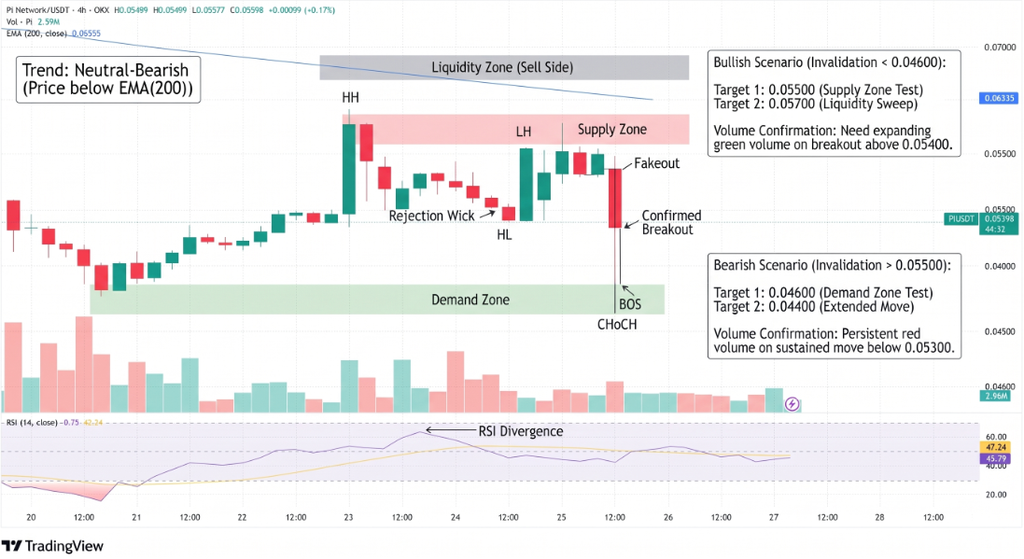
A sustained breakout above $0.0584 could expose the 50-day EMA at $0.0690. A subsequent move above $0.0667 would also help weaken the descending trendline resistance.
Traders should monitor these important levels:
- Immediate support: $0.0500
- Record-low support: $0.0473
- Lower Fibonacci support: $0.0461
- First major resistance: $0.0584
- Trendline resistance: $0.0667
- 50-day EMA: $0.0690
- 200-day EMA: $0.1030
On the downside, losing $0.0500 could expose PI to renewed selling toward the $0.0473 record low. A breakdown below that level would bring the $0.0461 Fibonacci extension into focus.
Conclusion
Pi Network is showing early signs of a recovery after three consecutive weeks of losses, but the broader bearish structure remains intact. Improving momentum indicators offer some encouragement, although extreme market fear continues to limit buying confidence. A sustained move above $0.0584 would strengthen the bullish reversal case and open the way toward $0.0690. Until then, PI remains vulnerable to renewed selling pressure around its $0.0500 support level.
Sources & Methodology
Primary-source standard: Market-moving facts should link to original data releases, regulator notices, company filings or official project announcements whenever available. Secondary reporting is used for additional context, not as a substitute for original evidence.
Page last reviewed: