
The US Dollar Index (DXY) traded near 103.70 on Friday, struggling to extend its recent advance as improving risk sentiment and reduced expectations of aggressive Federal Reserve rate increases limited demand for the greenback. The index remained below 103.85 after two sessions of narrow trading during the Thanksgiving holiday period. Despite its subdued weekly performance, the dollar remained approximately 1.7% higher for November, reflecting gains earlier in the month.
Risk appetite limits dollar demand
The DXY, which measures the US dollar against six major currencies, was last trading around 103.70. Investors reduced exposure to dollar positions despite stronger-than-expected economic signals, including an upward revision to third-quarter US GDP and elevated inflation.
The latest Federal Reserve Beige Book, published on November 25, offered a mixed assessment of economic conditions. Eight of the Fed’s 12 districts reported slight-to-moderate growth, while four recorded no change. Employment increased slightly, and businesses continued to report rising prices and operating costs.
Technology-sector volatility has also influenced currency positioning. Concerns about the profitability of artificial-intelligence investments have weighed on technology shares, although stabilisation in risk sentiment has reduced demand for the dollar as a defensive asset.
The dollar’s immediate performance reflects several competing forces:
- Strong inflation and economic growth support expectations for higher US interest rates.
- Improved investor sentiment reduces demand for traditional safe-haven currencies.
- Uncertainty surrounding technology valuations encourages cautious positioning.
Fed outlook shapes dollar direction
The Federal Reserve’s December 8–9 policy meeting remains a central focus for currency traders. Persistent inflation has strengthened expectations that policymakers may increase borrowing costs, but market participants have become less confident about the possibility of a larger, 50-basis-point move.
Higher interest rates generally support the dollar because they can increase returns on US assets relative to investments in other currencies. However, the prospect of tighter financial conditions and weaker equity markets could complicate the Fed’s decision.
Analysts at MUFG have highlighted that tighter financial conditions, including a stronger dollar and declining equity prices, could reduce the need for additional rate increases. This creates a potential counterweight to the inflation-driven argument for further monetary tightening.
DXY technical outlook and key levels
On the four-hour chart, the DXY retains a modestly bullish broader structure, but momentum indicators suggest that buying pressure is weakening. The Relative Strength Index (RSI) has moved below its 50 midpoint, while the Moving Average Convergence Divergence (MACD) histogram remains slightly negative.
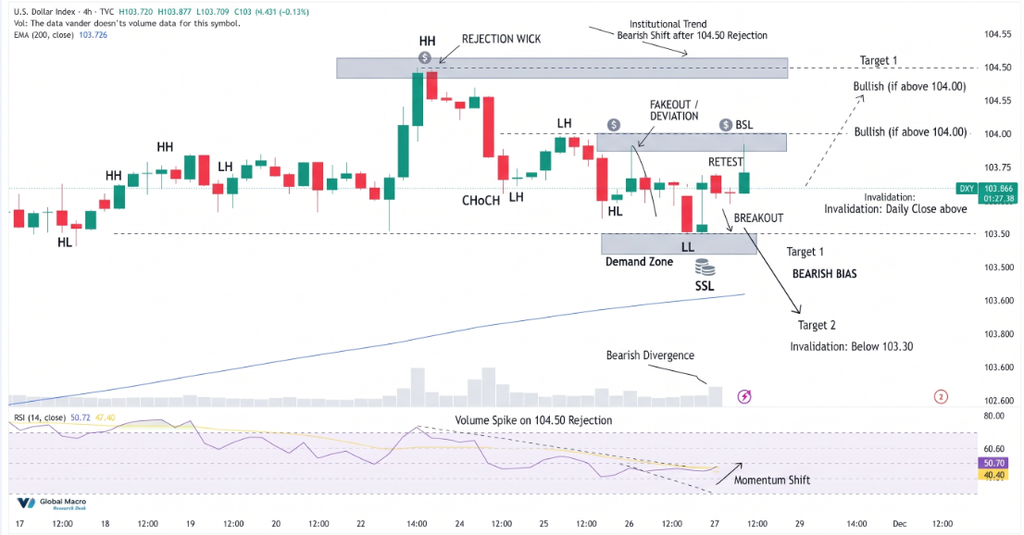
A potential bearish Head and Shoulders pattern is also developing. Its neckline lies around 103.55–103.60, making this area important for determining whether sellers can gain control.
Key technical levels include:
- Support: 103.55–103.60, followed by 103.36 and 103.26.
- Deeper support: 102.94, corresponding to the October 14 high.
- Immediate resistance: 103.86, the latest session high.
- Higher resistance: 104.00, followed by the 104.50 area.
Conclusion
The US Dollar Index remains near 103.70 as investors balance persistent inflation against improving risk appetite and uncertainty over the Federal Reserve’s next move. A break below 103.55 could strengthen the bearish technical outlook and expose lower support levels. Conversely, a sustained move above 103.86 would improve the near-term outlook and reopen the path toward 104.00. Until either boundary gives way, the DXY may continue consolidating while traders assess incoming economic data and the Fed’s December decision.
Sources & Methodology
Primary-source standard: Market-moving facts should link to original data releases, regulator notices, company filings or official project announcements whenever available. Secondary reporting is used for additional context, not as a substitute for original evidence.
Page last reviewed: